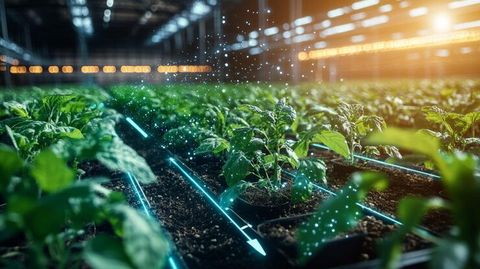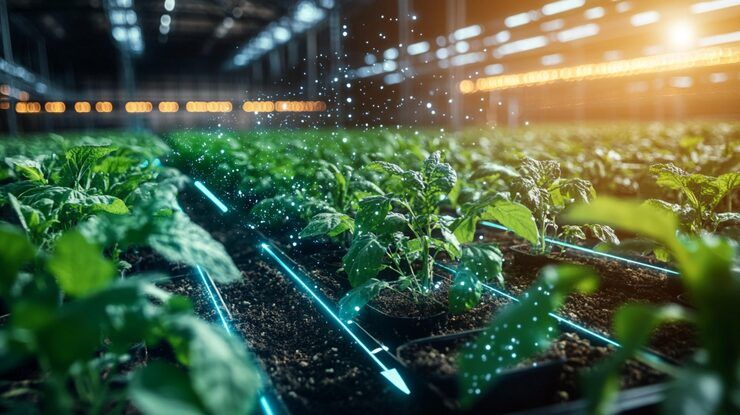
The Internet of Things (IoT) in agriculture refers to connected devices that collect, transmit, and analyze information about crops, soil, livestock, weather, and farm equipment. These technologies help farmers observe field conditions and make decisions using current data rather than relying entirely on manual inspections or fixed schedules.
Smart farming combines IoT sensors, wireless communication, cloud computing, data analytics, and automated equipment. Depending on the system, farmers can monitor soil moisture, measure temperature, track livestock movement, inspect greenhouse conditions, and manage irrigation remotely.
For example, a soil moisture sensor can transmit readings to a monitoring platform. When the soil becomes drier than a selected threshold, the system can notify the farmer or activate compatible irrigation equipment.
Main Components of Smart Farming
An agricultural IoT system generally contains several connected elements:
Sensors: Measure soil moisture, temperature, humidity, water levels, or other conditions.
Connectivity: Transfers data through Wi-Fi, cellular networks, Bluetooth, LoRaWAN, or satellite connections.
Data platforms: Organize readings and display them through dashboards or mobile applications.
Automation equipment: Controls irrigation valves, pumps, ventilation, or other compatible machinery.
Analytics tools: Identify patterns and support decisions about crop management and resource use.
Not every farm needs all these components. A small greenhouse may use a few sensors, while a large agricultural operation may combine satellite imagery, weather stations, automated machinery, and extensive field-monitoring networks.
Common Applications of Agricultural IoT
Smart farming technologies can be used across different agricultural activities.
| Application | Technology Used | Main Purpose |
|---|---|---|
| Soil monitoring | Moisture, temperature and nutrient sensors | Understand field conditions |
| Smart irrigation | Sensors, controllers and valves | Adjust watering to observed conditions |
| Weather monitoring | Connected weather stations | Track rainfall, wind and temperature |
| Livestock monitoring | Wearable tags and location sensors | Observe movement and activity |
| Greenhouse management | Humidity, temperature and light sensors | Maintain suitable growing conditions |
| Equipment monitoring | Telematics and machine sensors | Track operating status and maintenance needs |
| Crop monitoring | Cameras, drones and remote sensing | Identify visible crop changes |
Why IoT in Agriculture Matters
Agriculture is affected by changing weather, water availability, soil conditions, energy use, and the need to maintain consistent production. IoT technology can help farmers understand these conditions more accurately and respond to changes in a timely manner.
Improving Water Management
Water management is one of the most established applications of agricultural IoT. Soil moisture sensors and connected irrigation controllers can help determine when watering may be necessary.
Instead of relying only on a fixed timetable, farmers can consider soil conditions, recent rainfall, crop requirements, and weather forecasts.
However, sensors need appropriate placement and calibration. A reading from one part of a field may not represent the moisture conditions across the entire growing area.
Supporting Crop Monitoring
Connected sensors can help identify changes in temperature, humidity, soil moisture, and other environmental measurements. When combined with field inspections, these readings can help farmers investigate potential crop stress.
Remote sensing and agricultural imaging can provide a wider view of field conditions, particularly on large farms where inspecting every area regularly may be difficult.
Reducing Unnecessary Resource Use
Smart farming can support more precise decisions about irrigation, fertilizer application, and equipment operation. The potential benefit depends on the crop, local conditions, data quality, and how farmers use the information.
IoT does not automatically guarantee higher yields or lower expenditure. Its value depends on whether the information leads to practical improvements in farm management.
Supporting Livestock Management
Connected livestock devices can record movement, location, activity, and selected health-related indicators. These readings may help identify changes that require further observation.
Such systems support monitoring rather than replacing veterinary assessment or direct animal care.
Recent Developments in Smart Farming Technology
Agricultural IoT is increasingly being combined with artificial intelligence (AI), precision agriculture, satellite monitoring, and automated equipment. Recent developments focus on improving the usefulness of farm data and making digital technology more adaptable to different agricultural conditions.
Global Smart Farming Initiatives in 2026
On July 1, 2026, the Food and Agriculture Organization of the United Nations (FAO) opened its first Global Conference on Smart Farming in Rome. The conference brought together policymakers, researchers, farmers, and technology stakeholders to discuss scaling data-driven agriculture and strengthening rural resilience.
FAO's approach emphasizes the use of digital technology alongside efficient resource management and agricultural practices adapted to local conditions. This is particularly important for smaller farms that may face limitations in connectivity, technical knowledge, and infrastructure.
Plant-Based Sensor Research
On February 9, 2026, the US Department of Agriculture's National Institute of Food and Agriculture reported on research into small sensors that can measure water use directly in plants. The research combines sensing technology, software, and machine learning to investigate crop water and nitrogen requirements.
This research illustrates a broader trend toward measuring plant conditions more directly rather than relying exclusively on soil measurements and weather information. Such technologies remain subject to research, validation, and practical deployment requirements.
Digital Agriculture and AI
FAO's Digital Agriculture and AI Innovation Roadmap, published in December 2025, outlines a three-year approach to encouraging more coordinated, inclusive, and adaptable agricultural innovation. The roadmap emphasizes collaboration and solutions that can be adapted to different agricultural settings.
These developments indicate that smart farming is moving beyond isolated sensors toward connected systems that combine multiple sources of information.
Laws, Policies, and Data Protection
IoT in agriculture is affected by several types of rules, including equipment safety requirements, environmental regulations, data protection laws, telecommunications rules, and agricultural policies. The exact requirements depend on the country and the type of technology being used.
Agricultural and Environmental Regulations
Farmers using connected irrigation, fertilizer monitoring, or automated spraying equipment must still follow applicable agricultural and environmental rules.
For example, automated pesticide application does not remove the need to follow approved pesticide instructions, application restrictions, and relevant environmental requirements.
Data Ownership and Privacy
Agricultural IoT systems can collect commercially sensitive information about crop conditions, equipment performance, field locations, and production practices. Farmers should understand who can access this data, how it is stored, and whether it can be transferred between platforms.
In the European Union, the Data Act became applicable on September 12, 2025. It establishes rules concerning access to and use of data generated by connected products, including relevant industrial and agricultural equipment. Its application depends on the circumstances and applicable provisions.
Connectivity and Equipment Safety
Wireless sensors and connected agricultural devices may also be subject to national telecommunications requirements, radio-frequency rules, electrical safety standards, and cybersecurity expectations.
Before adopting a system, farms should check the requirements applicable to their location and confirm that devices are compatible with local networks.
Tools and Resources for Smart Farming
Several resources can help farmers, researchers, and agricultural planners understand and evaluate IoT technologies.
FAO Smart Farming: Provides information on resource-efficient agricultural practices and digital technology.
FAO AQUASTAT: Offers international data on water resources and agricultural water use.
FAO WaPOR: Uses satellite-based information to assess water productivity and support irrigation planning.
FAO Global Agro-Ecological Zones: Provides data and analytical tools for assessing land suitability and agricultural potential.
Weather monitoring platforms: Provide rainfall, temperature, wind, and forecast information.
IoT dashboards: Display sensor readings, alerts, equipment status, and historical trends.
Agricultural mapping tools: Help organize field boundaries, crop locations, and sensor positions.
FAO lists these and other digital agriculture resources through its official Smart Farming tools and projects page.
Planning an IoT Implementation
A basic evaluation can begin with a specific farming problem rather than purchasing multiple technologies at once.
Identify the main challenge, such as irregular irrigation or limited field visibility.
Select measurements that can help address that challenge.
Check connectivity, power requirements, and environmental suitability.
Test sensor accuracy and compare readings with field observations.
Review whether the information improves decisions over time.
Frequently Asked Questions
What is IoT in agriculture?
IoT in agriculture uses connected sensors and devices to collect and share information about crops, soil, weather, livestock, and equipment. The information supports monitoring, planning, and selected automated operations.
How does smart irrigation work?
Smart irrigation combines measurements such as soil moisture, weather information, and crop requirements to guide watering decisions. Compatible controllers can adjust irrigation according to configured conditions, although effective operation depends on sensor placement, calibration, and system maintenance.
Can small farms use agricultural IoT?
Yes. Smaller farms can begin with a limited number of sensors or a basic weather-monitoring system. The most suitable approach depends on the farm's needs, connectivity, technical capacity, and available infrastructure.
What are the main challenges of IoT in agriculture?
Common challenges include unreliable connectivity, equipment maintenance, sensor accuracy, cybersecurity, data compatibility, technical training, and initial investment requirements. These factors should be evaluated before implementing a connected farming system.
Does IoT guarantee higher crop yields?
No. IoT can improve access to agricultural information, but it does not guarantee higher yields. Results depend on crop type, weather, soil conditions, farm management, equipment quality, and how effectively the data is used.
Conclusion
IoT in agriculture is an important part of the development of smart farming and precision agriculture. Connected sensors, monitoring platforms, automated irrigation, and agricultural analytics can help farmers understand field conditions and make more informed decisions.
Recent research and international initiatives demonstrate growing interest in combining IoT with AI, plant-based sensing, satellite information, and digital agricultural planning. At the same time, successful implementation requires attention to connectivity, equipment reliability, data protection, environmental regulations, and practical farm requirements.
By beginning with a clearly defined agricultural challenge and evaluating results over time, farmers can determine where connected technology is useful. Smart farming is most effective when digital tools complement agricultural knowledge, direct observation, and responsible resource management.