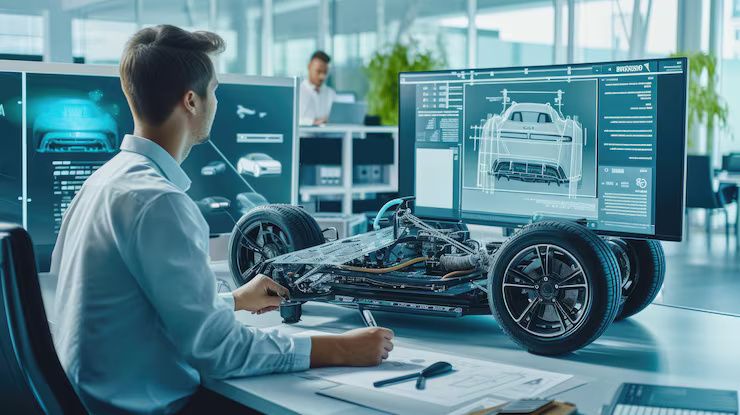
Automotive software development refers to the design, testing, and maintenance of software systems embedded in modern vehicles. These systems control everything from engine performance and braking to infotainment, navigation, and advanced driver assistance features. Over the past decade, vehicles have evolved into complex digital platforms, often described as “software-defined vehicles,” where functionality is increasingly driven by code rather than mechanical components.
This shift has become especially important in recent years due to the rapid adoption of electric vehicles (EVs), connected car technologies, and autonomous driving capabilities. Software now plays a central role in enabling features such as real-time diagnostics, over-the-air (OTA) updates, and enhanced safety systems. According to industry studies, modern vehicles can contain over 100 million lines of code, reflecting the growing complexity and importance of software in automotive engineering.
The comparison between traditional automotive systems and modern software-driven architectures matters today because it highlights the transformation of the industry. Automakers are transitioning from hardware-centric manufacturing to software-focused innovation, impacting product development cycles, user experience, and long-term vehicle performance. This evolution is shaping how vehicles are built, maintained, and experienced globally.
Who It Affects and What Problems It Solves
Automotive software development impacts a wide range of stakeholders, including automotive manufacturers, software engineers, suppliers, regulatory bodies, and end users. For manufacturers, it enables faster innovation cycles and the ability to differentiate products through digital features rather than purely mechanical design. Software engineers benefit from new opportunities in embedded systems, artificial intelligence, and cybersecurity within the automotive sector.
For consumers, the impact is visible in improved driving experiences, enhanced safety features, and seamless connectivity. Drivers now rely on software for navigation, driver assistance systems, entertainment, and even predictive maintenance alerts. Fleet operators and logistics companies also benefit from telematics and data-driven insights, which help optimize operations and reduce downtime.
Problems It Solves
Automotive software development addresses several critical challenges:
- Safety Enhancement: Advanced driver assistance systems (ADAS) reduce accidents by assisting with braking, lane keeping, and collision avoidance.
- Efficiency Optimization: Software improves fuel efficiency and energy management, particularly in electric vehicles.
- Predictive Maintenance: Real-time monitoring detects issues early, reducing repair costs and unexpected failures.
- User Experience: Infotainment systems and connectivity features enhance comfort and convenience.
- Scalability and Updates: OTA updates allow manufacturers to fix bugs and introduce new features without requiring physical service visits.
By solving these problems, software has become a foundational element in modern automotive design and operation.
Recent Updates and Industry Trends
Over the past year, several notable trends have shaped automotive software development:
Shift Toward Software-Defined Vehicles
Automakers are increasingly adopting centralized computing architectures, replacing multiple electronic control units (ECUs) with fewer, more powerful processors. This simplifies system integration and supports advanced functionalities.
Growth of Electric and Autonomous Technologies
Electric vehicles rely heavily on software for battery management, energy optimization, and charging infrastructure integration. Autonomous driving systems continue to evolve, with improvements in perception algorithms and sensor fusion.
Over-the-Air (OTA) Updates Expansion
OTA updates are becoming standard, allowing manufacturers to deploy security patches, performance improvements, and new features remotely. This reduces maintenance costs and enhances vehicle longevity.
Cybersecurity Focus
As vehicles become more connected, cybersecurity has become a top priority. Manufacturers are investing in secure software architectures to protect against hacking and data breaches.
Adoption of Artificial Intelligence
AI is increasingly used in driver assistance systems, voice recognition, and predictive analytics. Machine learning models help vehicles adapt to user behavior and environmental conditions.
These trends indicate a clear shift toward more intelligent, connected, and adaptable vehicles.
Key Components of Automotive Software Development
| Component | Description | Importance Level |
|---|---|---|
| Embedded Systems | Software integrated into vehicle hardware components | High |
| ADAS | Driver assistance features like lane assist and adaptive cruise control | High |
| Infotainment Systems | Entertainment, navigation, and connectivity features | Medium |
| Vehicle Networking | Communication between ECUs using protocols like CAN, LIN, and Ethernet | High |
| OTA Update Systems | Remote software updates and feature enhancements | High |
| Cybersecurity Frameworks | Protection against unauthorized access and data breaches | High |
| AI & Machine Learning Models | Data-driven decision-making and automation | Medium |
Laws or Policies Affecting Automotive Software Development
Automotive software development is heavily influenced by regulations and standards that ensure safety, reliability, and security.
Key Regulatory Areas
- Functional Safety Standards: Regulations such as ISO 26262 define requirements for ensuring the safety of electrical and electronic systems in vehicles.
- Cybersecurity Regulations: Standards like UNECE WP.29 require manufacturers to implement cybersecurity management systems and secure software updates.
- Data Privacy Laws: Connected vehicles must comply with data protection laws, ensuring user data is handled responsibly.
- Emission and Environmental Policies: Software plays a role in meeting emission standards by optimizing engine and energy performance.
Practical Guidance
- For manufacturers: Compliance with safety and cybersecurity standards is essential during development and testing phases.
- For developers: Understanding regulatory requirements helps ensure that software meets certification criteria.
- For businesses: Investing in compliant systems reduces legal risks and improves product reliability.
These policies ensure that automotive software systems are safe, secure, and aligned with global standards.
Tools and Resources
Automotive software development relies on a wide range of tools and platforms that support coding, testing, simulation, and deployment.
Development Tools
- Integrated Development Environments (IDEs) for embedded systems
- AUTOSAR platforms for standardized software architecture
- MATLAB and Simulink for modeling and simulation
Testing and Validation Tools
- Hardware-in-the-loop (HIL) testing systems
- Software-in-the-loop (SIL) simulation tools
- Automated testing frameworks for regression testing
Communication and Networking Tools
- CAN bus analyzers
- Ethernet testing tools for automotive networks
Version Control and Collaboration
- Git-based repositories for code management
- Continuous integration/continuous deployment (CI/CD) pipelines
Learning Resources
- Online courses in embedded systems and automotive engineering
- Open-source automotive platforms and documentation
- Industry whitepapers and technical standards
These tools enable efficient development, testing, and deployment of automotive software systems.
Frequently Asked Questions (FAQ)
What is automotive software development?
Automotive software development involves creating and maintaining software systems that control vehicle functions, including safety, performance, and user interfaces.
Why is software important in modern vehicles?
Software enables advanced features such as driver assistance, connectivity, and real-time diagnostics, improving safety and user experience.
What are software-defined vehicles?
Software-defined vehicles are cars where most features and functionalities are controlled and updated through software rather than hardware changes.
How do OTA updates work in vehicles?
OTA updates allow manufacturers to remotely update vehicle software via wireless connections, improving performance and fixing issues without physical servicing.
What skills are required for automotive software development?
Key skills include embedded programming, knowledge of automotive protocols, cybersecurity, and familiarity with tools like MATLAB and AUTOSAR.
Conclusion
Automotive software development has become a central pillar of the modern automotive industry, transforming vehicles into intelligent, connected systems. The transition from hardware-driven designs to software-defined architectures reflects a broader shift toward digital innovation. Data from industry research highlights the rapid growth in software complexity and its critical role in enabling safety, efficiency, and advanced features.
The increasing adoption of electric vehicles, AI-driven systems, and OTA updates demonstrates how software continues to redefine vehicle capabilities. At the same time, regulatory frameworks ensure that these advancements remain safe and secure.
From a practical perspective, organizations and professionals involved in automotive technology should prioritize scalable architectures, compliance with standards, and continuous learning of emerging tools. The most effective approach is to integrate software development early in the design process while maintaining strong testing and validation practices.
Overall, automotive software development is not just a supporting function—it is a driving force behind innovation, shaping the future of mobility with data-driven, adaptable, and user-focused solutions.