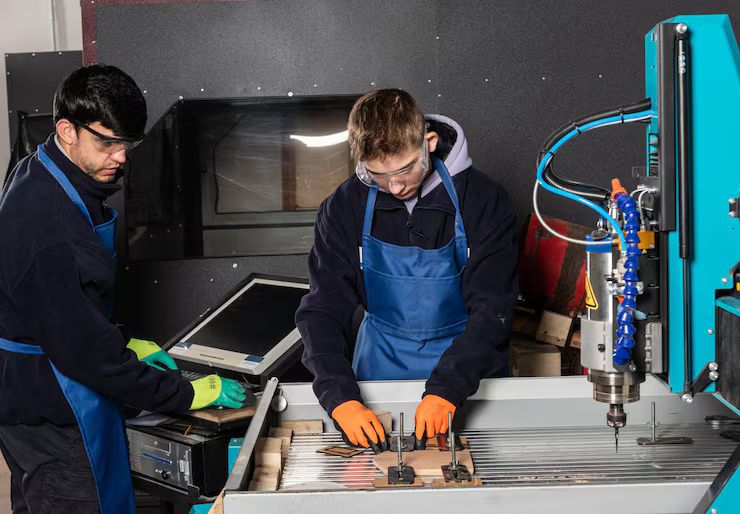
CNC turning centers are advanced machine tools used in manufacturing to produce cylindrical components with high precision. These machines operate using Computer Numerical Control (CNC), which automates machining processes based on programmed instructions. Unlike conventional lathes, CNC turning centers can perform multiple operations such as turning, facing, drilling, threading, and grooving in a single setup.
In recent years, CNC turning technology has evolved significantly with the integration of automation, multi-axis capabilities, and digital control systems. Industries are increasingly adopting CNC turning centers to improve productivity, reduce human error, and achieve consistent quality in high-volume production. The demand is particularly strong in sectors such as automotive, aerospace, medical devices, and industrial equipment manufacturing.
This guide explains the working principles, types, and applications of CNC turning centers. Understanding these systems helps manufacturers, engineers, and business owners select appropriate equipment and optimize machining processes.
Who It Affects and What Problems It Solves
CNC turning centers impact a wide range of stakeholders in the manufacturing industry. Machine operators, engineers, and production managers rely on these systems for precision machining and efficient production. Businesses benefit from reduced labor costs, improved accuracy, and faster turnaround times.
Industries such as automotive and aerospace depend on CNC turning centers for producing critical components with tight tolerances. Small and medium enterprises (SMEs) also use these machines to enhance competitiveness and scalability.
Problems It Solves
- Manual Machining Limitations: Automates processes for higher precision
- Inconsistent Quality: Ensures repeatable and accurate production
- Low Production Speed: Increases machining efficiency and output
- Complex Part Manufacturing: Handles intricate designs and geometries
- Labor Dependency: Reduces reliance on skilled manual labor
- Production Errors: Minimizes human error through automation
CNC turning centers streamline machining operations and improve overall manufacturing performance.
Recent Updates and Industry Trends
The CNC machining industry has seen several advancements over the past year:
- Multi-Axis Turning Centers: Increased adoption of 5-axis and multi-tasking machines
- Automation Integration: Use of robotic arms and automated loading systems
- Smart Manufacturing (Industry 4.0): Real-time monitoring and data analytics
- Energy-Efficient Machines: Reduced power consumption and improved sustainability
- Advanced Tooling Technology: Longer tool life and improved cutting performance
- Digital Twin and Simulation: Enhanced process planning and optimization
India’s manufacturing sector is also investing in CNC technology to improve precision and global competitiveness.
Comparison Table: Types of CNC Turning Centers
| Type of CNC Turning Center | Key Features | Common Applications |
|---|---|---|
| Horizontal Turning Center | Standard configuration, versatile | General machining |
| Vertical Turning Center | Handles large and भारी components | Heavy industries, large parts |
| Multi-Axis Turning Center | Complex machining with multiple axes | Aerospace, precision engineering |
| Swiss-Type Turning Center | High precision for small parts | Medical devices, electronics |
| CNC Turning with Live Tooling | Combines turning and milling operations | Complex components |
Laws, Policies, and Government Regulations
CNC turning operations are governed by safety and industrial standards.
Key Regulations
- Industrial Safety Standards: Ensure safe operation of CNC machines
- Quality Standards (ISO): Maintain precision and product quality
- Environmental Regulations: Control waste and emissions from machining processes
- Workplace Safety Laws: Ensure proper training and protective measures
Practical Guidance
- Manufacturing Units: Should implement safety guards and regular inspections
- Operators: Must be trained in CNC programming and machine operation
- Quality Control: Use standardized procedures and certifications
- Maintenance: Regular servicing ensures accuracy and longevity
Compliance ensures safe and efficient machining operations.
Tools and Resources
Several tools and resources support CNC turning operations:
Digital Tools
- CNC programming software (CAD/CAM)
- Simulation and toolpath optimization software
Machine Tools
- Cutting tools and inserts
- Tool holders and fixtures
Maintenance Tools
- Preventive maintenance scheduling systems
- Machine diagnostics and monitoring systems
Industry Resources
- Machining standards and guidelines
- Manufacturer manuals and technical documentation
Training Resources
- CNC programming courses
- Operator certification programs
These resources help improve machining efficiency, accuracy, and productivity.
Frequently Asked Questions (FAQ)
What is a CNC turning center?
A CNC turning center is a machine tool that uses computer control to perform turning operations on workpieces.
How does a CNC turning center work?
It rotates the workpiece while cutting tools remove material based on programmed instructions.
What industries use CNC turning centers?
Industries such as automotive, aerospace, medical, and manufacturing use these machines.
What is the advantage of CNC turning over manual machining?
CNC turning offers higher precision, automation, and repeatability.
What is live tooling in CNC turning?
Live tooling allows additional operations like milling and drilling within the same machine.
Conclusion
CNC turning centers are essential for modern manufacturing, offering precision, efficiency, and versatility in machining operations. Their ability to perform multiple tasks in a single setup makes them highly valuable for producing complex components.
Recent trends such as automation, multi-axis machining, and smart manufacturing are enhancing the capabilities of CNC turning centers. Data-driven insights indicate that businesses adopting advanced CNC systems benefit from improved productivity, reduced costs, and higher product quality.
For manufacturers, selecting the right CNC turning center depends on production requirements, part complexity, and budget. While basic machines are suitable for simple tasks, advanced multi-axis systems are ideal for high-precision and complex applications. Overall, CNC turning centers play a critical role in achieving efficient and reliable manufacturing processes.