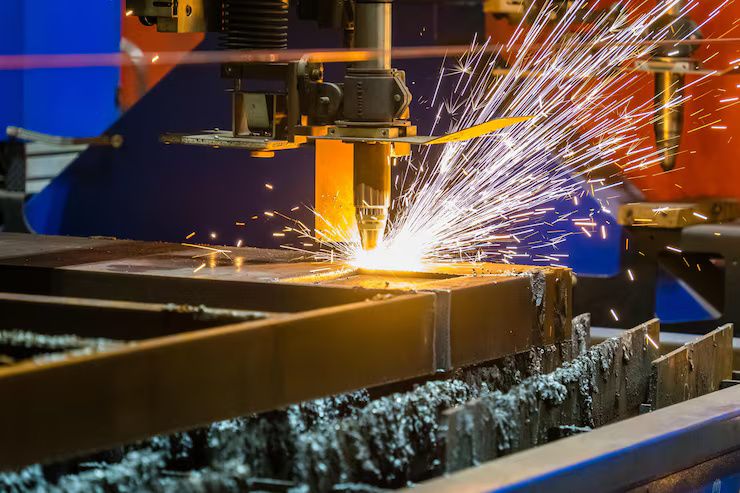
CNC milling machines are computer-controlled machining tools used to cut, shape, and form solid materials such as metal, plastic, wood, or composites. CNC stands for Computer Numerical Control, meaning the machine operates based on digital programming rather than manual hand adjustments. These machines use rotating cutting tools to remove material and create precise components for engineering, manufacturing, automotive, aerospace, electronics, and industrial applications.
CNC milling exists because modern manufacturing requires high precision, repeatability, and efficiency. Manual milling can be effective for simple work, but human error limits accuracy. CNC technology allows detailed machining of complex geometries, consistent dimensions, and mass production without physical tool adjustments.
CNC milling machines evolved from early mechanical mills through stages of digital programming, servo motors, and CAD–CAM integration. Today, CNC machines are equipped with automated tool changers, advanced sensors, surface measurement systems, multi-axis movement, and computer-controlled safety mechanisms. They support industries that rely on engineering accuracy and advanced part geometries.
These machines are essential for producing engine components, molds, gears, brackets, housings, prototypes, and custom-designed engineering parts. CNC milling brings together mechanical engineering, programming, and materials science to create reliable industrial components.
Importance: Why CNC Milling Machines Matter Today
CNC milling machines play a vital role in engineering, industrial operations, precision manufacturing, and product development.
Who CNC milling affects
-
Mechanical and manufacturing engineers
-
Industrial designers creating functional prototypes
-
Aerospace and automotive industries
-
Electronics and semiconductor component makers
-
Medical device engineers needing precision-quality parts
-
Educational institutions teaching engineering methods
-
Small-scale workshops using digital machining
Why CNC milling machines matter today
-
Enable high-precision part creation
-
Improve production speed and consistency
-
Reduce human error in engineering processes
-
Support complex geometries that manual methods cannot achieve
-
Facilitate rapid prototyping and iterative design
-
Help industries scale manufacturing with digital flexibility
Problems CNC milling helps solve
-
Inconsistent dimensions found in manual machining
-
Slow production cycles for complex components
-
Difficulty creating accurate curves, slots, contours, and cavities
-
Need for repeatable output across large quantities
-
Challenges with maintaining tolerance during fabrication
A simple comparison:
| Manual Milling | CNC Milling |
|---|---|
| Slow and labor-intensive | Fast and automated |
| Human-error dependent | Computer-driven precision |
| Limited complex shapes | Multi-axis advanced geometry |
| Repetitive fatigue | Digital repeatability |
| Single-tool operation | Multiple automated tools |
CNC milling enhances precision engineering, manufacturing efficiency, geometric complexity, and production scalability.
Recent Updates and Industry Trends in CNC Milling (2024–2025)
Multi-axis technology advancement
Five-axis and simultaneous machining systems became more widely adopted in 2024, enabling highly complex surface cutting and precision angles. This trend reduces the number of setups needed for parts.
Integration of AI-assisted machining
AI-based systems now assist with toolpath optimization, cutting-feed calculation, and error prediction. These support stability, reduce wear, and improve machining efficiency.
Digital twins in machining
Engineers increasingly use digital twin models—virtual replicas of CNC machines and part workflows—to simulate machining behavior before production. This reduces material waste.
Smart machining and sensor monitoring
CNC mills now include sensors for vibration tracking, spindle load monitoring, thermal compensation, and tool-wear detection. Real-time dashboards enhance operational safety and surface accuracy.
Eco-friendly machining focus
Newer CNC machines incorporate energy-efficient motors, coolant-saving systems, and environmentally responsible chip-removal methods. Sustainable machining gained emphasis in 2024–2025.
Hybrid manufacturing
Some modern machines combine CNC milling and additive manufacturing (3D printing). This helps engineers create parts by adding and subtracting material in one workflow.
CNC technology continues advancing through AI, sensors, simulation, sustainability, and hybrid engineering.
Laws, Regulations, and Policy Considerations (India Focus)
CNC milling in India is influenced by industrial standards, workplace safety laws, and manufacturing regulations that ensure operational responsibility.
Industrial machinery safety rules
Workplaces must follow machine guarding guidelines, emergency stop access, stable installation requirements, and operator safety protocols. Machines must include protective enclosures for milling operations.
Training and certification guidelines
Operators are encouraged to receive technical training in machine setup, programming, tool selection, and hazard avoidance. Proper training reduces incidents and machine misuse.
Electrical and mechanical compliance
CNC machines must follow national electrical standards, grounding rules, and mechanical safety guidelines. Periodic inspection ensures spindle integrity and wiring safety.
Environmental and waste management
Policies encourage responsible handling of metal chips, coolant fluids, and industrial waste. Many regions require recycling practices and proper disposal of machining byproducts.
Quality and testing standards
Manufactured parts may require inspection reports, tolerance verification, and adherence to engineering standards like ISO quality frameworks. CNC accuracy supports compliance with industry norms.
These policies support safe operation, responsible manufacturing, environmental care, and engineering quality assurance.
Tools, Resources, and Engineering Platforms for CNC Milling
Engineering education and machining efficiency benefit from digital tools, reference systems, and monitoring platforms.
CNC programming and simulation tools
-
CAD–CAM software for toolpath design
-
G-code simulators
-
Virtual machining models
-
Part visualization modules
Measurement and inspection tools
-
Digital calipers and micrometers
-
Coordinate measuring machines (CMM)
-
Surface roughness testers
-
Tool-wear measurement instruments
Engineering learning resources
-
Material selection databases
-
Cutting-speed calculators
-
Feed-rate and spindle-speed charts
-
Online engineering tutorials and CNC guides
Machine monitoring and optimization tools
-
Spindle load dashboards
-
Tool-life tracking systems
-
Temperature compensation software
-
Predictive maintenance analytics
These tools help engineers achieve precision machining, consistent performance, technical learning, and structured operation.
FAQs
What is a CNC milling machine?
A CNC milling machine is a computer-controlled cutting tool used to remove material and create precise shapes in metals, plastics, or composites. It follows programmed instructions for accuracy.
How does CNC milling differ from manual milling?
Manual milling relies on hand-operated controls, while CNC milling uses digital commands to guide tool movement. CNC offers higher precision and automation.
What industries use CNC milling?
Automotive, aerospace, electronics, medical engineering, manufacturing, and prototyping industries all rely on CNC precision.
What skills are needed to operate CNC machines?
Basic programming knowledge, understanding of materials, safe machine handling, and familiarity with tool selection are essential.
Are CNC machines safe?
Yes, when used responsibly. Safety features such as enclosures, emergency stops, and sensor systems help protect operators.
Conclusion
CNC milling machines represent the intersection of engineering precision, digital automation, and modern manufacturing. They create accurate components for industries that rely on detailed geometry and consistent performance. Their importance continues to grow as technology advances through AI-driven optimization, sensor-based monitoring, hybrid machining, and digital simulation.
Policies support safe operation, environmental responsibility, and quality control. Tools such as CAD–CAM software, inspection equipment, and machine dashboards enhance engineering understanding.
As CNC technology evolves, it will continue shaping product development, machine accuracy, and industrial problem-solving across global manufacturing environments.