Industrial AI agents are software systems designed to perform specific tasks using artificial intelligence, industrial data, automation technologies, and defined workflows. Unlike conventional software that follows fixed instructions, AI agents can interpret information, evaluate conditions, select actions within predefined boundaries, and support ongoing industrial processes.
In manufacturing and other industrial environments, AI agents can work with production data, maintenance records, quality information, supply-chain systems, and operational software. Their applications range from equipment monitoring and production planning to quality analysis, energy management, and technical knowledge retrieval.
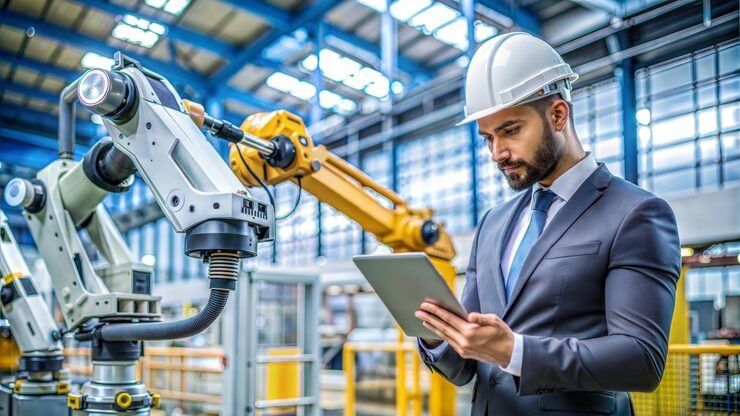
Context
What Are Industrial AI Agents?
An industrial AI agent is an AI-enabled software component designed to perform one or more operational or analytical tasks. It may receive information from sensors, databases, enterprise applications, industrial control systems, or human users and then process that information according to its assigned objectives.
For example, an AI agent monitoring production equipment could examine temperature, vibration, operating hours, and historical maintenance records. When predefined conditions indicate an abnormal pattern, the agent could generate an alert, retrieve relevant technical information, and prepare a maintenance recommendation for human review.
How Industrial AI Agents Work
Industrial AI agents generally combine several technologies:
- Artificial intelligence and machine learning
- Large language models
- Industrial data platforms
- Sensors and IoT devices
- Manufacturing execution systems
- Enterprise resource planning systems
- Computerized maintenance systems
- Workflow automation
- Data analytics
- Digital twins
A typical workflow begins with data collection. The agent interprets the available information, determines which action is appropriate within its assigned permissions, and then either performs an authorized software action or presents a recommendation to a human operator.
Agentic AI Versus Traditional Automation
Traditional industrial automation usually follows predefined rules. A programmable logic controller, for example, can execute programmed instructions when specific input conditions occur.
AI agents can work with more variable information and may support tasks involving interpretation, reasoning, planning, or natural-language interaction. However, industrial AI agents still require defined boundaries, validation, access controls, and human oversight for safety-critical activities.
| Technology | Primary Function | Industrial Example |
|---|---|---|
| Traditional Automation | Executes fixed logic | Machine control |
| Machine Learning | Identifies patterns | Predictive maintenance |
| Generative AI | Produces or interprets information | Technical documentation |
| AI Agent | Performs multi-step AI-assisted workflows | Maintenance investigation |
| Digital Twin | Represents physical systems digitally | Production simulation |
| Industrial IoT | Collects equipment data | Sensor monitoring |
Types of Industrial AI Agents
Industrial AI agents can be configured for different operational objectives.
Maintenance agents can analyze equipment information and assist with maintenance planning.
Quality agents can examine inspection records, production parameters, and defect information.
Production agents can support scheduling, production analysis, and workflow coordination.
Energy agents can analyze consumption patterns and identify unusual energy behavior.
Supply-chain agents can work with inventory, logistics, demand, and procurement information.
Knowledge agents can retrieve information from technical manuals, maintenance records, standard operating procedures, and engineering documents.
Importance
Why Industrial AI Agents Matter
Modern industrial facilities generate large quantities of operational information. Sensors, production systems, maintenance platforms, quality systems, and enterprise applications can create data faster than teams can manually review it.
AI agents can help organize and interpret this information. Their value comes from connecting data with specific workflows rather than simply generating isolated AI responses.
Supporting Manufacturing Operations
In manufacturing environments, an AI agent can combine information from several systems to provide operational context.
For example, a production analysis agent could examine:
- Production schedules
- Machine availability
- Historical production data
- Quality records
- Maintenance activities
- Material availability
The resulting analysis could help planners understand potential production constraints before making scheduling decisions.
AI Agents for Predictive Maintenance
Predictive maintenance systems use equipment data to identify patterns associated with abnormal operation or potential failures.
An AI agent can extend this workflow by connecting condition-monitoring information with maintenance records and technical documentation. Instead of only identifying an unusual reading, the agent can organize relevant information for a maintenance specialist.
Human personnel should remain responsible for confirming technical findings and deciding whether physical intervention is appropriate.
Industrial Quality Management
AI agents can support quality processes by analyzing inspection data, production parameters, and historical defect information.
A quality-focused agent could identify recurring patterns and organize records associated with a particular production batch or machine. Computer vision systems can also provide image-based inspection information that an AI workflow can incorporate into a broader analysis.
Supply-Chain Applications
Industrial supply chains involve multiple variables, including inventory levels, production schedules, transportation information, supplier data, and demand forecasts.
AI agents can help analyze these datasets and identify relationships between production requirements and material availability. More advanced implementations can connect planning workflows with enterprise systems, subject to appropriate authorization controls.
Industrial Knowledge Management
Manufacturing organizations often maintain extensive technical documentation. Manuals, maintenance instructions, engineering specifications, operating procedures, and historical records can be difficult to search manually.
Knowledge-oriented AI agents can use retrieval systems to locate relevant information and present it in a structured format. This can help personnel find documentation without manually searching through large collections of files.
Recent Updates
Agentic AI in Manufacturing
Industrial AI development is increasingly moving beyond standalone generative AI applications toward systems capable of performing multi-step workflows.
An agent may receive a request, gather information from authorized sources, analyze the information, and produce a structured result. In industrial settings, these workflows need additional controls because incorrect actions can affect production, equipment, safety, or product quality.
Integration With Industrial Data
AI agents can become more useful when they have controlled access to relevant industrial data.
Common integration points include:
- Manufacturing execution systems
- Enterprise resource planning systems
- Maintenance databases
- Industrial IoT platforms
- Quality management systems
- Laboratory information systems
- Warehouse systems
- Engineering databases
Integration architecture should define which data an agent can access and which actions it is permitted to perform.
Digital Twins and AI Agents
Digital twins provide digital representations of physical assets, processes, or facilities. When combined with AI, they can provide an environment for analyzing operating conditions and testing potential scenarios.
An AI agent could use digital-twin information to examine production scenarios, compare operating conditions, or assist with planning. Physical implementation should remain subject to established engineering and operational controls.
Edge AI and Industrial Computing
Some industrial AI applications require rapid processing close to equipment. Edge computing can reduce the need to transfer every data point to a remote computing environment.
Edge AI may be useful for applications involving machine vision, equipment monitoring, anomaly detection, and other processes where response time or data handling requirements are important.
Multi-Agent Industrial Systems
A larger industrial architecture can contain several specialized AI agents. For example, separate agents may handle maintenance, quality, production planning, and energy analysis.
A coordinating layer can organize information between these agents. Such architectures require careful identity management, permissions, logging, and validation to prevent unintended interactions.
Laws or Policies
Industrial Safety Requirements
AI agents used in industrial environments should operate within existing occupational safety and process-control frameworks. Safety-critical functions require particular attention because an incorrect AI-generated recommendation or action can have physical consequences.
Organizations should establish clear boundaries between AI-assisted analysis and authorized operational control.
Data Governance
Industrial AI systems can process sensitive operational information, engineering documentation, production records, and employee-related data.
Data governance policies can define:
- Authorized data sources
- User permissions
- Data retention
- Access logging
- Data classification
- Model access
- Third-party integrations
- Incident procedures
AI Governance
AI governance frameworks can establish requirements for system testing, monitoring, documentation, human oversight, and risk management.
Organizations implementing industrial AI agents should document what each agent is designed to do, which systems it can access, which actions it can perform, and when human approval is required.
Cybersecurity
Industrial AI agents introduce another layer into the technology environment. Security measures should therefore address identity management, authentication, authorization, network segmentation, software updates, logging, and protection of industrial interfaces.
Particular attention is required when AI systems interact with operational technology or equipment-control environments.
Tools and Resources
Industrial Data Platforms
Industrial data platforms can collect and organize information from machines, sensors, databases, and enterprise systems. These platforms provide the data foundation required by many AI applications.
Machine Learning Platforms
Machine learning tools can support predictive models for equipment monitoring, quality analysis, demand forecasting, and process optimization.
Large Language Models
Large language models can support natural-language interaction, technical-document retrieval, summarization, and structured information extraction.
For industrial applications, access should be controlled so that sensitive information is handled according to organizational requirements.
Digital Twin Platforms
Digital twin environments can provide virtual representations of assets and processes. These environments can support simulation, monitoring, engineering analysis, and AI-assisted planning.
Monitoring and Observability Tools
Industrial AI systems require monitoring of both technical performance and AI behavior. Useful metrics can include response accuracy, data quality, system availability, unusual activity, failed workflows, and human overrides.
FAQs
What are industrial AI agents?
Industrial AI agents are AI-enabled software systems designed to perform defined analytical or operational workflows in industrial environments. They can interpret information, connect data sources, and support authorized actions.
How are AI agents used in manufacturing?
Manufacturing AI agents can support predictive maintenance, quality analysis, production planning, energy monitoring, technical-document retrieval, and supply-chain analysis.
Are industrial AI agents the same as automation systems?
No. Conventional automation generally executes predefined rules, while AI agents can interpret more variable information and coordinate multi-step tasks. They can also work alongside conventional automation rather than replace it.
Can AI agents control industrial equipment?
Technically, AI systems can be connected to industrial control environments, but direct control requires rigorous engineering, cybersecurity, validation, and authorization procedures. Many implementations initially use AI for monitoring, analysis, and recommendations rather than autonomous physical control.
What data do industrial AI agents use?
Depending on the application, agents may use sensor readings, production records, maintenance histories, quality data, technical documents, inventory information, energy data, and enterprise-system records.
What are the main challenges of industrial AI agents?
Important challenges include data quality, system integration, cybersecurity, model reliability, access control, explainability, governance, legacy equipment, and appropriate human oversight.
Conclusion
Industrial AI agents combine artificial intelligence with industrial data, software systems, automation workflows, and defined operational objectives. Their applications extend across predictive maintenance, manufacturing analysis, quality management, energy monitoring, supply-chain planning, technical knowledge management, and other industrial processes.
The development of agentic AI introduces opportunities for more connected and responsive industrial workflows, but implementation requires careful attention to data governance, cybersecurity, system integration, validation, and human oversight.
As industrial facilities adopt connected equipment and centralized data architectures, AI agents can become another layer within the broader industrial technology stack. Their practical role will depend on the specific process, available data, required controls, and boundaries established by the organization.