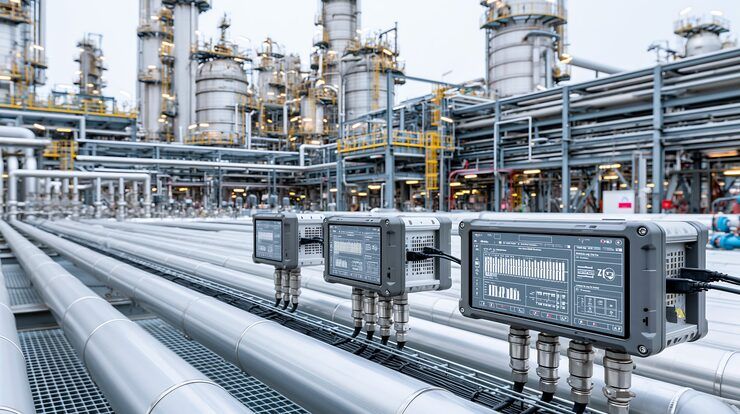
Industrial sensors are devices that detect physical or chemical conditions and convert them into measurable signals. Temperature, pressure, flow, level, vibration, position, proximity, humidity, and gas sensors are widely used in manufacturing, energy, transportation, food processing, and other industrial environments.
Industrial sensors help automated systems understand what is happening inside a machine or process. Their measurements can be sent to programmable logic controllers (PLCs), distributed control systems (DCS), supervisory control and data acquisition (SCADA) platforms, or industrial computers for monitoring, alarms, analysis, and process control.
Context – Understanding Industrial Sensors
Industrial sensors form an important part of measurement and automation systems. A sensor observes a physical condition and produces an electrical, digital, optical, or other type of signal that a control system can interpret.
For example, a temperature sensor can measure the temperature of a furnace, while a pressure sensor can monitor pressure inside a pipeline. A vibration sensor can detect changes in rotating equipment, and a level sensor can determine how much material or liquid is present in a tank.
Common industrial sensor categories include:
| Sensor type | Typical measurement | Common application |
|---|---|---|
| Temperature | Heat or temperature | Furnaces, motors, process lines |
| Pressure | Fluid or gas pressure | Pipelines, tanks, compressors |
| Flow | Liquid or gas movement | Process lines and utilities |
| Level | Material or liquid level | Tanks and storage systems |
| Proximity | Object presence or distance | Automated machinery |
| Vibration | Mechanical movement | Motors and rotating equipment |
| Humidity | Moisture in air | Warehouses and controlled environments |
| Gas | Specific gases or concentrations | Industrial safety and monitoring |
The purpose of industrial sensors is not simply to collect data. Their measurements can support automatic adjustments, warnings, equipment protection, quality monitoring, and process analysis.
Importance – Why Industrial Sensors Matter
Industrial sensors provide information that control systems need to make decisions. Without reliable measurement, automated equipment may have limited visibility into operating conditions.
Accurate sensor data can help organizations:
- Monitor machinery and production processes.
- Identify abnormal temperature or pressure conditions.
- Maintain process variables within defined ranges.
- Detect changes that may require inspection.
- Support automated control through PLCs and other controllers.
- Record information for analysis and process improvement.
Sensors can also affect workplace safety. For example, pressure, temperature, gas, and level measurements can be incorporated into systems designed to detect hazardous conditions.
Sensor selection depends on the application. Factors can include measurement range, accuracy, response time, environmental conditions, installation method, signal type, electrical requirements, and compatibility with the control system.
A sensor operating in a high-temperature environment may require different construction and specifications from one used in a clean indoor production area. Similarly, sensors used around chemicals or dust may need appropriate protection for the environment.
Recent Updates – Trends and Developments
Industrial sensing is increasingly connected with digital automation, industrial networking, and data analysis. Modern installations can combine traditional measurement devices with network connectivity and software-based monitoring.
One important development is the expansion of Industrial Internet of Things (IIoT) applications. IEC PAS 62443-1-6:2025 specifically addresses applying the IEC 62443 cybersecurity series to IIoT environments and recognizes new communication channels and cybersecurity considerations.
Another development is greater attention to cybersecurity for connected automation systems. The ISA/IEC 62443 family covers cybersecurity across industrial automation and control systems, including requirements for asset owners, product development, system design, and components.
Current industrial sensor trends include:
- Wireless and network-connected sensing.
- Remote monitoring of equipment.
- Condition monitoring and vibration measurement.
- Edge processing for faster data analysis.
- Integration with PLC, SCADA, and DCS platforms.
- Digital diagnostics and sensor health information.
- Greater attention to cybersecurity throughout the sensor and control-system lifecycle.
These developments can make sensor networks more capable, but they also increase the importance of proper configuration, cybersecurity controls, maintenance, and data management.
Laws or Policies – Standards and Regulatory Considerations
Industrial sensors are affected by the requirements applicable to the equipment and industry in which they are installed. There is not one universal law covering every industrial sensor worldwide. Requirements can differ according to country, equipment type, electrical characteristics, hazardous environment, and intended application.
In the European Union, Regulation (EU) 2023/1230 establishes health and safety requirements for machinery and related products. The regulation is therefore relevant when sensors form part of machinery or machinery safety functions within its scope.
For industrial automation cybersecurity, IEC 62443 provides a widely used standards framework. IEC 62443-2-1:2024 specifies security-program requirements for asset owners operating industrial automation and control systems. IEC 62443-3-2:2020 addresses risk assessment, zones, conduits, and target security levels for industrial automation and control system design.
In India, the Bureau of Indian Standards (BIS) maintains conformity-assessment frameworks and product-specific standards. BIS information shows that certain machinery and electrical equipment fall under Scheme-X certification and related technical requirements.
Organizations should therefore identify the specific standards and regulatory requirements applicable to their equipment, industry, location, and installation rather than assuming that one standard applies to every sensor.
Tools and Resources – Useful Information Sources
Several technical resources can help engineers, technicians, students, and plant personnel understand industrial sensors and control systems.
Useful resources include:
- IEC publications for international standards and technical specifications.
- ISA resources for automation and industrial control guidance.
- BIS resources for Indian standards and conformity-assessment information.
- Manufacturer technical documentation for sensor specifications and installation requirements.
- PLC and SCADA documentation for signal integration.
- Engineering reference materials for measurement principles and calibration.
- Industrial networking documentation for connected sensor systems.
When evaluating a sensor, a basic technical checklist can include measurement range, accuracy, response time, output signal, operating environment, power requirements, communication protocol, mounting arrangement, and maintenance requirements.
Documentation should also identify whether the sensor is intended for a particular safety-related, hazardous, sanitary, or environmental application.
FAQs – Industrial Sensors Facts
What are industrial sensors?
Industrial sensors detect physical or chemical conditions such as temperature, pressure, flow, vibration, level, position, or gas concentration and convert those conditions into usable signals.
How do industrial sensors improve process control?
They provide measurement data to control systems such as PLCs, DCS platforms, and SCADA systems. The control system can use this information to monitor conditions, generate alarms, or adjust process operations.
What are the most common industrial sensor types?
Common categories include temperature, pressure, flow, level, proximity, vibration, humidity, position, and gas sensors. The appropriate type depends on the measurement required and the operating environment.
Are connected industrial sensors subject to cybersecurity considerations?
Yes. When sensors communicate with industrial networks or control systems, cybersecurity becomes relevant. IEC 62443 provides a framework for addressing security in industrial automation and control systems.
Do industrial sensors have to follow the same regulations everywhere?
No. Applicable requirements depend on the country, industry, equipment, installation environment, and function of the sensor. Organizations should check the relevant national regulations and technical standards before installation or deployment.
Conclusion – Key Industrial Sensors Facts
Industrial sensors provide essential measurements for monitoring machinery and controlling industrial processes. Temperature, pressure, flow, level, vibration, proximity, gas, and other sensors allow automated systems to observe operating conditions and respond to defined process requirements.
Modern industrial sensing is increasingly connected with IIoT, digital monitoring, industrial networking, and cybersecurity. These developments make sensor selection, installation, calibration, documentation, and system security important parts of reliable industrial automation.
Understanding the measurement principle and operating environment is a practical starting point when working with industrial sensors. Technical specifications should be reviewed carefully, particularly for applications involving safety, hazardous environments, or regulated equipment.
Standards and regulatory requirements should also be checked for the specific location and application. International resources from IEC and ISA, together with national organizations such as BIS in India, can provide useful references for understanding applicable requirements.