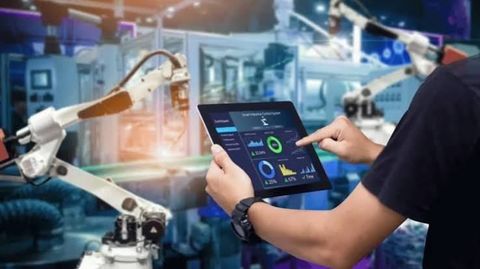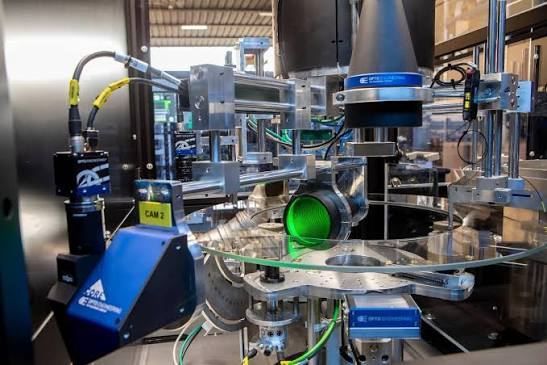
Industrial vision systems use cameras, lighting, optics, image-processing hardware, and software to capture and interpret visual information from industrial environments. These systems can examine products, identify patterns, measure dimensions, read codes, and detect visible defects without relying entirely on manual inspection.
Machine vision is used across manufacturing, logistics, electronics, food processing, automotive production, pharmaceuticals, and other industrial settings. Modern systems increasingly combine conventional image processing with artificial intelligence, allowing factories to handle more complex visual inspection tasks.
Context – What Are Industrial Vision Systems?
Industrial vision systems are technology setups designed to capture images and convert them into useful information for an industrial process. A typical system may include an industrial camera, lens, controlled lighting, image-processing hardware, software, and a connection to a machine controller.
The basic process is relatively straightforward:
- A camera captures an image of an object or process.
- Lighting helps create a consistent and usable image.
- Software analyzes specific visual characteristics.
- The system compares the result with defined rules or trained models.
- A decision or measurement is sent to another industrial system when required.
Common applications include:
| Application | Typical Function |
|---|---|
| Quality inspection | Identifies visible defects or inconsistencies |
| Measurement | Checks dimensions, position, or alignment |
| Code reading | Reads barcodes, QR codes, and printed information |
| Assembly verification | Checks whether components are correctly positioned |
| Object recognition | Identifies shapes, parts, or product types |
| Robot guidance | Helps robots locate and position objects |
| Process monitoring | Observes visual changes during production |
Traditional machine vision generally relies on predefined image-processing rules. These may include edge detection, pattern matching, thresholding, geometric analysis, and color inspection.
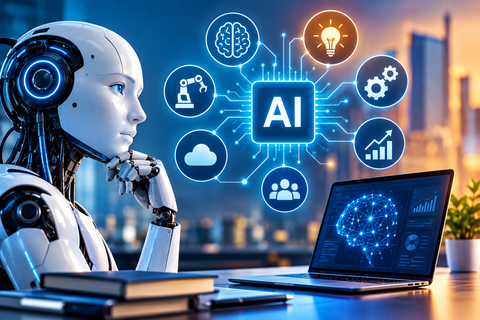
AI-based vision can use machine learning or deep learning models to recognize more complex visual patterns. This can be useful when objects naturally vary in appearance or when defects are difficult to describe with simple rules.
Importance – Why Does Machine Vision Matter?
Industrial vision systems can support consistent inspection and measurement in environments where products move quickly or where repeated visual checks are required.
A major benefit is repeatability. A properly configured system can apply the same inspection criteria to many items while recording image-based information for later analysis.
Machine vision can also help organizations:
- Detect visual inconsistencies earlier in a production process.
- Measure components without physical contact.
- Verify assembly steps.
- Read identification codes automatically.
- Support robotic positioning.
- Create digital records of inspection results.
- Reduce dependence on repetitive visual observation.
The technology affects several groups, including production engineers, quality teams, machine operators, automation specialists, maintenance personnel, and system developers.
However, machine vision is not automatically accurate in every environment. Poor lighting, vibration, reflective surfaces, changing product appearance, camera positioning, and incorrect model training can influence results. System validation and regular monitoring remain important.
Recent Updates – Trends and Developments
Industrial vision is developing alongside automation, edge computing, artificial intelligence, and connected manufacturing.
One important trend is the use of AI-based image analysis. Deep learning models can classify objects and recognize patterns that may be difficult to define through conventional rules. When AI is used, organizations also need to consider data quality, model performance, testing, monitoring, and documentation.
NIST's AI Risk Management Framework provides a voluntary framework for managing AI-related risks and considering characteristics such as validity, reliability, safety, security, transparency, and accountability. NIST also updated its AI RMF materials in 2026, while work continues on a revised version of the framework.
Another development is edge-based image processing. Instead of sending every image to a distant computing system, processing can occur closer to cameras and production equipment. This can reduce data-transfer requirements and support faster responses.
Three-dimensional vision is also increasingly relevant for applications involving depth, shape, volume, robotic picking, and spatial measurement. Multispectral and hyperspectral imaging can provide additional information beyond ordinary visible-light images in specialized applications.
Industrial cameras are also becoming more capable, with higher resolutions, faster image capture, improved sensors, and interfaces designed for automated production environments.
Laws or Policies – Relevant Rules and Standards
Industrial vision equipment may be part of a larger machine, robotic cell, or automated production system. Therefore, applicable safety requirements depend on the equipment, workplace, industry, and country.
In the United States, OSHA's machine-guarding requirements address hazards associated with machinery. OSHA regulation 29 CFR 1910.212 requires appropriate machine guarding for hazards such as points of operation, rotating parts, and other mechanical risks.
OSHA also notes that there is currently no specific OSHA standard dedicated exclusively to the robotics industry. Instead, several general industry requirements can apply to robotic environments, including machine guarding and hazardous-energy controls.
For industrial robots, ISO 10218-1:2025 is a significant international safety standard. The 2025 edition addresses safety requirements for industrial robots and was published as the third edition in February 2025.
In the European Union, Regulation (EU) 2023/1230 establishes machinery-related requirements and is scheduled to apply from January 20, 2027, subject to its stated transitional provisions.
Organizations should therefore check the regulations and standards applicable to their specific machine, location, industry, and deployment conditions. A camera system by itself does not determine the complete safety requirements of an automated installation.
Tools and Resources – Useful Information Sources
Several technical resources can help people understand industrial vision systems and related automation topics.
Useful resources include:
- NIST AI Risk Management Framework for AI governance and risk considerations.
- NIST AI Resource Center for testing, evaluation, verification, and validation information.
- OSHA Machine Guarding resources for workplace machinery safety information.
- ISO 10218 information for industrial robot safety requirements.
- EU legislation through EUR-Lex for European machinery requirements.
When evaluating a vision application, useful technical documentation can include camera specifications, lens information, lighting requirements, image-resolution calculations, inspection criteria, environmental conditions, and system validation records.
FAQs – Industrial Vision Systems
What is an industrial vision system?
An industrial vision system uses cameras, optics, lighting, processing hardware, and software to capture and analyze images for manufacturing or automation tasks.
How does machine vision detect defects?
The system captures an image and analyzes visual characteristics using predefined image-processing rules, comparison methods, or trained AI models. The result can then be classified according to defined inspection criteria.
Can machine vision measure physical dimensions?
Yes. With suitable camera calibration, optics, positioning, and image-processing methods, machine vision can measure dimensions, distances, angles, positions, and other geometric characteristics.
Is AI required for industrial vision?
No. Many applications can use conventional machine vision techniques such as pattern matching, edge detection, thresholding, and geometric analysis. AI is useful for more complex visual classification and recognition tasks.
What factors affect machine vision accuracy?
Lighting, lens selection, camera resolution, object positioning, surface characteristics, vibration, image-processing methods, environmental conditions, and model training can all affect results.
Conclusion – Understanding the Role of Machine Vision
Industrial vision systems provide a way to capture and analyze visual information within automated environments. They can support inspection, measurement, identification, assembly verification, robotic guidance, and process monitoring across many industries.
The technology continues to develop through AI-based analysis, edge computing, three-dimensional imaging, and increasingly capable industrial cameras. At the same time, safety standards, workplace rules, data practices, and system validation remain important parts of responsible industrial deployment.
Understanding the fundamentals helps engineers, operators, and other industrial professionals evaluate where machine vision may fit within an automation process. The most appropriate approach depends on the inspection objective, operating environment, required accuracy, equipment configuration, and applicable regulations.