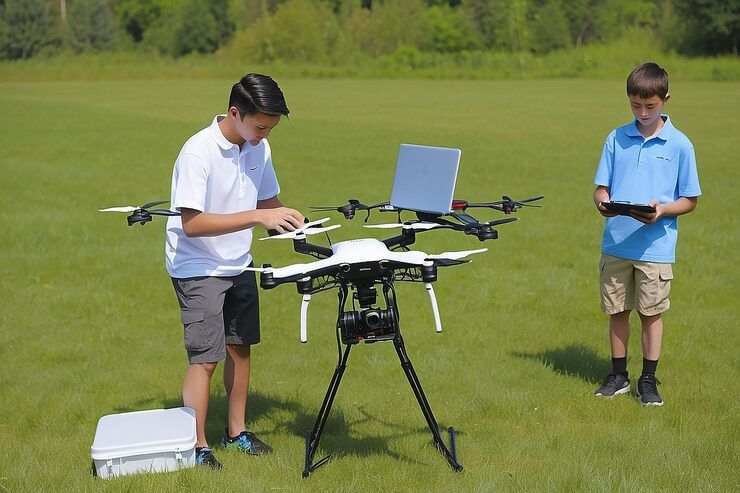
Drone technology, also known as Unmanned Aerial Vehicle (UAV) systems, refers to aircraft that operate without a human pilot onboard. Controlled remotely or autonomously using software, drones are equipped with sensors, cameras, GPS, and communication systems that enable a wide range of tasks—from aerial photography to industrial inspections.
In recent years, drone technology has moved beyond hobbyist use and become a critical tool across industries such as agriculture, logistics, construction, defense, and environmental monitoring. This shift is driven by advancements in artificial intelligence (AI), battery efficiency, and real-time data processing. As industries seek cost-effective, faster, and safer alternatives to traditional methods, drones provide scalable solutions.
The importance of understanding drone types and applications has grown due to increasing adoption and regulatory attention. Governments worldwide are introducing policies to manage airspace safety, while businesses are integrating drones into daily operations. These developments highlight how drone technology is reshaping workflows, improving efficiency, and enabling data-driven decision-making.
Who It Affects and What Problems It Solves
Drone technology impacts a wide range of stakeholders, including businesses, governments, professionals, and consumers. Industries such as agriculture, logistics, media, and infrastructure rely heavily on drones for operational efficiency. Farmers use drones for crop monitoring and precision agriculture, while logistics companies explore drone delivery systems to reduce last-mile delivery time.
Public sector agencies also benefit significantly. Emergency services use drones for disaster assessment, search and rescue missions, and surveillance. Urban planners and environmental researchers use aerial data for mapping and monitoring changes in landscapes. For individuals, drones have opened new opportunities in photography, videography, and small-scale business services.
Problems Drone Technology Solves
- High Operational Costs: Traditional aerial surveys using helicopters or planes are expensive. Drones provide a cost-effective alternative.
- Safety Risks: Inspections in hazardous environments (e.g., power lines, mines) can be conducted remotely using drones.
- Limited Accessibility: Drones can reach remote or difficult terrains, improving data collection in inaccessible areas.
- Time Inefficiency: Tasks like land surveys or infrastructure inspections are completed faster with drones.
- Data Accuracy Issues: Equipped with advanced sensors, drones deliver high-resolution and real-time data for better decision-making.
Recent Updates and Industry Trends
The drone industry has experienced rapid innovation and regulatory evolution over the past year. Several notable trends have emerged:
Increased Use of AI and Automation
Drones are increasingly integrated with AI for autonomous navigation, object detection, and predictive analytics. This reduces the need for manual control and enhances operational efficiency.
Expansion in Drone Delivery
Major logistics companies are expanding pilot programs for drone-based delivery, particularly in urban and semi-urban areas. This trend is supported by improvements in payload capacity and route optimization.
Growth in Agricultural Drones
Precision agriculture continues to grow, with drones being used for crop spraying, soil analysis, and yield estimation. Governments in several countries are supporting this adoption through subsidies and training programs.
Enhanced Battery and Flight Time
Advancements in battery technology are extending drone flight durations, enabling longer missions and broader coverage.
Integration with IoT and Cloud Platforms
Drones are increasingly connected to cloud systems for data storage and analysis, enabling real-time monitoring and remote decision-making.
Rising Focus on Regulation
Countries are updating drone policies to balance innovation with safety. Licensing requirements, geofencing, and airspace management systems are becoming more standardized.
Drone Types and Key Characteristics
| Drone Type | Description | Common Uses | Advantages | Limitations |
|---|---|---|---|---|
| Fixed-Wing Drones | Airplane-like structure, uses wings for lift | Mapping, surveying, agriculture | Long flight time, wide coverage | Requires runway or launcher |
| Multi-Rotor Drones | Multiple rotors (quadcopters, hexacopters) | Photography, surveillance | Easy to control, vertical takeoff | Limited flight time |
| Single-Rotor Drones | Helicopter-like design | Heavy payload transport | Efficient for longer flights | Complex maintenance |
| Hybrid Drones | Combines fixed-wing and rotor features | Delivery, long-range missions | Versatile and efficient | Higher cost and complexity |
Laws and Policies Affecting Drone Technology
Drone operations are subject to strict regulations in many countries to ensure safety, privacy, and airspace management.
Key Regulatory Aspects
- Registration and Licensing: Operators often need to register drones and obtain certification.
- Flight Restrictions: Limits on altitude, no-fly zones (e.g., near airports), and restricted areas.
- Privacy Laws: Use of cameras must comply with data protection and privacy regulations.
- Commercial Use Permissions: Businesses must meet additional compliance requirements for commercial drone operations.
Practical Guidance
- Use drones for commercial purposes only after obtaining necessary permits.
- Follow geofencing rules to avoid restricted airspace.
- Maintain visual line-of-sight (VLOS) unless authorized for advanced operations.
- Regularly check updates from aviation authorities to ensure compliance.
In countries like India, the Digital Sky platform regulates drone usage, requiring operators to follow structured guidelines for safe operations.
Tools and Resources
Several tools and platforms support drone operations, planning, and analysis:
Flight Planning Tools
- DroneDeploy
- Pix4D
- UAV Forecast
Data Processing and Mapping
- GIS software (Geographic Information Systems)
- Cloud-based mapping tools
Simulation and Training
- Drone simulators for pilot training
- Online certification courses
Hardware and Components
- GPS modules
- LiDAR sensors
- High-resolution cameras
Regulatory Resources
- National aviation authority websites
- Digital registration portals
- Safety compliance guides
Frequently Asked Questions (FAQ)
What are the main types of drones?
The main types include fixed-wing, multi-rotor, single-rotor, and hybrid drones. Each type serves different purposes based on flight duration, payload, and operational requirements.
How are drones used in agriculture?
Drones assist in crop monitoring, spraying fertilizers, soil analysis, and yield prediction, improving efficiency and reducing resource usage.
Are drones legal for commercial use?
Yes, but commercial use requires registration, licensing, and compliance with local aviation regulations.
What industries benefit most from drone technology?
Industries such as agriculture, logistics, construction, media, defense, and environmental monitoring benefit significantly from drone applications.
What are the limitations of drones?
Common limitations include battery life, payload capacity, regulatory restrictions, and weather sensitivity.
Conclusion
Drone technology has evolved into a critical component of modern industrial and commercial ecosystems. Its ability to reduce costs, improve safety, and deliver high-quality data has accelerated adoption across sectors. Data trends indicate steady growth in drone usage, particularly in agriculture, logistics, and infrastructure monitoring.
While challenges such as regulatory compliance and technical limitations remain, ongoing advancements in AI, battery systems, and connectivity are addressing these issues. The increasing integration of drones with digital platforms further enhances their value in data-driven environments.
For most use cases, multi-rotor drones are suitable for short-range and flexible operations, while fixed-wing and hybrid drones are better for long-distance and large-scale applications. Selecting the right type depends on operational needs, regulatory conditions, and budget.
Overall, drone technology is expected to continue expanding, driven by innovation, policy support, and growing demand for efficient, scalable solutions.