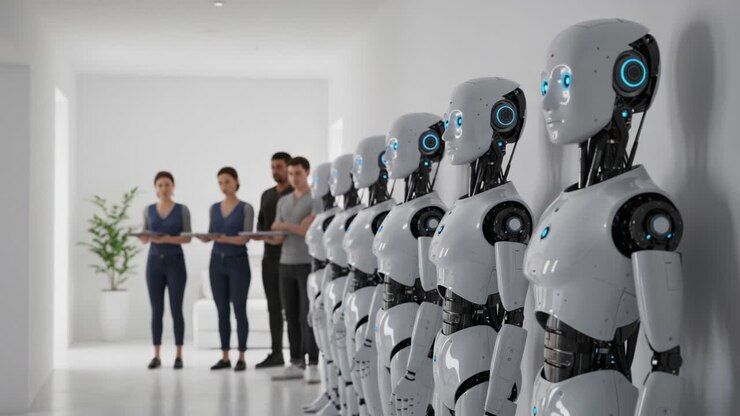
Personal assistant robots are physical robots designed to help people with everyday activities in homes, workplaces, healthcare environments, and other settings. Unlike software-based AI assistants that operate through phones or speakers, these robots can interact with the physical environment.
They may combine artificial intelligence (AI), computer vision, voice recognition, machine learning, sensors, navigation systems, and robotic control to understand instructions and perform actions.
Depending on their design, a personal assistant robot may be able to:
- Respond to spoken questions and commands
- Recognize people, objects, and locations
- Navigate rooms autonomously
- Provide reminders and notifications
- Monitor selected home conditions
- Carry or move lightweight objects
- Connect with smart home devices
- Provide information through a screen or voice interface
- Support communication and companionship
The technology exists because conventional digital assistants are limited to screens, speakers, and connected devices. A mobile or humanoid robot can potentially combine digital intelligence with physical movement.
Modern systems are also increasingly connected to cloud AI and large language models, allowing users to interact with robots using more natural language.
Why Personal Assistant Robots Matter Today
Personal assistant robots are part of a broader shift toward AI-powered automation and physical AI. Research published in June 2026 reviewed recent developments in AI-based mobile robots designed for human companionship, highlighting progress in perception, interaction, navigation, and autonomous behavior.
The technology can affect several groups, including households, older adults, people with accessibility requirements, caregivers, researchers, and organizations developing smart environments.
One important application is assistance with routine activities. A robot that can understand a verbal instruction and physically move through a home could potentially perform tasks that a smartphone-based AI assistant cannot.
Another area is accessibility. Physical assistance may become useful for people who have difficulty reaching objects, navigating certain environments, or interacting with conventional interfaces.
Personal assistant robots can also contribute to smart home automation. Instead of relying exclusively on stationary sensors, a mobile robot can potentially move between rooms and collect information from different locations.
However, these systems also create challenges. Robots operating in private spaces may encounter personal conversations, faces, household layouts, and other sensitive information. Physical movement introduces additional safety considerations that do not exist with ordinary software.
| Capability | Conventional AI Assistant | Personal Assistant Robot |
|---|---|---|
| Voice interaction | Yes | Yes |
| Physical movement | No | Yes |
| Computer vision | Limited/device dependent | Commonly integrated |
| Smart home control | Yes | Yes |
| Object interaction | No | Possible |
| Autonomous navigation | No | Possible |
| Physical safety considerations | Limited | Significant |
| Privacy considerations | Yes | Yes, potentially broader |
Recent Developments in Personal Assistant Robots
The past year has seen continued movement toward AI systems that can perform actions rather than simply generate responses.
In January 2026, the U.S. National Institute of Standards and Technology (NIST) requested information about security considerations for AI agent systems. NIST described AI agents as systems capable of planning and taking autonomous actions that affect real-world systems or environments. This is relevant to personal robots because future robotic assistants may combine AI agents with physical capabilities.
In February 2026, NIST announced its AI Agent Standards Initiative, focused on interoperability and security for AI systems capable of autonomous actions.
NIST subsequently published its analysis of responses to the AI-agent security request in May 2026. The report noted that autonomous AI systems introduce security issues that require adaptation of conventional cybersecurity practices.
Research has also increasingly examined robots designed for human interaction and companionship. A June 2026 survey in Artificial Intelligence Review examined recent advances in AI-based mobile robots for human companionship.
The technology is also moving toward physical intelligence, where AI models, sensors, processors, and mechanical systems work together to allow robots to perceive and act in real-world environments. This remains an evolving field, and capabilities differ substantially between robotic platforms.
Laws, Regulations, and Government Policies
There is no single worldwide law specifically governing all personal assistant robots. Requirements can depend on where a robot is used, what it does, whether it collects personal data, and whether it performs safety-critical functions.
In the European Union, the EU AI Act is particularly relevant to AI-enabled robotic systems. The Act entered into force in August 2024, while different provisions have applied on different dates. The European Commission states that prohibited AI practices and AI literacy requirements began applying in February 2025, while broader AI Act provisions became applicable in August 2026, subject to exceptions and transitional periods.
The AI Act specifically recognizes that increasingly autonomous robots used for personal assistance and care can create health and safety risks.
AI systems that function as safety components of regulated products can fall under high-risk requirements when the relevant legal conditions are met.
The EU's July 2026 AI Omnibus also extended some implementation timelines. High-risk AI systems embedded in certain physical products are scheduled for the applicable requirements from August 2, 2028 under the updated framework.
Privacy is another important issue. Under the GDPR, organizations processing personal data of people in the EU generally have specific obligations concerning how that data is collected, stored, and managed.
Cybersecurity is also becoming increasingly relevant. The EU Cyber Resilience Act establishes cybersecurity requirements for products with digital elements, including requirements for manufacturers to assess cybersecurity risks and address them during design, development, production, delivery, and maintenance.
In the United States, NIST provides voluntary frameworks and technical guidance rather than a single federal law covering every personal robot. Its AI Risk Management Framework provides a structure for managing AI risks, while NIST's work on AI-agent security addresses emerging autonomous systems.
Because rules differ by jurisdiction and application, organizations developing or deploying robotic systems should evaluate applicable product safety, privacy, cybersecurity, consumer protection, and AI regulations.
Tools and Resources for Personal Assistant Robots
Several resources can help people understand the technology and its safety requirements.
- NIST AI Risk Management Framework: A framework for identifying and managing AI-related risks.
- NIST AI Agent Standards Initiative: Resources concerning standards and interoperability for autonomous AI agents.
- NIST Smart Home Security Guidance: Practical information about privacy and cybersecurity considerations for connected household devices.
- EU AI Act resources: Official information about AI classifications, obligations, implementation dates, and regulatory requirements.
- GDPR resources: Useful for understanding personal-data obligations in European environments.
- Robot simulation platforms: Simulation environments can help developers test navigation, perception, and robot behavior before deployment.
- Computer vision frameworks: Software frameworks for image recognition, object detection, and environmental perception are widely used in robotics research.
- Robot operating platforms: Robotics middleware can provide tools for navigation, sensor integration, motion control, and communication between robotic components.
A practical evaluation of a personal assistant robot should consider AI capabilities, navigation accuracy, privacy controls, cybersecurity, physical safety, connectivity, accessibility, and human oversight rather than focusing only on the robot's appearance or conversational ability.
Frequently Asked Questions
What can a personal assistant robot do?
Capabilities vary considerably. Depending on its hardware and software, a robot may provide voice interaction, reminders, navigation, object recognition, smart home control, monitoring, communication, or limited physical assistance.
Are personal assistant robots autonomous?
Some systems can perform specific tasks autonomously, while others require human instructions or supervision. Autonomy generally depends on the robot's sensors, AI models, navigation software, connectivity, and safety controls.
Do personal assistant robots use AI?
Many modern systems use AI technologies such as machine learning, computer vision, natural-language processing, speech recognition, and autonomous decision-making. The exact technologies depend on the robot.
Are personal assistant robots safe?
Safety depends on the robot's design, environment, software, hardware, and operating rules. Robots capable of physical movement require safeguards against collisions, unexpected movements, falls, and inappropriate interaction with people or objects.
Can personal assistant robots protect privacy?
Privacy protection depends on how the robot handles microphones, cameras, location information, recordings, and other data. Users should review data-processing controls, permissions, security updates, and storage practices before connecting a robot to a private environment.
The Future of Personal Assistant Robots
Personal assistant robots are developing at the intersection of robotics, artificial intelligence, smart home automation, computer vision, and AI agent technology.
The most significant change is the movement from AI that only produces digital responses toward AI that can potentially perceive environments and take physical actions. This creates opportunities for household assistance, accessibility, communication, and automation.
At the same time, physical AI introduces responsibilities that go beyond conventional software. Privacy, cybersecurity, reliability, physical safety, transparency, and human control will remain important as these systems become more capable.
The technology is still developing, and capabilities vary widely between platforms. Current progress suggests that personal assistant robots will increasingly be evaluated not only by how naturally they communicate, but also by how safely and reliably they operate around people.