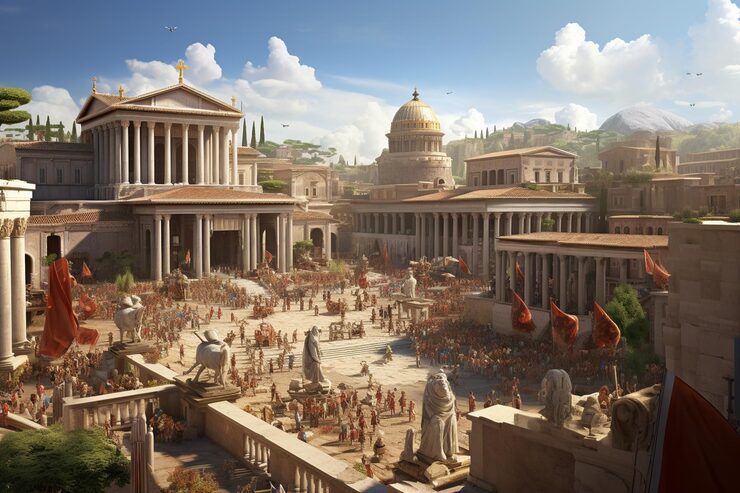
Rome is one of the world's most important archaeological cities. Ancient monuments are visible throughout the modern capital, including amphitheaters, temples, forums, roads, aqueducts, baths, arches, houses, and monumental structures.
The remains of ancient Rome provide evidence of how the Roman Republic and Empire developed their political institutions, religious practices, engineering systems, architecture, and urban organization.
Among the best-known sites are the Colosseum, Roman Forum, Palatine Hill, Pantheon, Baths of Caracalla, Circus Maximus, and Imperial Fora. Other archaeological remains are integrated into modern streets, museums, churches, and neighborhoods.
The Archaeological Park of the Colosseum connects several major sites, including the Colosseum, Roman Forum, Palatine Hill, and Imperial Fora. Its current visitor information also includes archaeological museums and ongoing exhibitions.
Major Ancient Monuments in Rome
| Monument | Historical Role | Approximate Period |
|---|---|---|
| Colosseum | Amphitheater for public spectacles | 1st century CE |
| Roman Forum | Political, religious and civic center | Republican–Imperial |
| Palatine Hill | Elite residences and imperial palaces | Republican–Imperial |
| Pantheon | Monumental Roman temple, later church | 2nd century CE |
| Baths of Caracalla | Large public bathing complex | 3rd century CE |
| Circus Maximus | Chariot-racing and public-event venue | Ancient period |
| Arch of Constantine | Monumental commemorative arch | 4th century CE |
| Imperial Fora | Political and monumental complexes | Imperial period |
Why Rome's Ancient Monuments Matter
Ancient Roman monuments provide physical evidence of one of history's most influential civilizations.
They help researchers and visitors understand Roman approaches to engineering, architecture, administration, religion, public entertainment, transportation, water management, and urban planning.
The monuments also demonstrate how cities can evolve while retaining layers of earlier development. Modern Rome was built around, above, and sometimes directly beside ancient structures.
What Ancient Monuments Reveal
Visitors can use archaeological sites to examine:
- Roman building techniques
- Stone and concrete construction
- Ancient road systems
- Public water infrastructure
- Religious architecture
- Political institutions
- Imperial architecture
- Domestic life
- Public entertainment
- Archaeological conservation
The Colosseum Archaeological Park includes the Roman Forum and Palatine areas alongside the amphitheater, allowing visitors to examine several connected parts of ancient Rome in one archaeological landscape.
Ancient Rome as an Urban System
Rome's monuments should not be viewed only as individual buildings.
The Roman Forum was connected to government, religion, commerce, public ceremonies, and political life. The Palatine was associated with elite and imperial residences. The Imperial Fora expanded the monumental center of the city.
Similarly, the Colosseum formed part of a much larger urban environment that included roads, temples, baths, public spaces, and other buildings.
This broader perspective helps explain why archaeological tourism in Rome often involves walking between multiple sites rather than visiting one isolated monument.
Recent Developments in Rome's Ancient Heritage
Rome's archaeological landscape continues to be studied, restored, and adapted for visitors.
2026 Colosseum Visitor Arrangements
The Archaeological Park of the Colosseum introduced new arrangements for on-site ticket purchases beginning May 4, 2026. The 24-hour Colosseum, Roman Forum and Palatine ticket became available at the Piazza del Colosseo ticket office, while Forum Pass SUPER tickets were directed to designated Forum-area ticket offices.
The change is part of continuing efforts to organize visitor flows at one of Italy's most heavily visited archaeological areas.
The standard 2026 schedule also requires a reserved entry time for the Colosseum. The official park states that reservations open 30 days before the visit date.
Extended Archaeological Experiences
The Archaeological Park continued its nighttime programming during 2026.
The “A Night at the Colosseum” program provides evening access on selected Tuesdays and Thursdays, including a guided route through the Colosseum's arena and underground areas.
A separate “A Night at the Roman Forum” program provides guided evening visits on Fridays. The tour focuses on the archaeological area that served as the political and ceremonial center of ancient Rome.
These programs illustrate how archaeological interpretation can extend beyond conventional daytime visits.
Seasonal Opening Changes
Opening times vary during the year.
For example, from March 29 through September 30, 2026, the Colosseum Archaeological Park is scheduled to remain open until 19:15, with last admission at 18:15. From October 25, 2026 through February 28, 2027, the park's closing time is scheduled to move earlier, with last admission at 15:30.
Visitors planning a winter archaeological itinerary therefore need to check the current schedule rather than assuming summer hours.
A Snapshot of Recent Changes
| Area | 2026 Development |
|---|---|
| Ticketing | Revised on-site ticket-office arrangements |
| Colosseum | Timed entry required |
| Night visits | Selected evening programs |
| Roman Forum | Dedicated nighttime guided visits |
| Opening hours | Seasonal schedule |
| Visitor planning | Official online reservation system |
Laws and Policies Protecting Ancient Monuments
Ancient monuments in Rome are protected under Italy's cultural heritage framework, with responsibilities shared among national cultural authorities, archaeological parks, and local institutions.
Italy's principal legal framework is the Code of Cultural Heritage and Landscape, established through Legislative Decree No. 42 of 2004. It provides the legal basis for protecting and enhancing cultural heritage and archaeological resources.
The Ministry of Culture oversees national cultural heritage policies, while specialized archaeological authorities manage individual sites.
Archaeological Protection
Ancient remains are treated as protected cultural heritage rather than ordinary urban structures.
Activities that could affect archaeological areas can therefore be subject to authorization, archaeological assessment, conservation requirements, or other controls.
This framework is particularly important in Rome because archaeological remains can exist beneath modern streets and buildings.
Monument Conservation
Conservation work must balance several objectives:
- Protecting original materials
- Stabilizing structures
- Limiting physical deterioration
- Allowing controlled public access
- Recording archaeological evidence
- Explaining the historical context
- Managing visitor pressure
The challenge is particularly significant at monuments exposed to weather, pollution, vibration, humidity, and large visitor numbers.
Visitor Rules
Archaeological parks establish their own visitor regulations.
At the Colosseum Archaeological Park, visitors must follow designated routes, security procedures, access restrictions, and monument-protection rules.
The park also limits the number of people in certain areas and has specific rules for guided groups. Its current visitor information states that groups can contain up to 25 people, with whisper systems required for groups of 10 or more.
These measures help reduce noise and physical pressure inside sensitive archaeological spaces.
Photography and Preservation
Personal photography is generally possible in many outdoor archaeological areas, but visitors should follow location-specific instructions.
Tripods, professional equipment, commercial filming, or special photographic projects can be subject to additional permissions.
Visitors should never touch ancient surfaces, climb restricted structures, remove fragments, or enter closed archaeological areas.
Tools and Resources for Exploring Ancient Rome
Digital resources can make an archaeological visit easier to understand and organize.
Archaeological Park of the Colosseum
The official Colosseum Archaeological Park website provides:
- Opening schedules
- Official tickets
- Visitor regulations
- Archaeological information
- Guided tours
- Current exhibitions
- Accessibility information
- Transportation information
The park's official ticketing system is particularly important because Colosseum entry requires a reserved time slot.
Digital Maps
Mapping applications can help visitors create walking routes between:
- Colosseum
- Roman Forum
- Palatine Hill
- Pantheon
- Imperial Fora
- Circus Maximus
- Baths of Caracalla
- Capitoline Hill
A map can also help identify entrances and exits because large archaeological areas can have different access points.
Rome Archaeological Resources
Travelers interested in deeper historical research can consult Italian Ministry of Culture resources, museum databases, archaeological publications, and institutional websites.
These sources can provide more detailed information than general travel guides.
Audio and Translation Tools
Translation applications can help visitors understand Italian archaeological descriptions, museum labels, and public notices.
Audio guides and official digital interpretation tools can also provide historical context while walking through large archaeological areas.
Planning Checklist
Before visiting ancient monuments, consider:
- Check official opening times.
- Reserve timed entry where required.
- Confirm which archaeological areas are included in the selected ticket.
- Check temporary closures.
- Review accessibility information.
- Wear suitable footwear for uneven archaeological surfaces.
- Carry water during warm weather.
- Allow additional time for security procedures.
- Follow photography and monument-protection rules.
- Check official information shortly before the visit.
Frequently Asked Questions
What are the most important ancient monuments in Rome?
Major examples include the Colosseum, Roman Forum, Palatine Hill, Pantheon, Imperial Fora, Baths of Caracalla, Circus Maximus, and Arch of Constantine. Rome also contains many smaller archaeological remains throughout the city.
Can the Colosseum, Roman Forum and Palatine Hill be visited together?
Yes. The official Archaeological Park provides combined ticket options covering the Colosseum, Roman Forum, and Palatine Hill. Some ticket types also include additional archaeological areas and exhibitions.
Does the Colosseum require a reservation?
The official Archaeological Park states that a reserved time slot is compulsory for Colosseum entry. Ticket sales open 30 days before the selected visit date.
Can visitors see ancient monuments at night?
Selected nighttime programs are available during parts of the year. In 2026, “A Night at the Colosseum” is scheduled on selected Tuesdays and Thursdays, while “A Night at the Roman Forum” has selected Friday evening visits. Availability can change, so visitors should check the official calendar.
How should visitors protect Rome's ancient monuments?
Visitors should remain on designated paths, avoid touching or climbing structures, respect barriers, follow staff instructions, and avoid removing archaeological material. These simple practices help preserve fragile remains for future research and public access.
Conclusion
Rome's ancient monuments are not isolated ruins. Together, they form a large archaeological landscape that explains how Roman political, religious, social, architectural, and engineering systems developed.
The Colosseum, Roman Forum, Palatine Hill, Imperial Fora, Pantheon, Baths of Caracalla, and other sites reveal different aspects of ancient urban life. Their preservation also demonstrates the challenges of protecting archaeological resources within a modern capital.
Recent 2026 developments include revised ticket-office arrangements, mandatory timed Colosseum entry, seasonal opening schedules, and selected nighttime archaeological programs.
For visitors, the most useful approach is to combine historical research with current official information. Checking opening times, access requirements, archaeological rules, and temporary changes before visiting can make the experience more organized.
Rome's ancient monuments remain valuable not only because of their age, but because they provide physical evidence of how one of history's most influential civilizations built, governed, worshipped, traveled, and lived.