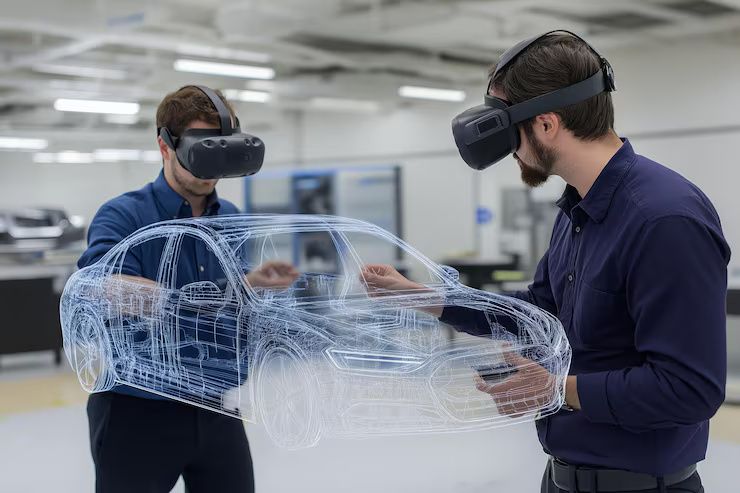
Virtual Reality (VR) in automotive design refers to the use of immersive digital environments to visualize, evaluate, and refine vehicle designs before physical production. This technology exists to help designers and engineers experience a vehicle in three dimensions, allowing them to interact with digital models as if they were real.
Traditionally, automotive design relied heavily on physical clay models, scale mockups, and repeated prototyping cycles. While effective, these methods required significant time, material, and coordination. As vehicles became more complex and global collaboration increased, the industry needed tools that allowed faster iteration and shared understanding across teams.
VR emerged as a response to these challenges. By combining computer-aided design data with immersive visualization, automotive teams gained the ability to review interiors, exteriors, and spatial layouts early in the design process. Today, VR is a core part of digital automotive development, supporting creativity, accuracy, and collaboration.
Importance: Why VR Matters in Automotive Design Today
VR matters in automotive design today because modern vehicles are highly complex systems that must balance aesthetics, ergonomics, safety, and engineering constraints. Visualizing these elements together at an early stage helps reduce uncertainty and improve design decisions.
This topic matters because VR in automotive design:
-
Improves understanding of scale, proportion, and space
-
Reduces reliance on physical prototypes
-
Supports collaboration across global design teams
-
Helps identify design issues earlier in development
VR affects automotive designers, engineers, product planners, and manufacturing teams. Designers use VR to explore form and style, while engineers assess visibility, reach, and packaging constraints. Decision-makers can review concepts in immersive environments, supporting clearer communication and faster alignment.
By addressing challenges related to cost, time, and complexity, VR helps solve long-standing issues in vehicle development workflows.
Recent Updates: VR in Automotive Design Over the Past Year
During 2024 and early 2025, VR adoption in automotive design continued to evolve alongside advances in computing and simulation. In early 2024, greater emphasis was placed on higher-resolution headsets and improved motion tracking, enhancing realism and reducing visual distortion during design reviews.
By mid-2024, integration between VR platforms and real-time simulation tools became more visible. Designers could explore lighting conditions, material reflections, and interior ergonomics dynamically, allowing more informed evaluations of design choices.
In late 2024, collaborative VR environments gained attention. Multiple participants, located in different regions, were able to join shared virtual spaces to review and discuss vehicle designs simultaneously. This supported distributed design teams and reduced the need for frequent physical meetings.
Another notable update involved the use of VR earlier in concept development. Rather than being limited to later review stages, VR increasingly supported initial ideation and sketch-to-model transitions.
Laws and Policies: Regulations Affecting VR Use in Automotive Design
VR itself is a design and visualization tool, so it is not regulated in the same way as physical vehicle components. However, its use in automotive design is indirectly influenced by regulations related to vehicle safety, ergonomics, and manufacturing standards.
Automotive designs evaluated using VR must ultimately comply with national and international vehicle regulations. These include safety visibility requirements, interior layout standards, and driver ergonomics guidelines. VR helps teams assess compliance early, but final validation still follows regulatory testing procedures.
Digital data handling and collaborative platforms used in VR environments may also be influenced by data protection and intellectual property policies, particularly when designs are shared across borders.
Technical standards related to digital modeling and simulation often align with guidance from the International Organization for Standardization, supporting consistency in digital engineering practices.
Tools and Resources: Understanding VR in Automotive Design
Several tools and educational resources help explain how VR is applied in automotive design. These resources focus on learning, visualization, and process understanding rather than commercial promotion.
Helpful tools and references include:
-
VR-based design review environments
-
Digital vehicle interior and exterior mockups
-
Ergonomic assessment visualizations
-
Real-time lighting and material simulation tools
-
Collaborative virtual design spaces
The table below outlines key automotive design activities supported by VR:
| Design Activity | Role of VR | Outcome |
|---|---|---|
| Exterior styling | Immersive form review | Improved proportions |
| Interior layout | Cabin and visibility evaluation | Better ergonomics |
| Color and materials | Realistic surface visualization | Informed design choices |
| Design reviews | Shared virtual walkthroughs | Faster decision-making |
| Concept validation | Early-stage exploration | Reduced rework |
Another table highlights how VR compares with traditional design methods:
| Aspect | Traditional Methods | VR-Based Methods |
|---|---|---|
| Visualization | Physical models | Immersive digital models |
| Iteration speed | Slower | Faster |
| Collaboration | Location-dependent | Remote and shared |
| Material use | High | Minimal |
| Design feedback | Sequential | Real-time |
These resources help readers understand how VR fits into the broader automotive design workflow.
Frequently Asked Questions About VR in Automotive Design
What is the main purpose of VR in automotive design?
VR allows designers and engineers to experience and evaluate vehicle designs in an immersive digital environment.
Does VR replace physical prototypes?
VR reduces the number of physical prototypes needed but does not eliminate them entirely.
Who uses VR in the automotive industry?
Designers, engineers, product planners, and review teams commonly use VR tools.
Is VR used only for interior design?
No, VR is used for both interior and exterior design evaluation.
Does VR improve design accuracy?
Yes, by enabling early detection of spatial and ergonomic issues, VR supports more accurate design decisions.
Conclusion: The Role of VR in Automotive Design Innovation
VR has become a powerful tool in automotive design by transforming how vehicles are visualized, reviewed, and refined. Through immersive environments, teams can explore design concepts more deeply and collaboratively than ever before.
Understanding the context, importance, recent developments, regulatory considerations, tools, and common questions related to VR in automotive design highlights its growing role in digital innovation. VR does not replace engineering fundamentals but enhances them, supporting clearer insight, faster iteration, and more informed decision-making in the creation of modern vehicles