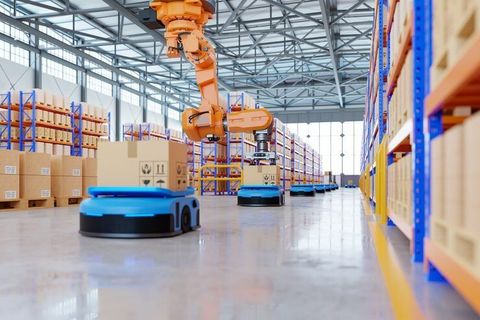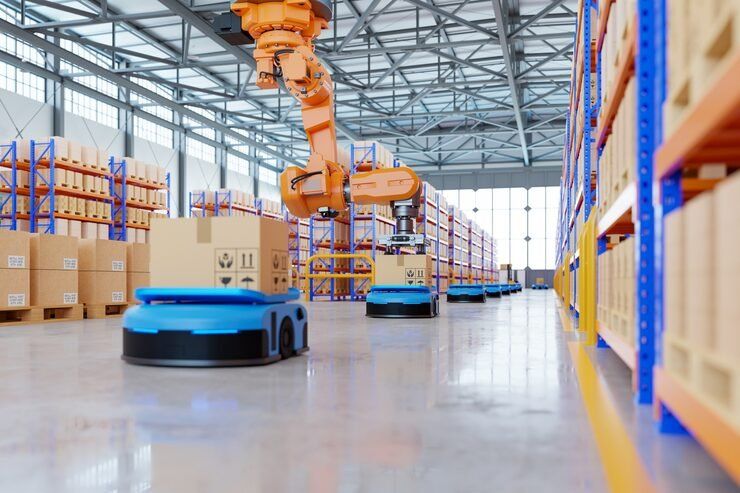
Warehouses are no longer organized around people moving continuously between storage locations, picking areas, packing stations, and shipping zones.
Warehouse robotics automation systems are increasingly changing that movement by combining mobile robots, automated storage equipment, software, sensors, and human workflows into coordinated operations.
The shift is driven by the growing complexity of warehouse activities. Facilities may handle thousands of product variations while managing changing order volumes, tighter fulfillment windows, limited floor space, and the need for accurate inventory information. Robotics can help coordinate these activities without requiring every movement to depend on manual handling.
Understanding modern warehouse workflows means looking beyond individual robots. The real transformation happens when robotics, warehouse management software, inventory systems, conveyors, picking technologies, and employees operate as one connected process. That integration determines how efficiently goods move from receiving through storage and eventually toward dispatch.
How Robotics Fits Into a Modern Warehouse
A robotic warehouse is not necessarily a completely autonomous building. In many facilities, automation is introduced selectively, with machines handling repetitive transportation, storage, retrieval, sorting, or picking tasks while employees manage activities that require judgment and flexibility.
The workflow typically begins when goods arrive at a receiving area. Items may be identified through barcode scanning, RFID technology, machine vision, or other identification methods. Warehouse software then determines where inventory should be stored based on factors such as product characteristics, available locations, order patterns, and operational priorities.
Once inventory has been received and identified, robotic systems can move containers, pallets, totes, or individual items to designated areas. This creates a continuous material flow rather than requiring employees to manually coordinate every movement.
The Core Technologies Behind Warehouse Robotics
Several different technologies can contribute to an automated warehouse. Their roles vary depending on the building layout, inventory profile, and workflow requirements.
Autonomous mobile robots (AMRs) use sensors, mapping technologies, and navigation software to move through warehouse environments. They can transport inventory between workstations, storage areas, and picking zones while adapting their routes to changing conditions.
Automated guided vehicles (AGVs) generally follow predefined paths or navigation systems to transport materials. They are particularly useful for predictable movement between established points.
Automated storage and retrieval systems (AS/RS) use mechanical equipment to place and retrieve inventory from structured storage locations. These systems can make better use of vertical space and reduce the amount of manual travel required.
Robotic picking systems use robotic arms, machine vision, gripping technologies, and software to identify and manipulate individual products. Their effectiveness depends heavily on product shape, packaging, orientation, and variation.
Conveyor and sortation systems connect different warehouse zones. They can move cartons, totes, and other containers between receiving, storage, picking, packing, and dispatch areas.
These technologies are often most effective when integrated rather than treated as isolated machines.
From Receiving to Storage: Where Automation Begins
The receiving process establishes the accuracy of everything that follows. When incoming inventory is scanned and recorded correctly, warehouse systems can maintain a reliable digital representation of what is physically present.
After identification, software can assign storage locations according to predefined rules. A fast-moving item might be positioned closer to a picking area, while slower-moving inventory can be placed farther away.
Robotic transportation then moves the inventory into the appropriate location. Depending on the system, this may involve an AMR carrying a tote, an AGV transporting a pallet, or an automated storage system placing a container into a rack.
This creates an important connection between physical movement and inventory records. The warehouse management system needs to know not only what was received but also where the inventory has been positioned.
How Robotic Picking Changes Order Fulfillment
Picking is often one of the most movement-intensive warehouse activities. In a conventional workflow, employees may walk through multiple aisles to locate individual products and bring them to a packing station.
Robotics can change this process in several ways.
In a goods-to-person workflow, robots transport inventory to an employee at a designated workstation. The employee remains in a relatively fixed location while the system delivers the required items.
In a person-to-goods workflow, employees travel through the warehouse while robotic technologies assist with navigation, transportation, or task sequencing.
Robotic arms can also perform selected picking operations. Vision systems identify an item, software determines how it should be grasped, and the robotic arm performs the movement.
The appropriate approach depends on the inventory. Uniform products with predictable packaging are generally easier for robotic picking systems to handle than irregular, fragile, or highly variable items.
The Role of Warehouse Management Software
Robots cannot create an efficient workflow by themselves. Software provides the coordination layer that determines what needs to move, where it needs to go, and when the movement should occur.
A warehouse management system maintains inventory information and coordinates warehouse activities. Robotics control software may then translate those requirements into specific instructions for individual machines.
In a connected operation, several systems can exchange information continuously. An order can trigger a picking task, the picking task can create a robot assignment, and the completed movement can update inventory records.
This creates a digital feedback loop between physical warehouse activity and software. When properly designed, it allows managers to monitor workflow conditions and identify operational bottlenecks more quickly.
Why Workflow Design Matters More Than Individual Robots
Adding robots does not automatically make a warehouse efficient. Poorly designed processes can remain inefficient even when sophisticated equipment is installed.
For example, a robot may transport inventory rapidly but still create delays if the receiving station cannot process incoming goods quickly enough. Similarly, automated picking can create congestion if packing stations cannot handle the resulting workload.
Effective automation therefore starts with process analysis. Warehouse operators need to understand movement patterns, inventory characteristics, order profiles, workstation capacity, and points where work accumulates.
Important considerations include:
- Where inventory enters and leaves the facility
- How frequently different products move
- Which tasks involve repetitive transportation
- Where employees spend significant time walking
- Which processes create queues or bottlenecks
- How inventory information moves between systems
This process-first approach helps determine where robotics can contribute meaningfully.
Human Workers and Robots Working Together
Modern warehouse automation does not necessarily eliminate human involvement. Instead, many systems are designed around human-robot collaboration.
Employees may handle activities requiring inspection, exception management, problem-solving, quality checks, replenishment decisions, or handling products that robotic systems cannot reliably manipulate.
Robots can take responsibility for repetitive transportation or positioning tasks. This division allows each part of the workflow to perform the activities it is better suited to handle.
Safety is central to this relationship. Mobile robots need appropriate navigation and obstacle-detection capabilities, while fixed robotic equipment requires controlled operating areas and suitable safeguards. Warehouse layouts also need clearly defined interaction zones where people and machines can work together safely.
Managing Data, Exceptions, and Bottlenecks
Automation works well when normal conditions are predictable. Real warehouses, however, contain exceptions.
An item may be missing from its expected location. A barcode may be unreadable. A robot may encounter an obstruction. A storage location may become unavailable. An order may require a product that does not fit the standard automated workflow.
These situations require exception-management processes. Rather than designing automation only for ideal conditions, warehouse operators need clear procedures for when automated workflows cannot proceed normally.
Operational data can help identify recurring problems. If robots repeatedly wait at a particular station, for example, the underlying issue may involve workstation capacity rather than robot performance.
Scaling Warehouse Robotics Over Time
Warehouse robotics automation systems can be implemented progressively rather than as a single transformation. A facility may begin by automating internal transportation before expanding into storage, picking, sorting, or replenishment.
This approach allows operational teams to understand how automation interacts with existing processes. It also provides opportunities to evaluate system performance before introducing additional complexity.
Scalability depends on more than adding machines. Software architecture, network infrastructure, warehouse layout, charging arrangements, maintenance procedures, employee training, and system interoperability all influence whether an automated operation can expand effectively.
A scalable design therefore considers future workflow requirements while solving current operational problems.
Frequently Asked Questions
Are warehouse robotics systems fully autonomous?
Not always. Many systems operate with substantial automation while still depending on employees for supervision, exception handling, quality control, maintenance, and decisions involving unusual situations.
What is the difference between an AMR and an AGV?
An AMR typically uses onboard sensing and navigation to adapt its route around changing warehouse conditions. An AGV generally operates according to more structured navigation methods or predefined pathways, although modern systems can vary considerably.
Can robots work alongside warehouse employees?
Yes. Collaborative workflows are common. Robots can handle transportation or repetitive movements while employees perform tasks requiring judgment, dexterity, inspection, or exception management.
Does warehouse automation require replacing existing systems?
Not necessarily. Modern automation can sometimes integrate with existing warehouse management, inventory, conveyor, scanning, and enterprise systems. The level of integration depends on the facility and technologies involved.
Conclusion
Warehouse robotics automation systems are reshaping modern warehouse workflows by connecting physical movement with software-driven coordination. Mobile robots, automated storage systems, robotic picking equipment, conveyors, sensors, and warehouse software can work together to create more structured material flows.
The most effective approach is not simply to introduce more robots. It is to understand the complete workflow, identify repetitive or constrained processes, design appropriate human-machine interactions, and build reliable systems for normal operations and exceptions. When automation is treated as an integrated workflow rather than a collection of machines, warehouses can create more coordinated and adaptable operating environments.