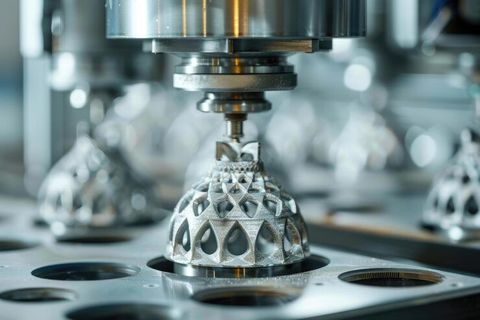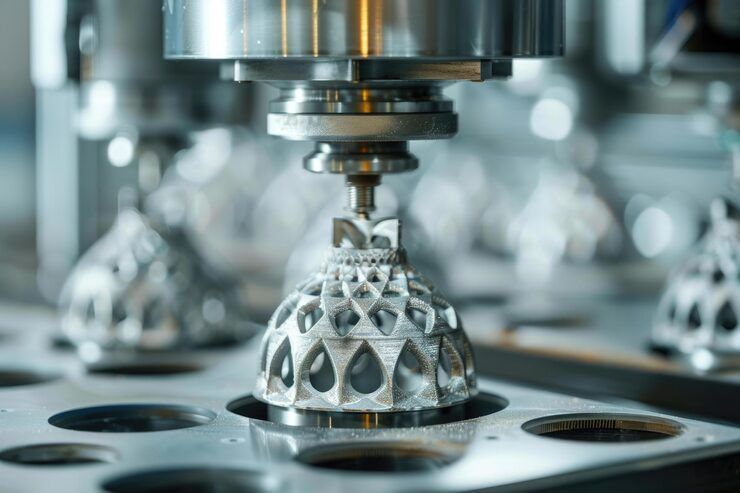
Industrial 3D printing, also known as additive manufacturing, is a process that creates physical objects by building them layer by layer from digital designs. Unlike traditional manufacturing methods that remove material (such as cutting or drilling), this approach adds material only where needed.
This technology emerged to address limitations in conventional production methods. Traditional manufacturing often requires molds, tooling, and long setup times. Industrial 3D printing reduces these constraints by allowing direct production from digital files.
It is widely used in industries such as aerospace, automotive, healthcare, and electronics. Engineers and designers rely on it to produce complex shapes that are difficult or impossible to achieve with traditional techniques.
Common materials used include:
- Metals such as titanium and aluminum
- Polymers and high-performance plastics
- Composite materials
- Ceramics
The process typically involves:
- Designing a 3D model using CAD software
- Converting the design into a printable format
- Layer-by-layer printing using specialized machines
- Post-processing such as cleaning or finishing
This approach simplifies production workflows and supports rapid design changes without major delays.
Why Industrial 3D Printing Matters Today
Industrial 3D printing plays a significant role in modern manufacturing due to its flexibility and efficiency. It helps organizations respond quickly to changing demands and supports innovation across multiple sectors.
One key advantage is the ability to produce complex geometries without additional tooling. This reduces design constraints and allows engineers to optimize products for performance rather than manufacturability.
Another important benefit is reduced material waste. Since the process only uses the material required for each layer, it is more efficient compared to subtractive methods.
Industries that benefit include:
- Aerospace for lightweight components
- Healthcare for customized medical devices
- Automotive for prototyping and spare parts
- Energy sector for durable components
The technology also supports:
- Faster prototyping cycles
- Shorter production timelines
- Improved supply chain flexibility
- On-demand manufacturing
Below is a simple comparison between traditional manufacturing and industrial 3D printing:
| Feature | Traditional Manufacturing | Industrial 3D Printing |
|---|---|---|
| Material Usage | Higher waste | Efficient usage |
| Design Complexity | Limited | Highly flexible |
| Setup Time | Longer | Shorter |
| Customization | Limited | High |
| Production Speed (small runs) | Slower | Faster |
These advantages make it particularly useful in situations where customization, precision, and rapid iteration are required.
Recent Updates and Trends in Industrial 3D Printing
Over the past year, industrial 3D printing has seen several important developments. As of 2025, advancements in materials, software, and machine capabilities continue to expand its applications.
One major trend is the improvement in metal 3D printing technologies. New systems now offer better precision and faster production speeds, making them more suitable for industrial-scale manufacturing.
Another key development is the integration of artificial intelligence and automation. These tools help optimize print quality, reduce errors, and improve efficiency in production workflows.
Recent trends include:
- Expansion of large-scale 3D printing systems for construction and infrastructure
- Increased adoption in healthcare for personalized implants and devices
- Development of sustainable materials such as biodegradable polymers
- Improved simulation software for design validation before printing
In 2024–2025, many manufacturers also focused on digital supply chains. This approach allows companies to store designs digitally and produce components closer to where they are needed, reducing transportation challenges.
Additionally, hybrid manufacturing systems are gaining attention. These systems combine additive and traditional methods to enhance overall production capabilities.
Laws, Policies, and Regulatory Considerations
Industrial 3D printing is influenced by various regulations and standards, especially in industries where safety and precision are critical. Governments and international organizations have introduced guidelines to ensure quality and reliability.
Key regulatory areas include:
- Material safety standards
- Product certification requirements
- Intellectual property protection
- Environmental compliance
In India, manufacturing technologies including additive manufacturing are supported under initiatives such as the National Strategy for Additive Manufacturing (NSAM) introduced by the government. This strategy aims to promote research, innovation, and adoption of 3D printing technologies across industries.
Globally, standards organizations such as ISO and ASTM have developed frameworks for additive manufacturing processes. These standards help ensure consistency in production and testing.
Regulations often vary depending on the application:
- Medical devices require strict validation and certification
- Aerospace components must meet high safety standards
- Industrial parts must comply with quality assurance guidelines
Organizations adopting industrial 3D printing must stay updated with these regulations to ensure compliance and maintain product reliability.
Tools and Resources for Industrial 3D Printing
A wide range of tools and resources support the implementation and understanding of industrial 3D printing. These tools help with design, simulation, and production management.
Common categories include:
Design Software
- CAD tools for creating 3D models
- Simulation software for testing designs
- Topology optimization tools
Slicing Software
- Converts 3D models into printable layers
- Adjusts print settings such as speed and temperature
Material Databases
- Provide information on material properties
- Help in selecting suitable materials for specific applications
Learning Resources
- Online courses and tutorials
- Industry reports and research papers
- Technical documentation from manufacturers
Digital Platforms
- File-sharing platforms for 3D models
- Collaboration tools for engineering teams
- Cloud-based manufacturing solutions
Below is a simplified table of tool categories and their purpose:
| Tool Category | Purpose |
|---|---|
| CAD Software | Design and modeling |
| Slicing Tools | Preparing files for printing |
| Simulation Software | Testing performance and durability |
| Material Databases | Selecting appropriate materials |
| Cloud Platforms | Managing digital manufacturing workflows |
These resources help improve accuracy, efficiency, and collaboration in industrial 3D printing processes.
Frequently Asked Questions
What is the main difference between 3D printing and traditional manufacturing?
Traditional manufacturing removes material to shape an object, while 3D printing builds objects layer by layer using digital designs.Is industrial 3D printing suitable for mass production?
It is more commonly used for small to medium production runs and complex parts. However, advancements are gradually improving its scalability.What materials are commonly used in industrial 3D printing?
Materials include metals, plastics, composites, and ceramics, depending on the application and required properties.How accurate is industrial 3D printing?
Modern systems offer high precision, especially in industries like aerospace and healthcare, where accuracy is critical.Does industrial 3D printing reduce environmental impact?
It can reduce material waste and support efficient production, but the overall impact depends on materials and energy usage.Conclusion
Industrial 3D printing has become an important part of modern manufacturing by offering flexibility, efficiency, and innovation. It addresses many challenges associated with traditional production methods, including design limitations and material waste.
With continuous advancements in technology, materials, and software, its applications are expanding across industries. At the same time, regulatory frameworks and standards are evolving to ensure safety and quality.
As manufacturing continues to shift toward digital and sustainable practices, industrial 3D printing is expected to play a key role in shaping future production systems.