Artificial intelligence (AI) is changing how businesses plan, manage, and monitor supply chains. A supply chain includes the activities required to move raw materials, components, and finished products from their sources to their final destinations. These activities involve manufacturers, suppliers, warehouses, transportation networks, distributors, and retailers.
Traditional supply chain management often relies on historical reports, manually updated spreadsheets, and fixed planning assumptions. These approaches can become difficult to maintain when demand changes quickly, transportation routes are disrupted, or suppliers experience delays.
AI in supply chain optimization uses data analysis, machine learning, forecasting models, and automated decision-support systems to improve planning and coordination. The technology can help organizations estimate future demand, manage inventory, identify transportation bottlenecks, and recognize potential disruptions.
AI does not eliminate the need for experienced planners. Instead, it can help them process large amounts of information and evaluate possible decisions more efficiently.
Understanding AI-Powered Supply Chain Management
AI-powered supply chain management combines operational data with analytical models to support planning and execution.
Machine learning systems can identify patterns in historical demand, delivery times, production output, and inventory movements. Predictive analytics uses these patterns, together with relevant current information, to estimate future conditions.
Common applications include:
Demand forecasting: Estimating future product requirements.
Inventory optimization: Determining appropriate stock levels for different locations.
Route optimization: Evaluating delivery routes, traffic conditions, and transportation constraints.
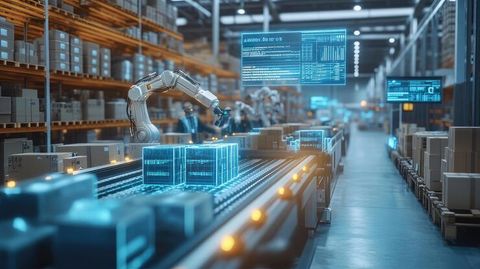
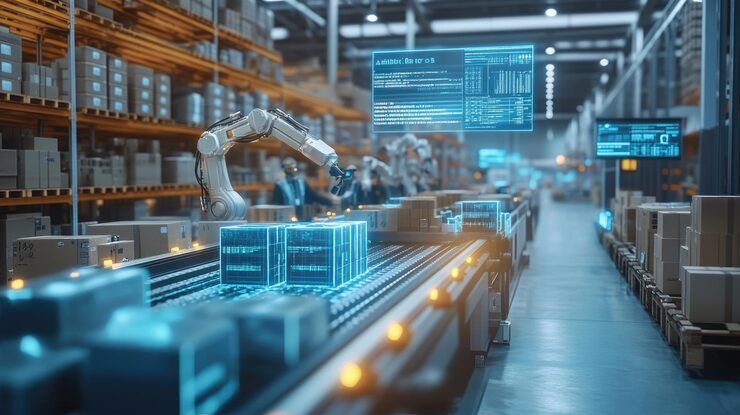
Warehouse automation: Supporting inventory identification, picking, sorting, and movement.
Supplier risk analysis: Identifying potential delays or weaknesses in supply networks.
Production planning: Coordinating materials, equipment capacity, and manufacturing schedules.
Predictive maintenance: Identifying equipment patterns that may indicate an increased likelihood of failure.
These applications can operate separately or within an integrated supply chain management platform.
How AI Optimization Works
An AI-based supply chain system generally follows a structured process.
First, it collects information from enterprise resource planning systems, warehouse management software, transportation records, supplier databases, and inventory systems.
Next, the data is cleaned and standardized. This step is important because missing records, inconsistent product codes, and outdated information can reduce the reliability of predictions.
Analytical models then identify patterns or generate forecasts. Planning software can use these results to evaluate possible actions, such as adjusting inventory allocations or changing delivery schedules.
Finally, planners review the recommendations, implement appropriate decisions, and compare actual outcomes with earlier predictions.
Why AI in Supply Chain Optimization Matters
AI can help organizations respond to changing customer demand, transportation delays, supplier disruptions, and unexpected production problems. These challenges affect manufacturers, retailers, logistics companies, wholesalers, and businesses operating across international markets.
Improving Inventory Management
Inventory forecasting helps businesses estimate how much stock they need at different locations. AI models can analyze historical sales, seasonal patterns, lead times, and market changes to identify potential shortages or excess inventory.
Better forecasting can support decisions about replenishment schedules and warehouse capacity. However, forecasts remain estimates, and unexpected events can still produce inaccurate results.
Reducing Transportation Inefficiencies
AI-powered logistics optimization can evaluate delivery routes, vehicle capacity, traffic conditions, fuel consumption, and delivery deadlines.
Potential applications include:
Selecting suitable delivery routes
Grouping shipments with compatible destinations
Improving vehicle utilization
Identifying recurring delivery delays
Estimating arrival times
Evaluating alternative transportation arrangements
The actual results depend on data quality, network complexity, and the ability to implement recommendations.
Managing Supply Chain Risks
Predictive analytics can help organizations identify warning signs such as supplier delays, unusual demand changes, production interruptions, or inventory shortages.
Risk models can combine internal operational data with external information, including weather conditions, transportation disruptions, and relevant market indicators.
These insights can help planners evaluate alternatives before a disruption affects customers or production schedules.
Recent Developments in AI Supply Chain Technology
During 2025 and 2026, AI development increasingly focused on practical business applications, data security, and responsible deployment.
Greater Use of AI Agents
AI agents are being developed to perform connected tasks within business workflows. In supply chain management, potential applications include monitoring inventory exceptions, preparing supplier summaries, comparing shipment options, and assisting with procurement planning.
These systems can support routine decisions, but actions involving significant financial, operational, or contractual consequences should have suitable approval controls.
Greater Attention to AI Data Security
In May 2025, the US National Security Agency's Artificial Intelligence Security Center and partner organizations published guidance on protecting data used to train, test, and operate AI systems.
This development highlights the importance of data integrity, access controls, and cybersecurity when AI becomes part of business-critical operations.
Regulatory Developments in 2026
On August 2, 2026, major provisions of the European Union's AI Act became applicable, including relevant transparency requirements and enforcement arrangements. Some high-risk AI obligations follow later implementation dates under the updated framework.
For supply chain organizations, the implications depend on how an AI system is used, its risk classification, and whether the organization falls within the regulation's scope.
These developments demonstrate that adopting AI involves both technical implementation and appropriate governance.
Laws, Policies, and Responsible AI Use
AI in supply chain optimization is affected by regulations governing data protection, cybersecurity, product safety, transportation, competition, and industry-specific operations. The exact requirements depend on the countries in which an organization operates.
Data Protection and Privacy
Supply chain systems can process employee information, supplier records, delivery addresses, customer details, and commercial data.
Organizations should apply appropriate data protection requirements, including relevant privacy laws such as the European Union's General Data Protection Regulation where applicable.
Data minimization, access restrictions, retention policies, and secure data sharing can reduce privacy risks.
Artificial Intelligence Regulation
The EU AI Act uses a risk-based framework for regulating AI systems. Its requirements vary according to the system's intended purpose and risk classification.
Not every inventory forecasting or route-planning system automatically qualifies as high-risk. Organizations should assess the specific use case and applicable legal requirements rather than assuming all AI applications follow identical rules.
Cybersecurity and Operational Safety
AI systems connected to warehouses, transportation networks, and production equipment can create additional cybersecurity risks.
Responsible implementation should include:
Secure user authentication
Restricted access to sensitive data
Monitoring of automated decisions
Protection against unauthorized system changes
Regular software updates
Human review of critical recommendations
Backup procedures for system failures
Organizations should also consider the consequences of incorrect forecasts or automated decisions before allowing systems to operate without supervision.
Tools and Resources for AI Supply Chain Optimization
Several categories of technology can support supply chain planning and analysis.
Supply Chain Management Software
Enterprise resource planning, warehouse management, and transportation management platforms help organizations coordinate inventory, production, storage, and distribution.
AI capabilities may be integrated into these systems or connected through separate analytical tools.
Forecasting and Analytics Tools
Data analytics platforms can help teams analyze historical sales, demand variability, delivery performance, and inventory movements.
Useful functions include:
Demand forecasting
Inventory analysis
Delivery performance monitoring
Supplier risk assessment
Scenario planning
Operational dashboards
Planning Checklist
Evaluation Area | Key Question |
|---|---|
Data quality | Are operational records complete and accurate? |
Forecasting | Can the model account for seasonality and demand changes? |
Integration | Can the system exchange information with existing software? |
Security | Are sensitive records appropriately protected? |
Performance | Are forecast errors and delivery outcomes measured? |
Oversight | Can staff review and override recommendations? |
Compliance | Have relevant legal obligations been assessed? |
A pilot project can help an organization evaluate model accuracy and operational suitability before expanding deployment across the entire supply chain.
Frequently Asked Questions
What is AI in supply chain optimization?
It is the use of artificial intelligence, machine learning, and predictive analytics to improve planning, inventory control, transportation, production scheduling, and supply chain risk management.
How does AI improve inventory forecasting?
AI models analyze historical demand, seasonality, lead times, and other relevant information to estimate future inventory requirements. Forecast accuracy depends on data quality and changing market conditions.
Can AI reduce supply chain disruptions?
AI can help identify potential risks and evaluate alternative plans. It cannot prevent every disruption, particularly when unexpected events occur or reliable data is unavailable.
Which industries use AI-powered supply chain management?
Manufacturing, retail, automotive, healthcare, agriculture, electronics, food distribution, and logistics are among the industries that can use AI to support supply chain planning.
Is AI suitable for small businesses?
AI can be useful for smaller organizations when the application addresses a clear operational problem and the required data is available. A focused forecasting or inventory analysis project may be more practical than introducing a complex system across every business function.
Conclusion
AI in supply chain optimization helps organizations analyze operational data, forecast demand, manage inventory, improve transportation planning, and identify potential disruptions. Its value comes from supporting informed decisions rather than guaranteeing specific business outcomes.
Recent developments in AI agents, data security, and regulatory oversight demonstrate the need to balance automation with reliability, transparency, and human supervision.
Organizations considering AI should begin with a clearly defined operational challenge, evaluate data quality, measure performance, and establish appropriate security and governance controls. When implemented carefully, AI can become a useful component of modern supply chain management and long-term operational planning.