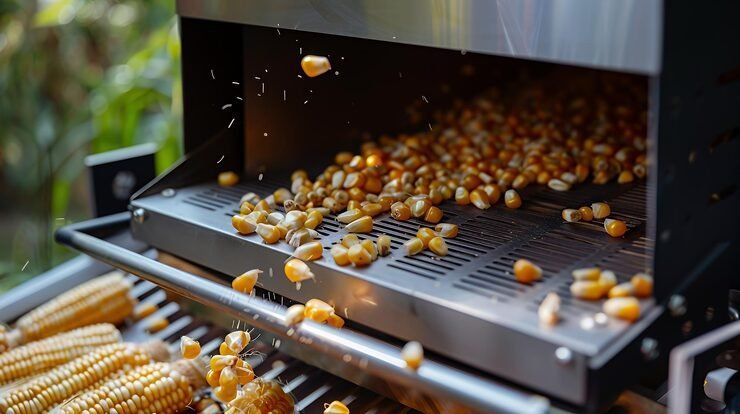
Corn processing equipment consists of industrial machines and integrated production systems used to clean, condition, mill, grind, separate, dry, and transform corn into food ingredients, animal feed, starch, flour, grits, meal, and other products. Modern systems combine mechanical processing, thermal treatment, separation, conveying, and automation technologies.
Equipment configuration varies according to the desired corn product, raw-material characteristics, production capacity, and processing method.
What Is Corn Processing Equipment?
Corn processing equipment refers to machinery used throughout the industrial transformation of corn kernels into finished or intermediate products.
A typical processing facility may include:
Grain receiving systems
Cleaning machines
Destoners
Magnetic separators
Corn dryers
Degerminators
Milling machines
Roller mills
Hammer mills
Sifters
Pneumatic conveying systems
Packaging equipment
Some facilities use individual machines for specific operations, while larger plants integrate multiple machines into continuous production lines.
Major Corn Processing Technologies
Cleaning and Separation Technology
Cleaning systems remove dust, stones, metal particles, husks, broken kernels, and other unwanted material. Screens, aspirators, magnets, and destoners can be combined according to feedstock conditions.
Degermination
Degermination separates the germ from the endosperm and outer portions of the kernel. This process is important in the production of products such as corn meal, grits, and flour.
Milling Technology
Milling reduces cleaned and conditioned corn into particles of controlled size. Different milling systems are selected according to the desired final product.
Dry Milling
Dry milling processes corn without extensive water-based separation. It can produce products such as corn flour, meal, grits, and other milled fractions.
Wet Milling
Wet milling uses water and controlled separation processes to divide corn into components such as starch, germ, fiber, and protein. It is commonly associated with large-scale starch and corn-ingredient production.
Grinding Technology
Grinding equipment reduces corn into smaller particles for food processing, animal feed, and other applications. Hammer mills, roller mills, and specialized grinding systems can be selected according to particle-size requirements.
Major Types of Corn Processing Machines
| Machine Type | Primary Function | Typical Application |
|---|---|---|
| Grain Cleaner | Removes impurities | Initial cleaning |
| Destoner | Separates stones | Grain preparation |
| Magnetic Separator | Removes ferrous particles | Material cleaning |
| Corn Dryer | Reduces moisture | Grain conditioning |
| Degerminator | Separates germ | Milling preparation |
| Roller Mill | Produces controlled particle sizes | Flour and meal |
| Hammer Mill | Fine or coarse grinding | Feed and food processing |
| Plansifter | Separates milled particles | Flour production |
| Purifier | Separates fractions | Milling |
| Packaging Machine | Packs finished products | Final processing |
Corn Processing Production Process
The exact process depends on the final product, but a typical industrial workflow includes several stages.
1. Corn Receiving
Raw corn arrives at the processing facility and is unloaded into receiving systems. Sampling and inspection can be performed to evaluate moisture, foreign material, and other quality parameters.
2. Cleaning
The grain passes through screens, aspiration systems, magnets, and destoners to remove unwanted materials.
3. Conditioning
Corn may undergo moisture adjustment or controlled conditioning before milling. This helps prepare the kernel for subsequent separation and size reduction.
4. Degermination
For processes requiring separation of the germ, specialized equipment removes the germ from the kernel while preparing the remaining material for milling.
5. Milling and Grinding
Prepared corn enters milling or grinding equipment. The machine configuration depends on whether the desired product is flour, meal, grits, feed material, or another fraction.
6. Sifting and Separation
Screens and sifters classify particles according to size. Additional separation equipment may be used to achieve the desired product specification.
7. Drying
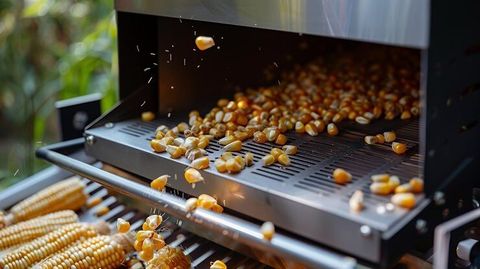
Where required, thermal drying reduces moisture to an appropriate level for storage, further processing, or packaging.
8. Packaging
Finished corn products can be transferred into bags, bulk containers, cartons, or other packaging formats using automated or semi-automated packaging systems.
Automation in Corn Processing
Modern industrial corn processing equipment increasingly uses automation to coordinate production stages and monitor operating conditions.
Common technologies include:
PLC-based controls
Industrial sensors
Automated conveying
Temperature monitoring
Moisture measurement
Motor control systems
Automated weighing
Process monitoring software
Machine alarms
Data collection systems
Automation can help maintain consistent material flow and processing conditions while reducing manual intervention.
Global Manufacturers and Suppliers
The global corn processing equipment sector includes manufacturers specializing in grain cleaning, milling, grinding, separation, drying, conveying, and complete processing plants.
When evaluating manufacturers and suppliers, important considerations include:
Processing capacity
Corn product requirements
Milling technology
Particle-size range
Automation capabilities
Energy consumption
Equipment footprint
Maintenance requirements
Spare-parts availability
Production-line integration
Equipment should be selected according to the intended product and raw-material characteristics rather than capacity alone.
Industrial Applications
Corn processing equipment supports numerous industries.
Food Processing
Corn milling systems produce flour, meal, grits, and other ingredients used in food manufacturing.
Animal Feed
Grinding and milling systems prepare corn for use as an ingredient in animal-feed formulations.
Starch Production
Wet-processing systems separate starch and other kernel components for downstream industrial and food applications.
Corn-Based Ingredients
Processed corn can be converted into ingredients used across food, beverage, fermentation, and other manufacturing sectors.
Industrial Processing
Corn-derived materials can also enter specialized industrial processes where starch, oil, protein, fiber, or other fractions are required.
How to Select Corn Processing Equipment
Choosing suitable machinery requires evaluating the complete processing workflow.
Raw-material quality: Moisture, kernel characteristics, impurities, and storage conditions can affect equipment requirements.
Final product: Flour, meal, grits, starch, feed material, and other products require different processing configurations.
Production capacity: Determine the required throughput in tonnes or kilograms per hour.
Processing method: Decide whether dry milling, wet milling, grinding, or a combination of technologies is appropriate.
Particle size: Milling and separation equipment should be matched to the required particle-size distribution.
Automation: Consider the required level of process monitoring, control, and material handling.
Energy requirements: Motors, dryers, fans, pneumatic systems, and other equipment contribute to overall energy consumption.
Maintenance: Evaluate accessibility, wear components, cleaning requirements, and spare-parts availability.
Frequently Asked Questions
What machines are used for corn processing?
Common machines include grain cleaners, destoners, magnetic separators, dryers, degerminators, roller mills, hammer mills, sifters, purifiers, conveyors, and packaging systems.
What is corn processing equipment used for?
Corn processing equipment transforms raw corn into products such as flour, meal, grits, feed ingredients, starch, and other processed corn materials.
What is the difference between dry and wet corn milling?
Dry milling primarily processes corn through mechanical cleaning, degermination, milling, and separation. Wet milling uses water-based separation to recover components such as starch, germ, fiber, and protein.
Why is corn degermination important?
Degermination separates the germ from other parts of the corn kernel. It can improve the suitability of the remaining material for producing specific milled products and can allow the germ to be processed separately.
What factors affect corn processing equipment selection?
The major factors include raw-corn characteristics, desired product, production capacity, processing method, particle-size requirements, automation, energy consumption, factory layout, and maintenance needs.
Conclusion
Corn processing equipment integrates cleaning, separation, conditioning, milling, grinding, drying, classification, conveying, and packaging technologies. Depending on the production objective, facilities can use dry milling, wet milling, or specialized processing systems to transform corn into food ingredients, feed materials, starch, and other products.
Understanding processing technologies, machine types, production stages, automation, and supplier considerations provides a foundation for developing a corn processing system aligned with specific production requirements.