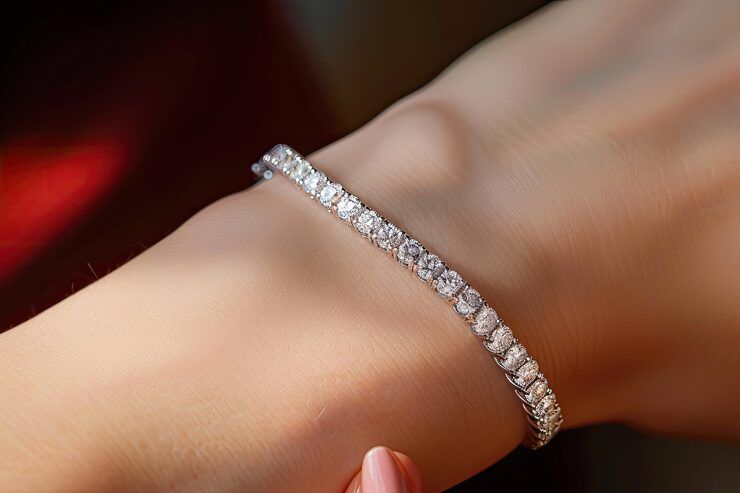
Diamond tennis bracelets are flexible jewellery pieces featuring a continuous or near-continuous row of diamonds arranged along a narrow metal bracelet. Their defining characteristic is the repeated diamond pattern, which creates a consistent line of sparkle around the wrist.
The style became widely recognized after American tennis champion Chris Evert wore a diamond bracelet during a 1987 US Open match. Her bracelet reportedly broke during play, and she asked officials to pause the match while it was recovered. The incident contributed to the popular use of the term “tennis bracelet.”
Today, tennis bracelets can contain natural diamonds, laboratory-grown diamonds, or other gemstones. They are commonly made with gold, platinum, or other precious-metal settings.
How a Tennis Bracelet Is Constructed
A typical tennis bracelet consists of several small gemstone settings connected by flexible joints. The construction allows the bracelet to follow the shape of the wrist rather than remaining rigid.
Common setting styles include:
Prong settings
Bezel settings
Shared-prong settings
Channel-style settings
Bar or edge settings
Prong settings allow more of the diamond's surface to remain visible, while bezel or enclosed designs can provide additional protection to individual stones.
Diamond Characteristics
Diamond quality is commonly discussed using the 4Cs:
Cut: Influences how effectively a diamond reflects light.
Color: Describes the degree of body color in a white diamond.
Clarity: Describes internal and external characteristics.
Carat weight: Measures the diamond's weight.
For a tennis bracelet, the overall appearance depends not only on individual diamond quality but also on consistency across the entire row.
| Factor | Relevance to Tennis Bracelets |
|---|---|
| Diamond cut | Influences brightness and visual appearance |
| Color | Helps maintain a consistent appearance |
| Clarity | Indicates internal and surface characteristics |
| Carat weight | Determines individual and total diamond weight |
| Setting | Holds and protects each diamond |
| Metal | Provides the structural framework |
| Bracelet flexibility | Influences wrist fit and movement |
| Clasp | Helps secure the bracelet |
Why Diamond Tennis Bracelets Matter Today
Tennis bracelets occupy an important position within the fine diamond jewellery, diamond bracelet, luxury jewellery, and diamond accessories categories.
Their relatively narrow profile allows them to work as standalone jewellery or as part of a layered bracelet arrangement.
Versatile Jewellery Design
The linear diamond arrangement gives tennis bracelets a recognizable appearance without relying on a large central gemstone. They can therefore complement both formal and minimalist styles.
Variations include:
Single-row diamond bracelets
Double-row designs
Graduated diamond bracelets
Mixed-shape diamond bracelets
Colored gemstone tennis bracelets
Diamond and gemstone combinations
Yellow-gold, white-gold, rose-gold, and platinum versions
Natural and Laboratory-Grown Diamonds
Modern tennis bracelets can use both natural and laboratory-grown diamonds. Laboratory-grown diamonds have essentially the same chemical composition and crystal structure as natural diamonds, although their formation process is different.
The Federal Trade Commission has stated that laboratory-grown diamonds should be accurately described so that consumers understand that they are not mined diamonds. (ftc.gov)
This distinction is important when comparing diamond jewellery because origin and production method are different characteristics from the 4Cs.
Design and Durability
Because a tennis bracelet contains many individual stones and connecting components, construction quality is important.
Important structural features include:
Secure diamond settings
Flexible links
Reliable clasp construction
Safety mechanisms
Appropriate metal thickness
Proper alignment of individual stones
A bracelet that moves constantly against clothing, furniture, or other jewellery can experience gradual wear, making periodic inspection useful.
Recent Diamond Jewellery Trends in 2025–2026
The diamond and jewellery sector experienced notable changes during 2025 and 2026, particularly around laboratory-grown diamonds, consumer preferences, gold prices, and jewellery design.
Laboratory-Grown Diamond Market
The Gemological Institute of America announced in June 2025 that it would change its terminology for laboratory-grown diamonds in its reporting system, moving toward descriptive terms such as “Premium” and “Standard” rather than applying the same grading terminology traditionally used for natural diamonds. The transition began in October 2025. (gia.edu)
The change reflects continued evolution in how laboratory-grown diamonds are documented and communicated within the gemological industry.
Diamond Market Conditions
The natural diamond market continued to experience significant structural changes during 2025 and 2026. At the same time, laboratory-grown diamonds expanded their presence in jewellery.
For tennis bracelets, this means consumers may encounter designs using natural diamonds, laboratory-grown diamonds, or mixtures of different gemstone materials.
Lightweight Jewellery
High gold prices have also influenced jewellery design. The World Gold Council reported in 2026 that jewellery demand volumes had weakened in several markets while jewellery demand values remained comparatively high. Lightweight jewellery became one adaptation to elevated gold prices. (gold.org)
This can influence tennis-bracelet construction through slimmer metal links, smaller individual stones, and designs focused on efficient material use.
Personalization and Layering
Contemporary jewellery styling increasingly combines multiple bracelets with different widths, textures, metals, and gemstones.
A tennis bracelet can function as a central piece within a layered arrangement or as a relatively subtle standalone bracelet.
Laws, Hallmarking and Jewellery Policies in India
India provides an important regulatory example because gold and silver jewellery in covered categories are subject to BIS hallmarking requirements.
Hallmarking relates primarily to precious-metal purity. It does not certify the quality, origin, or treatment of the diamonds in a tennis bracelet.
BIS Gold Hallmarking
The Bureau of Indian Standards states that hallmarking provides an official indication of precious-metal content. Applicable gold jewellery can carry the BIS logo, fineness information, and a six-digit Hallmark Unique Identification number. (bis.gov.in)
Recognized gold fineness grades include:
14K — 585
18K — 750
20K — 833
22K — 916
23K — 958
24KS — 995
Therefore, an 18K gold tennis bracelet and a 14K gold tennis bracelet have different metal-purity specifications even when their diamond arrangement looks similar.
Recent Hallmarking Developments
BIS's mandatory-hallmarking framework continued to be updated during 2025 and 2026. The BIS page lists amendments dated July 31, 2025, March 2, April 28, and August 3, 2026. (bis.gov.in)
On March 2, 2026, BIS announced an additional seven districts under the sixth phase of mandatory hallmarking coverage. (bis.gov.in)
Because hallmarking coverage and requirements can change, current BIS information should be consulted for the applicable location and jewellery category.
Diamond Documentation
Diamond documentation is separate from gold hallmarking. A gemological laboratory report can identify characteristics such as natural or laboratory-grown origin and provide information about relevant diamond properties.
For a tennis bracelet containing many diamonds, documentation may address individual stones, groups of stones, or the overall piece depending on the laboratory and jewellery configuration.
Tools and Resources for Diamond Tennis Bracelets
Evaluating a diamond tennis bracelet involves understanding diamond characteristics, metal purity, dimensions, setting construction, and documentation.
Useful Resources
GIA Diamond Grading Reports: Provide information about diamond characteristics.
GIA education resources: Explain diamond cut, color, clarity, carat weight, treatments, and laboratory-grown diamonds.
BIS Care App: Can be used to verify HUID information for applicable hallmarked gold jewellery in India.
BIS Hallmarking Portal: Provides current information about India's hallmarking framework.
Jewellery measurement tools: Help determine bracelet length and link dimensions.
Digital calipers: Useful for measuring stone and setting dimensions.
Diamond carat calculators: Help explain relationships between dimensions and approximate carat weight.
Diamond proportion references: Useful for understanding cut characteristics.
Jewellery inspection loupes: Allow close examination of settings and stones.
Gemological reports: Provide independent information about gemstone characteristics.
Measurements Worth Comparing
When evaluating a diamond tennis bracelet, useful specifications include:
Total diamond carat weight
Number of diamonds
Average stone size
Diamond shape
Color range
Clarity range
Metal purity
Bracelet length
Bracelet width
Setting type
Clasp construction
Safety mechanism
Laboratory documentation
Total carat weight should not be confused with the quality of individual diamonds. Two bracelets with similar total carat weight can have significantly different stone sizes, proportions, color, clarity, and design.
Frequently Asked Questions
What is a diamond tennis bracelet?
A diamond tennis bracelet is a flexible bracelet containing a continuous or near-continuous row of diamonds set into a precious-metal framework. It is designed to follow the shape of the wrist.
Why is it called a tennis bracelet?
The name became associated with tennis player Chris Evert after an incident during the 1987 US Open in which her diamond bracelet reportedly broke during a match. She asked for the match to be paused while the bracelet was recovered.
Can tennis bracelets contain laboratory-grown diamonds?
Yes. Tennis bracelets can use laboratory-grown diamonds as well as natural diamonds. The two types differ primarily in their formation origin, while laboratory-grown diamonds have essentially the same chemical composition and crystal structure as natural diamonds.
What should be considered when evaluating a tennis bracelet?
Important factors include diamond quality, total carat weight, individual stone size, setting construction, metal purity, bracelet length, clasp security, flexibility, and available documentation.
Does a BIS hallmark certify the diamonds in a tennis bracelet?
No. A BIS hallmark concerns the purity of the precious-metal component. It does not certify diamond origin, color, clarity, cut, treatment, or laboratory-grown versus natural origin. (bis.gov.in)
Conclusion
Diamond tennis bracelets combine repeated gemstone settings with a flexible metal structure, creating a jewellery format that has remained recognizable for decades. Their design can range from simple single-row arrangements to elaborate combinations involving different diamond shapes, gemstones, metals, and setting styles.
Modern tennis bracelets also reflect changes occurring across the wider diamond industry. Laboratory-grown diamonds have become an established category, while gemological organizations have continued developing approaches for documenting and describing them. (gia.edu)
Gold-market conditions have also encouraged greater attention to lightweight jewellery, potentially influencing bracelet proportions and metal construction. (gold.org)
For anyone researching diamond tennis bracelets, the most useful approach is to examine the diamonds, metal, setting, flexibility, clasp, dimensions, and documentation together rather than relying on a single specification.
In India, BIS hallmarking provides an important way to identify the purity of applicable precious-metal components, while independent gemological documentation addresses separate questions about the diamonds themselves.
The enduring appeal of tennis bracelets comes from their balance of geometric consistency, flexible construction, diamond repetition, and adaptability across both traditional and contemporary jewellery design.