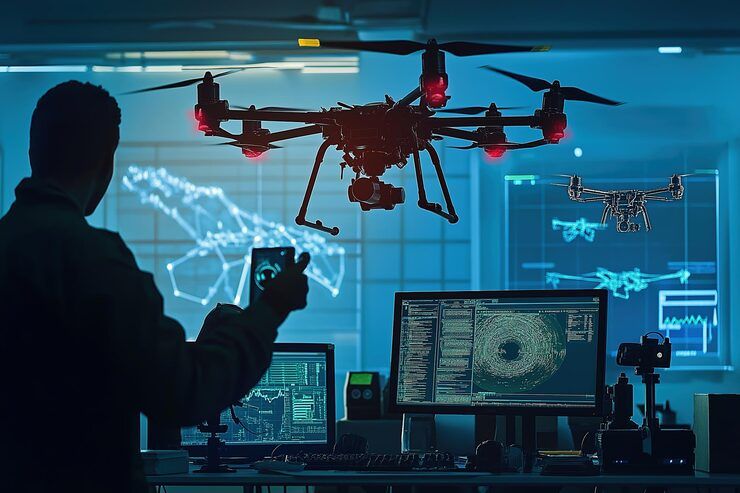
Drone data transmission security refers to the methods used to protect information exchanged between an unmanned aerial vehicle (UAV), its remote controller, ground control station, and connected systems. This information can include flight commands, navigation coordinates, telemetry, photographs, video streams, sensor readings, and operational records.
Modern drones are used in agriculture, construction, infrastructure inspections, environmental monitoring, emergency response, logistics research, and aerial photography. These applications depend on reliable communication links to transmit information and maintain appropriate control of the aircraft.
However, wireless communication introduces cybersecurity risks. An inadequately protected connection may expose sensitive information, allow unauthorized access, or create opportunities for interference with drone operations. Drone data transmission security combines encryption, authentication, secure network configuration, access controls, and continuous monitoring to reduce these risks.
Understanding Drone Communication Systems
A typical drone communication system contains several interconnected components. Each component has a different role and may require separate security controls.
The aircraft contains onboard electronics, navigation systems, sensors, and communication equipment. A remote controller or ground station sends commands and receives operational information. Some systems also communicate with cloud platforms, mobile applications, mapping software, or enterprise data systems.
Common communication channels include:
Radio-frequency links between the aircraft and controller
Wi-Fi connections for configuration or local data transfer
Cellular networks for supported long-range applications
Satellite communication in specialized operations
Cloud connections for data storage and analysis
Bluetooth connections for certain peripheral devices
The security requirements depend on the communication technology, operating environment, sensitivity of the data, and consequences of a connection failure.
Common Security Risks
Drone systems can face several cybersecurity threats.
Unauthorized access: Weak authentication or exposed interfaces may allow an unauthorized person to access a controller, application, or connected system.
Data interception: Information transmitted without adequate encryption may be exposed to someone monitoring the communication channel.
Signal interference: Radio-frequency interference can disrupt communications between a drone and its controller.
Spoofing: False signals or fabricated information may mislead a receiver when appropriate authentication and validation controls are absent.
Malware and compromised software: Infected applications, outdated firmware, or compromised computers can introduce risks into the drone operating environment.
Cloud account compromise: Weak passwords, stolen credentials, or improperly configured cloud storage can expose collected photographs, flight records, and other sensitive information.
These risks require different countermeasures. Encryption can protect confidentiality, but it does not by itself prevent radio interference, equipment failure, or every form of unauthorized control.
How Drone Data Transmission Security Works
A secure drone communication architecture generally combines multiple protective measures.
Encryption: Encryption converts readable information into a protected format that requires the appropriate cryptographic key to recover. Modern systems may use established algorithms such as AES, depending on the platform and protocol.
Authentication: Authentication verifies that communicating devices or users are authorized to participate in a connection. It can help prevent unauthorized devices from impersonating legitimate controllers.
Integrity protection: Cryptographic message authentication can help detect whether transmitted information has been altered.
Access control: Permissions limit who can operate a drone, change settings, view collected information, or administer connected systems.
Secure software updates: Authenticated firmware updates help reduce the risk of installing unauthorized or modified software.
Monitoring and logging: Flight records, authentication events, and communication alerts can help identify suspicious activity and support incident investigations.
A strong security design applies these controls across the aircraft, controller, ground station, mobile application, and connected data infrastructure.
Why Drone Data Security Matters
Drone data transmission security is important because drones increasingly collect information that can be operationally sensitive, commercially valuable, or personally identifiable.
Protecting Sensitive Information
Surveying drones may capture maps, infrastructure layouts, industrial facilities, or detailed aerial imagery. Agricultural systems can collect field measurements and crop information, while inspection drones may record the condition of bridges, power installations, and other critical assets.
Appropriate encryption, restricted access, and secure storage help reduce the risk of unauthorized disclosure.
Maintaining Operational Reliability
A drone depends on communication for many functions, including receiving commands and transmitting telemetry. Security planning therefore needs to consider availability and safety as well as confidentiality.
A reliable design should define what the aircraft does when communication is interrupted, such as following a configured return-to-home procedure, holding position when appropriate, or landing safely according to the platform's capabilities and operating conditions.
Supporting Enterprise Cybersecurity
Organizations using multiple drones need consistent policies for device registration, software updates, account management, data retention, and incident response.
Security controls should also account for third-party applications and cloud platforms because vulnerabilities may exist outside the aircraft itself.
Recent Developments in Drone Cybersecurity
During 2025 and 2026, cybersecurity discussions involving unmanned aircraft increasingly focused on supply-chain risk, secure communications, software integrity, and the protection of sensitive data.
Growing Attention to Connected Systems
Drone platforms increasingly connect with mapping software, cloud storage, artificial intelligence applications, and enterprise information systems. This creates additional opportunities for analysis but also expands the number of systems that must be protected.
Organizations are therefore placing greater emphasis on identity management, device authentication, encryption, and secure application programming interfaces.
Software Supply-Chain Security
Drone security depends partly on the reliability of hardware components, firmware, mobile applications, and third-party libraries. Security teams increasingly examine software provenance, update mechanisms, vulnerability reporting, and the integrity of installed components.
Signed firmware updates and documented software components can help organizations identify unauthorized modifications and manage vulnerabilities more systematically.
Standards-Based Security Planning
The National Institute of Standards and Technology Cybersecurity Framework 2.0, released in February 2024, continues to provide a structured approach to managing cybersecurity risks. Its functions cover Govern, Identify, Protect, Detect, Respond, and Recover.
Although the framework is not a drone-specific law, its principles can help drone operators organize security responsibilities, assess risks, monitor systems, and prepare for incidents.
Because cybersecurity guidance and government requirements can change, organizations should check current advisories from relevant national cybersecurity agencies before deploying sensitive drone systems.
Laws, Regulations, and Security Policies
Drone data transmission security is influenced by aviation regulations, privacy legislation, radio-spectrum rules, and cybersecurity requirements. The applicable framework depends on the country, aircraft category, purpose of operation, and type of information collected.
Aviation Rules in the United States
The Federal Aviation Administration regulates civil drone operations in the United States. Its rules address matters such as aircraft registration, operating limitations, remote identification where applicable, and pilot responsibilities.
FAA aviation rules are not a complete cybersecurity standard. Operators must also consider relevant privacy, communications, and information-security obligations.
Data Protection and Privacy
Drone photographs, video recordings, location records, and other collected information may contain personal or sensitive data.
Depending on the jurisdiction and use case, privacy legislation may establish requirements concerning lawful collection, data minimization, access, retention, disclosure, and security safeguards.
Organizations should determine whether their operations involve personal information and document appropriate handling procedures.
Radio Communications and Cybersecurity
Drone communication systems must operate within applicable spectrum and equipment requirements. In the United States, the Federal Communications Commission regulates radio-frequency equipment and spectrum use.
Organizations should not assume that encryption makes unauthorized transmission frequencies or prohibited interference lawful.
India's Regulatory Context
In India, drone operations are governed by the Drone Rules, 2021, as amended, alongside applicable aviation, spectrum, privacy, and information-security requirements.
Operators should consult the Directorate General of Civil Aviation for current operational requirements and relevant government authorities for applicable data protection and cybersecurity obligations.
Tools and Resources for Drone Security
Several established resources can help organizations evaluate and improve drone cybersecurity.
Cybersecurity Frameworks
The NIST Cybersecurity Framework can help develop a risk-management plan covering device inventory, access control, threat detection, incident response, and recovery.
The OWASP Internet of Things guidance can also help identify common security weaknesses in connected devices and supporting applications.
Encryption and Authentication
Security teams can evaluate established cryptographic libraries and protocols appropriate to their systems. The selection should consider supported hardware, implementation quality, key management, and the capabilities of the drone platform.
Avoid inventing a proprietary encryption algorithm or assuming that a protocol is secure simply because it is not publicly documented.
Monitoring and Documentation
Useful operational resources include:
Device and firmware inventory
Access-control register
Software update records
Encryption and key-management policies
Incident-response procedures
Data-retention schedules
Security assessment checklists
Communication-loss contingency plans
These records help maintain consistent security practices across individual aircraft and larger fleets.
Frequently Asked Questions
What is drone data transmission security?
It is the protection of information exchanged between a drone, its controller, ground station, and connected systems. Common measures include encryption, authentication, integrity checks, access controls, and security monitoring.
Does encryption prevent all drone communication attacks?
No. Encryption helps protect data confidentiality, but it does not eliminate radio interference, hardware failures, compromised devices, or every type of spoofing attack. Multiple security controls are necessary.
Which encryption methods are used for drones?
Depending on the platform, established cryptographic methods such as AES and secure communication protocols may be used. The exact implementation varies, so operators should verify the manufacturer's documented security capabilities rather than assume every drone uses the same protection.
How can organizations protect drone-collected data?
Organizations can restrict access, encrypt data during transmission and storage, maintain secure software updates, use strong authentication, limit retention, and monitor for suspicious activity.
Which regulations apply to drone cybersecurity?
Requirements vary by country and operation. Aviation regulations, radio-spectrum rules, privacy laws, and organizational cybersecurity requirements may all apply. Operators should consult the relevant aviation and cybersecurity authorities for their jurisdiction.
Conclusion
Drone data transmission security is an essential part of responsible unmanned aircraft operation. Protecting communication channels and collected information requires more than encryption alone; it also involves authentication, integrity checks, secure software, access management, monitoring, and well-defined procedures for communication failures.
As drones become more connected to cloud platforms and enterprise systems, security planning must cover the entire technology environment rather than the aircraft alone. Organizations should assess the sensitivity of their data, identify potential threats, apply established security practices, and maintain compliance with relevant aviation, privacy, and communications requirements.
A layered, risk-based approach can help protect sensitive information, improve operational resilience, and support safer drone deployments across industrial, commercial, research, and public-sector applications.