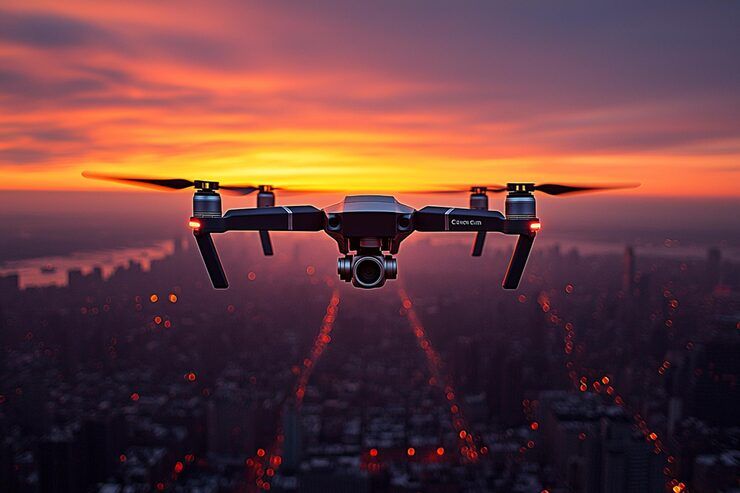
Drones, also known as unmanned aerial vehicles, are aircraft that operate without a human pilot onboard. They exist to perform aerial tasks that are difficult, time-consuming, or risky for manned aircraft. Early drones were developed mainly for military observation, but advancements in electronics, sensors, and navigation systems have expanded their use into many civilian and commercial fields.
Modern drones combine lightweight materials, compact motors, flight controllers, and communication systems. These components work together to enable stable flight, precise navigation, and aerial data collection.
Drone technology extends human capability by allowing remote access to areas that are difficult or unsafe to reach. It supports monitoring, mapping, and data gathering across various environments.
Importance: Why Drone Technology Matters Today
Drone technology is increasingly important as industries rely more on automation and real-time data. Drones provide faster and safer ways to gather information.
Key Reasons for Importance
- Improved aerial visibility for large or remote areas
- Reduced risk in hazardous environments
- Faster data collection compared to manual methods
- Support for precision-based operations
Drones are widely used in agriculture, infrastructure monitoring, environmental studies, and emergency response.
Key Technologies and Features Explained
Modern drones rely on interconnected systems that ensure flight stability, navigation, and data accuracy.
Propulsion and Power Systems
- Electric motors and propellers generate lift
- Rechargeable batteries supply energy
- Power management systems monitor usage
Efficient power systems improve flight time and performance.
Navigation and Control Systems
- GPS and GNSS modules determine position
- Sensors such as gyroscopes and accelerometers maintain balance
- Flight controllers manage stability and movement
These systems ensure smooth and controlled flight.
Imaging and Data Collection
- Cameras capture visual data
- Thermal and multispectral sensors provide advanced analysis
- Data systems store and transmit collected information
These features enable mapping, inspection, and monitoring tasks.
Safety and Redundancy Features
- Return-to-home functions
- Geofencing for restricted areas
- Automatic landing systems
These features enhance operational safety and reliability.
Core Drone Technologies and Their Roles
| Technology | Primary Function | Practical Benefit |
|---|---|---|
| Flight Controller | Stabilizes flight | Smooth movement |
| GPS / GNSS Module | Determines position | Accurate navigation |
| Sensors (IMU, Gyro) | Measures motion | Stable hovering |
| Communication Link | Transfers data and commands | Reliable control |
Recent Updates: Trends and Developments
Drone technology continues to advance with improvements in autonomy and performance.
Key Trends
- AI-based flight assistance and obstacle avoidance
- Improved battery management systems
- Multi-sensor payload integration
- Enhanced GPS and RTK positioning
- Better communication and transmission systems
These developments improve precision, safety, and operational efficiency.
Laws and Policies Affecting Drone Use
Drone operations are regulated to ensure safety and protect public airspace.
Key Regulatory Areas
- Drone registration requirements
- Altitude and distance limits
- Restrictions near sensitive areas
- Operator certification and awareness
These regulations help integrate drones safely into aviation systems.
Tools and Resources for Drone Knowledge
Various tools support learning and safe drone operation.
Helpful Tools and Resources
- Flight planning applications
- Battery and flight time calculators
- Drone simulation software
- Technical documentation
- Aviation authority portals
These resources help users understand drone systems and operate them responsibly.
Feature Adoption Trends in Drone Systems
| Feature Category | Earlier Adoption | Recent Adoption |
|---|---|---|
| Manual Flight Control | High | Moderate |
| Assisted Navigation | Moderate | High |
| Obstacle Avoidance | Limited | Increasing |
| Data Encryption | Low | Moderate |
These trends highlight the shift toward automation and improved system security.
FAQs: Common Questions About Drones
What are drones used for?
Drones are used for aerial observation, mapping, monitoring, and emergency operations.
How do drones stay stable?
They use sensors and flight controllers to adjust motor speed and maintain balance.
What limits drone flight time?
Flight time depends on battery capacity, payload weight, and environmental conditions.
Are drones regulated?
Yes, most countries have aviation rules governing drone operation.
How accurate is drone positioning?
Accuracy varies from standard GPS to high-precision RTK systems.
Conclusion
Drone technology represents a significant advancement in aerial systems by combining navigation, sensors, and power management into compact platforms. These systems support efficient data collection and remote operations across industries.
Recent trends highlight increased automation, improved battery systems, and enhanced data accuracy. Regulations ensure safe and responsible use.
Understanding drone technology helps users operate systems effectively and adapt to evolving advancements in aerial innovation.