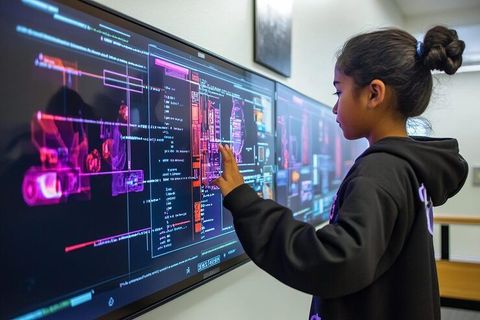
Artificial intelligence can process information in different computing environments. Two important approaches are Edge AI and Cloud AI. Both use artificial intelligence models to analyze data, identify patterns, and generate predictions, but they differ in where computation takes place and how information moves through a system.
Edge AI processes data on or near the device where it is generated. Examples include cameras, industrial controllers, smartphones, connected vehicles, and factory sensors. Cloud AI performs computation on remote infrastructure, typically using data centers with substantial computing resources.
The choice between these approaches depends on factors such as response time, network connectivity, privacy, computing capacity, operating expenses, and the complexity of the AI model. Many modern systems combine both approaches to balance local responsiveness with centralized analysis.
Understanding Edge AI
Edge AI refers to artificial intelligence workloads that run directly on local devices or nearby computing infrastructure. Instead of sending every observation to a remote data center, a system can analyze information close to its source.
For example, an industrial camera may identify a defective product on a production line. A local AI model can analyze the image and trigger an alert without waiting for a round trip to a cloud platform.
Common Edge AI applications include:
Predictive maintenance in manufacturing
Object detection in security cameras
Speech recognition on smartphones
Driver-assistance systems
Smart home automation
Agricultural monitoring
Local quality inspection
Medical-device data analysis
Edge AI can reduce dependence on continuous internet connectivity, although devices may still require network access for updates, centralized reporting, or remote management.
Understanding Cloud AI
Cloud AI uses remote computing infrastructure to train, deploy, or run artificial intelligence models. Data is transmitted to cloud servers, processed, and returned to the application when needed.
Cloud infrastructure can provide access to powerful processors, graphics processing units, specialized AI accelerators, large storage systems, and managed machine learning environments.
Typical applications include:
Large language models
Enterprise data analysis
Recommendation systems
Large-scale image processing
Customer interaction analytics
Centralized fraud detection
AI model training
Business forecasting
Cloud AI is particularly useful when a task requires substantial computing capacity or access to large, frequently updated datasets.
Key Differences Between Edge AI and Cloud AI
| Factor | Edge AI | Cloud AI |
|---|---|---|
| Processing location | Local device or nearby server | Remote data center |
| Response time | Often lower when processing locally | Depends on network and server response |
| Internet dependency | Can operate offline for supported tasks | Usually requires network connectivity |
| Computing capacity | Limited by local hardware | Can access large-scale infrastructure |
| Data movement | Can keep raw data local | Often transfers data to remote systems |
| Updates | Device-level or distributed updates | Centralized deployment is often easier |
| Infrastructure management | Distributed devices require maintenance | Centralized infrastructure management |
| Typical applications | Robotics, sensors, local detection | Large models, analytics, centralized AI |
These are general characteristics rather than absolute rules. Actual performance depends on hardware, model design, network quality, system architecture, and workload requirements.
Why the Difference Matters Today
The growing use of AI in manufacturing, healthcare, transportation, retail, and consumer electronics has made deployment architecture an important technical decision.
Response Time and Reliability
Applications that need immediate responses may benefit from Edge AI. A machine safety system, for example, may need to identify an unsafe condition without depending on a remote connection.
Cloud AI can introduce network latency, but well-designed cloud systems can still support many interactive and operational applications.
Data Privacy and Security
Local processing can reduce the amount of sensitive information transmitted outside a device. This can be useful when analyzing video, audio, location information, or industrial data.
However, Edge AI is not automatically more secure. Local devices may be physically accessible, vulnerable to tampering, or difficult to update consistently. Cloud infrastructure can provide centralized security controls, but transferring and storing data creates additional privacy considerations.
Infrastructure and Operating Expenses
Edge AI may require specialized hardware, local maintenance, power management, and device replacement. Cloud AI involves computing, storage, data transfer, monitoring, and other infrastructure expenses.
Organizations should compare total operating expenses rather than assuming that one architecture is always less expensive.
Model Complexity
Cloud environments can support large AI models that exceed the memory or processing capabilities of small devices. Edge AI generally favors optimized models designed for limited hardware.
Model compression, quantization, and hardware acceleration can help run AI workloads locally while maintaining acceptable accuracy.
Recent Developments in Edge AI and Cloud AI
During 2025 and 2026, AI infrastructure development increasingly emphasized hybrid computing, smaller specialized models, and efficient deployment across different hardware environments.
Smaller Models and Local AI
Smaller language models and optimized machine learning systems have expanded the range of tasks that can run on local devices. Techniques such as quantization reduce the numerical precision used by a model, which can lower memory requirements and improve inference efficiency.
These techniques are particularly relevant to smartphones, embedded computers, industrial gateways, and other devices with limited computing resources.
Hybrid AI Architectures
A growing architectural approach combines local inference with cloud-based model training, analytics, and coordination.
For example, a factory sensor may identify unusual vibration locally and transmit selected information to a cloud platform for longer-term trend analysis. This arrangement can reduce unnecessary data transmission while preserving centralized visibility.
AI Infrastructure and Hardware Acceleration
Advances in processors, neural processing units, graphics processing units, and specialized AI accelerators continue to influence how models are deployed.
Cloud infrastructure remains important for large-scale training, while local accelerators can improve performance and energy efficiency on compatible devices. Actual gains depend on workload, software support, and hardware design.
Privacy-Aware AI
Organizations are paying greater attention to techniques that reduce unnecessary exposure of sensitive information. These include local processing, data minimization, access controls, encryption, and federated learning.
Federated learning allows participating devices or organizations to contribute to model training without necessarily transferring all raw data to a central location. It still requires careful protection of model updates and training information.
Laws, Regulations, and AI Governance
Edge AI and Cloud AI can both be affected by privacy legislation, cybersecurity requirements, consumer protection rules, and sector-specific regulations. The applicable framework depends on where a system operates, what data it processes, and how its decisions affect people.
European Union AI Act
The European Union's AI Act entered into force on August 1, 2024, with provisions applying in stages. Its prohibited-practice and AI-literacy requirements began applying in February 2025, while obligations for general-purpose AI models began applying in August 2025, subject to the legislation's transitional provisions and subsequent developments.
The Act establishes a risk-based framework for AI systems. Requirements can include risk management, documentation, transparency, human oversight, and conformity assessment, depending on the system's classification and intended use.
The location of computation does not automatically determine compliance. Both edge-based and cloud-based systems may fall within the relevant requirements.
Data Protection and Privacy
The EU General Data Protection Regulation and other privacy laws can apply when AI systems process personal data. Organizations may need to establish a lawful basis for processing, limit data collection, maintain appropriate security, and respect applicable individual rights.
Keeping information on a local device may reduce some data-transfer risks, but it does not automatically remove legal responsibilities.
United States and India
In the United States, AI deployment can be affected by federal and state privacy rules, consumer protection requirements, sector-specific regulations, and cybersecurity standards.
In India, relevant requirements can include the Digital Personal Data Protection Act, 2023, applicable rules and commencement notifications, the Information Technology Act, and sector-specific requirements. Organizations should check which provisions are currently in force and how they apply to their particular use case.
Tools and Resources for AI Deployment
Several technical frameworks and platforms help developers evaluate, build, and deploy Edge AI and Cloud AI systems.
Edge AI Development Tools
TensorFlow Lite: Supports machine learning inference on mobile and embedded devices.
ONNX Runtime: Provides inference capabilities across supported hardware and operating environments.
NVIDIA TensorRT: Optimizes compatible neural network models for supported NVIDIA hardware.
OpenVINO: Supports optimized AI inference on compatible Intel hardware.
Cloud AI and Machine Learning Platforms
Amazon Web Services AI and machine learning tools: Support model development, deployment, and cloud-based inference.
Microsoft Azure AI: Provides cloud AI infrastructure and model deployment capabilities.
Google Cloud AI: Supports machine learning development, managed infrastructure, and AI application deployment.
Platform capabilities, hardware compatibility, and pricing structures vary. Technical documentation should be reviewed before selecting a platform.
Evaluation Checklist
Before selecting an architecture, assess:
Required response time
Network availability
Model size and complexity
Data sensitivity
Hardware capabilities
Expected number of devices
Energy consumption
Maintenance requirements
Security controls
Total operating expenses
Applicable legal requirements
Testing with representative workloads is essential because theoretical specifications do not always predict real-world performance.
Frequently Asked Questions
What is the main difference between Edge AI and Cloud AI?
Edge AI processes information on or near the device generating it, while Cloud AI uses remote computing infrastructure. Edge AI can reduce network dependence, whereas Cloud AI can provide greater access to computing resources.
Is Edge AI faster than Cloud AI?
Edge AI can respond faster when local processing avoids network delays. However, performance depends on hardware, model complexity, network conditions, and system design. A cloud system may perform some complex tasks more efficiently.
Is Cloud AI more accurate than Edge AI?
Not necessarily. Accuracy primarily depends on the model, training data, and implementation. Edge devices may use smaller or compressed models, which can affect accuracy, but optimized local models can perform well for specific tasks.
Can Edge AI and Cloud AI work together?
Yes. A hybrid system can perform immediate inference locally and use cloud infrastructure for model training, centralized reporting, updates, and more complex analysis.
Which architecture is suitable for a business?
The choice depends on the application's response-time requirements, data sensitivity, model complexity, connectivity, hardware constraints, and operating expenses. Businesses should evaluate both architectures against real workloads before deciding.
Conclusion
Edge AI and Cloud AI represent two complementary approaches to deploying artificial intelligence. Edge AI supports local processing, rapid responses, and reduced dependence on continuous connectivity. Cloud AI provides access to substantial computing resources, centralized management, and large-scale model deployment.
Developments in efficient AI models, specialized hardware, and hybrid architectures are making it increasingly practical to combine both approaches. The most suitable design depends on the task rather than on a universal preference for local or remote processing.
Organizations should evaluate performance, privacy, security, scalability, maintenance, energy consumption, and regulatory responsibilities before selecting an AI architecture. A carefully designed system can use local and cloud computing together to balance responsiveness, computing capacity, and responsible data management.