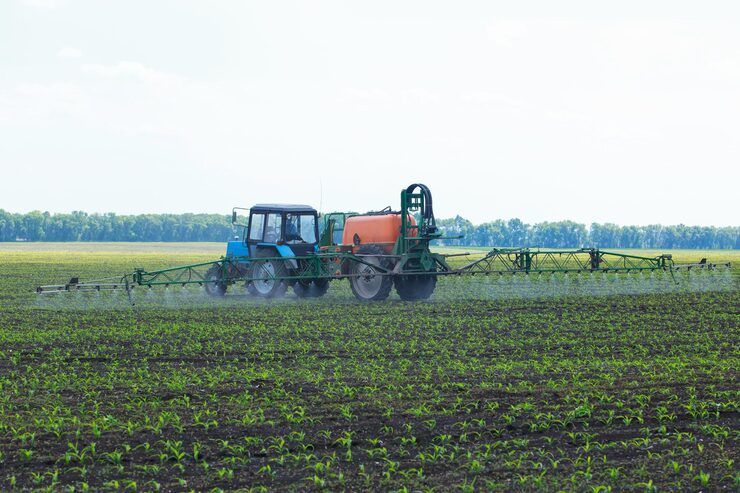
Fertilizer spreaders are agricultural machines designed to distribute granular, powdered, or other suitable fertilizer materials across fields, lawns, gardens, and landscaped areas. They help farmers and land managers apply nutrients more evenly, supporting plant growth while reducing the uneven distribution that can occur with manual application.
These machines are used in commercial agriculture, horticulture, landscaping, turf management, and some forestry operations. Their design ranges from small hand-operated units to tractor-mounted and self-propelled agricultural equipment capable of covering large areas.
Fertilizer spreaders are an important part of modern crop nutrient management because application accuracy influences plant development, field productivity, operating efficiency, and environmental protection.
Understanding Fertilizer Spreader Technology
A fertilizer spreader generally consists of a hopper, a metering mechanism, a delivery system, and controls that regulate the quantity and distribution of material.
The hopper stores the fertilizer, while the metering mechanism controls its release. Depending on the machine design, the material may be distributed through rotating discs, gravity-fed outlets, pneumatic airflow, or other delivery mechanisms.
The appropriate machine depends on fertilizer characteristics, field size, terrain, crop requirements, and the desired application rate.
Common Types of Fertilizer Spreaders
Broadcast spreaders: These machines distribute granular fertilizer across a wide area, commonly using rotating discs. They are widely used for agricultural fields, lawns, and landscaped spaces.
Drop spreaders: These release material directly beneath the machine through controlled openings. They can provide relatively precise placement over narrow areas but generally require more careful alignment between passes.
Pneumatic spreaders: These use airflow to transport and distribute fertilizer through tubes or outlets. They are used in certain agricultural applications where controlled placement is important.
Tractor-mounted spreaders: Attached to agricultural tractors, these machines are suitable for larger fields and can cover substantial areas during a single operation.
Tow-behind spreaders: These are pulled by tractors or other compatible vehicles and are used in agricultural, horticultural, and grounds-maintenance applications.
Handheld spreaders: These are intended for smaller areas, including gardens and lawns, where a large agricultural machine would be unnecessary.
How Fertilizer Spreaders Work
The application process typically begins with selecting a suitable fertilizer based on soil conditions and crop nutrient requirements.
The operator then adjusts the spreader according to the intended application rate, fertilizer characteristics, travel speed, and spreading width.
During operation, the metering system releases the material while the delivery mechanism distributes it across the target area. Properly calibrated equipment helps maintain a consistent application rate.
Important operating variables include:
Fertilizer particle size and density
Moisture content and material flow
Machine speed
Spreading width
Metering settings
Wind direction and speed
Field shape and surface conditions
Because fertilizer products differ in their physical properties, a setting suitable for one material may not produce the same result with another.
Why Fertilizer Spreaders Matter in Modern Agriculture
Fertilizer spreaders help farmers distribute nutrients across agricultural land according to crop requirements. Their importance extends beyond convenience because uneven application can affect plant growth, nutrient efficiency, and environmental conditions.
Improving Nutrient Distribution
Plants require nutrients such as nitrogen, phosphorus, and potassium at different stages of growth. When fertilizer is distributed unevenly, some parts of a field may receive excessive nutrients while others receive insufficient amounts.
Accurate spreading helps reduce these differences when equipment is correctly calibrated and the fertilizer is appropriate for the crop.
Supporting Precision Agriculture
Precision agriculture uses field data, positioning technology, sensors, and digital equipment controls to manage agricultural inputs according to changing field conditions.
Modern fertilizer spreaders may incorporate GPS guidance, variable-rate application, electronic controllers, and digital mapping. These features can help operators adjust application rates across different parts of a field rather than applying one uniform rate everywhere.
Reducing Nutrient Losses
Excess fertilizer can contribute to nutrient runoff, groundwater contamination, and the growth of unwanted algae in water bodies. Applying the appropriate quantity at a suitable time can help reduce these risks.
Fertilizer spreaders are most effective when used alongside soil testing, crop nutrient planning, weather monitoring, and responsible fertilizer storage.
Comparing Fertilizer Spreader Types
Spreader Type | Main Application | Key Consideration |
|---|---|---|
Broadcast | Large fields and lawns | Wind and spreading pattern |
Drop | Narrow areas and precise placement | Accurate alignment |
Pneumatic | Specialized agricultural applications | Airflow and distribution control |
Tractor-mounted | Large agricultural fields | Tractor compatibility |
Tow-behind | Farms and managed landscapes | Towing capacity |
Handheld | Gardens and small areas | Manual consistency |
No single spreader is ideal for every application. Equipment selection should reflect the required accuracy, operating area, material type, and available machinery.
Recent Developments in Fertilizer Spreader Technology
During 2025 and 2026, agricultural equipment development continued to emphasize precision application, automation, digital field management, and improved nutrient efficiency.
Variable-Rate Fertilizer Application
Variable-rate technology allows a spreader to change the amount of fertilizer applied according to a prescription map or other field information.
For example, a field may contain areas with different nutrient levels, soil characteristics, or crop growth conditions. A compatible spreader can adjust the application rate as it moves through those zones.
The effectiveness of this approach depends on reliable field data, accurate calibration, suitable fertilizer characteristics, and correct machine operation.
GPS Guidance and Automated Controls
GPS guidance helps operators maintain consistent travel paths and reduce unintended overlap between adjacent passes. Some advanced systems combine positioning data with electronic metering controls and digital farm-management platforms.
These technologies can improve recordkeeping and support more consistent field operations, although performance varies according to equipment capability and field conditions.
Data-Driven Nutrient Management
Digital agriculture increasingly combines soil analysis, crop information, satellite imagery, and yield records to support fertilizer planning.
During 2025 and 2026, precision nutrient management remained an important area of agricultural technology development. The broader direction is toward applying nutrients according to documented crop requirements rather than relying exclusively on uniform application rates.
However, digital controls do not automatically guarantee better results. Soil sampling, field validation, appropriate agronomic advice, and routine equipment checks remain essential.
Laws, Policies, and Environmental Requirements
Fertilizer spreading is influenced by agricultural regulations, environmental protection rules, water-quality requirements, and equipment safety standards. The applicable requirements depend on the country, region, crop, and type of fertilizer used.
European Union Regulations
The European Union's Nitrates Directive establishes measures intended to protect water quality from agricultural nitrate pollution. In designated vulnerable zones, national authorities implement requirements relating to fertilizer application, nutrient management, and periods when spreading may be restricted.
The EU's Sustainable Use of Pesticides framework does not directly regulate fertilizer spreaders as fertilizer equipment, so it should not be confused with the rules governing nutrient application.
Farmers operating in Europe should consult the relevant national and regional agricultural requirements before applying fertilizer near waterways or during restricted periods.
United States Environmental Requirements
In the United States, fertilizer application may be affected by state nutrient-management programs, water-quality rules, and federal environmental legislation.
The Clean Water Act provides a framework for protecting water quality, while specific requirements for agricultural operations depend on the activity and circumstances. Certain concentrated animal feeding operations and other regulated activities may be subject to additional permitting requirements.
Farmers should check applicable state and local rules regarding nutrient runoff, water protection, and agricultural land management.
India and Agricultural Nutrient Management
In India, fertilizer use is influenced by national fertilizer regulations, state agricultural guidance, and programs promoting balanced nutrient management and soil testing.
The Soil Health Card programme supports farmers by providing information about soil nutrient status and recommendations for appropriate nutrient application.
Farmers should use relevant soil-test results and follow current state-level agricultural guidance when determining fertilizer rates and timing.
Environmental Best Practices
Regardless of location, responsible spreading generally involves:
Avoiding application immediately before heavy rainfall.
Maintaining appropriate distances from waterways where required.
Following fertilizer label instructions.
Preventing fertilizer from entering drains and surface water.
Calibrating equipment before field operations.
Observing restrictions on slopes and vulnerable soils.
Recording application dates, materials, and rates.
Tools and Resources for Fertilizer Spreader Management
Several practical tools can help farmers select equipment, calculate application rates, and improve fertilizer distribution.
Fertilizer Spreader Calibration
Calibration determines how much fertilizer a machine applies over a specific area. It involves measuring material output and comparing it with the intended application rate.
A basic calculation is:
Application rate (kg/ha) = Fertilizer applied (kg) ÷ Area covered (ha)
For example, if a spreader distributes 50 kilograms of fertilizer across 0.5 hectares, its measured application rate is 100 kilograms per hectare.
Actual field calibration should account for spreading width, operating speed, overlap, and material distribution.
Soil Testing and Nutrient Calculators
Soil testing helps identify nutrient deficiencies and supports more appropriate fertilizer planning. Agricultural extension agencies and laboratories can provide soil analysis, while nutrient calculators can help estimate application quantities using crop requirements and fertilizer composition.
Digital Farm Management Tools
GPS guidance systems, field-mapping software, and farm-management applications can help operators document field boundaries, application rates, and completed operations.
Useful resources include:
Soil analysis reports
Agricultural extension guidance
Equipment calibration manuals
GPS field-mapping applications
Weather forecasting tools
Nutrient management calculators
Fertilizer product specifications
Frequently Asked Questions
What is a fertilizer spreader used for?
A fertilizer spreader distributes fertilizer across fields, lawns, gardens, and other managed landscapes. Depending on the equipment, it can apply granular materials through rotating discs, gravity-fed outlets, or pneumatic systems.
What is the difference between a broadcast spreader and a drop spreader?
A broadcast spreader distributes fertilizer across a wider area, while a drop spreader releases material directly beneath the machine. Broadcast models generally cover ground faster, whereas drop spreaders provide more localized placement.
How often should a fertilizer spreader be calibrated?
Calibration should be checked before important application operations, when changing fertilizer products, and whenever settings or operating conditions change. Regular inspection also helps identify blockages, worn components, and inconsistent material flow.
How does precision agriculture improve fertilizer spreading?
Precision agriculture combines field data, positioning technology, and electronic controls to adjust fertilizer application. Variable-rate systems can apply different quantities across a field according to soil conditions and crop requirements.
What safety precautions should operators follow?
Operators should follow the equipment manual, use appropriate protective equipment, avoid contact with moving components, and keep fertilizer away from drains and waterways. Machinery should be stopped and isolated before cleaning blockages or performing maintenance.
Conclusion
Fertilizer spreaders are important agricultural machines that support the distribution of nutrients across farms, gardens, and managed landscapes. Broadcast, drop, pneumatic, and tractor-mounted systems serve different purposes, depending on field conditions, fertilizer characteristics, and application requirements.
Developments in GPS guidance, variable-rate technology, and digital farm management are helping farmers make more informed decisions about fertilizer application. Nevertheless, accurate calibration, soil testing, regular maintenance, and suitable operating conditions remain essential for consistent results.
Environmental regulations also influence how and when fertilizer can be applied. By combining appropriate equipment with responsible nutrient management and current agricultural guidance, farmers can improve application accuracy while reducing avoidable nutrient losses and protecting surrounding ecosystems.