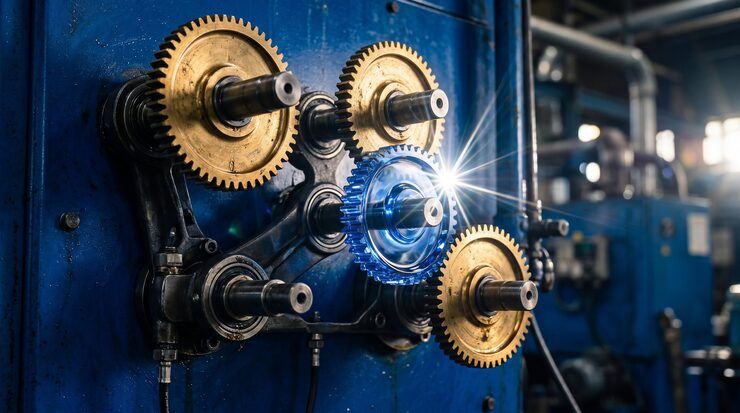
A gear shaping machine is a machine tool used to manufacture gears by cutting teeth into a cylindrical or similar workpiece. It uses a reciprocating cutting tool called a pinion cutter or rack-type cutter. The cutter and workpiece rotate in a coordinated relationship while the cutter moves up and down, gradually forming the gear teeth.
Gear shaping is particularly useful when a gear requires internal teeth, external teeth, or features that may be difficult to produce with other gear-cutting methods. It is widely associated with precision manufacturing for mechanical power transmission.
Unlike general milling, gear shaping creates the tooth profile through a controlled generating process. The cutter and workpiece effectively reproduce the geometry required for the final gear.
Why Gear Shaping Exists
Gears are used to transfer motion, torque, and rotational speed between components. They are found in applications such as:
- Automotive transmissions and drivetrains
- Industrial gearboxes
- Machine tools
- Robotics and automation equipment
- Aerospace systems
- Construction and agricultural machinery
- General mechanical equipment
The quality of a gear affects noise, vibration, efficiency, durability, and the smooth transfer of motion. Gear shaping provides manufacturers with a controlled method for producing accurate tooth profiles.
How the Gear Shaping Process Works
A typical gear shaping cycle involves several coordinated movements.
- The gear blank is securely mounted on the machine.
- A suitable gear-shaped cutter is selected.
- The cutter reciprocates vertically or along its designed cutting path.
- The cutter and workpiece rotate in a synchronized relationship.
- Cutting continues until the required tooth depth and profile are achieved.
- The finished gear can then undergo inspection and, where required, additional processes such as heat treatment or gear finishing.
Modern CNC gear shaping machines can control these movements electronically, allowing programmable machining cycles and repeatable production parameters.
Key Machine Components
| Component | Main Function |
|---|---|
| Cutter spindle | Holds and drives the cutting tool |
| Work spindle | Holds and rotates the gear blank |
| Reciprocating mechanism | Produces the cutting stroke |
| CNC control | Coordinates machine movements and parameters |
| Workholding system | Secures the gear blank |
| Lubrication/cooling system | Helps control heat and cutting conditions |
| Safety enclosure | Helps protect operators from moving parts and chips |
Why Gear Shaping Matters Today
Modern manufacturing increasingly depends on precision gear manufacturing. Smaller, lighter, quieter, and more efficient mechanical systems require accurate gear geometry and consistent quality.
Gear shaping is especially relevant where manufacturers need flexibility across different gear designs. It can also be useful for internal gears, which can present different manufacturing challenges from conventional external gears.
The technology affects several groups:
- Automotive manufacturers: Gearboxes and transmission systems depend on accurately manufactured gears.
- Industrial equipment producers: Gear reducers and transmission systems require controlled gear geometry.
- Aerospace manufacturers: High-precision components require strict dimensional and inspection practices.
- Robotics companies: Compact transmissions often require small, accurately manufactured gears.
- Machine-tool manufacturers: Gear technology contributes to the broader CNC machine tools ecosystem.
- Engineering teams: Gear design, machining, inspection, and material selection must work together.
India's Ministry of Heavy Industries identifies machine tools as a foundational part of the capital-goods sector and lists gear cutting and grinding among the machine-tool technologies manufactured in the country.
Problems Gear Shaping Helps Address
The process can help manufacturers address several engineering requirements:
- Accurate gear-tooth geometry
- Repeatability across production batches
- Internal and external gear production
- Controlled tooth spacing
- Integration with CNC manufacturing systems
- Compatibility with automated inspection and production workflows
However, gear shaping is not automatically the correct process for every gear. Gear hobbing, milling, broaching, grinding, and power skiving each have different strengths depending on geometry, production requirements, material, accuracy, and finishing requirements.
Recent Technology Trends in Gear Shaping
The gear-manufacturing sector has increasingly moved toward CNC control, automation, digital inspection, simulation, and connected manufacturing.
In August 2026, Gleason announced technology demonstrations for IMTS 2026 covering gear design, manufacturing, inspection, closed-loop manufacturing, and lights-out production. Its announcement also highlighted high-precision gears for emerging applications such as humanoid robotics.
This illustrates a broader trend: gear production is increasingly connected with digital engineering rather than being treated as an isolated machining operation.
Another important development is the growth of software-based gear engineering. KISSsoft Release 2026, announced on March 17, 2026, added capabilities including a more powerful REXS interface, manufacturing-related functions, additional hob types, and plastic-gear calculations.
In September 2026, KISSsoft also highlighted system-level sizing for gears, shafts, bearings, and complete transmission systems, showing how modern gear engineering increasingly combines component design with broader transmission analysis.
Recent Developments in India
India is also placing attention on advanced manufacturing systems and machine-tool technology.
On February 23, 2026, the Office of the Principal Scientific Adviser and Ministry of Heavy Industries held a stakeholder consultation at CMTI, Bengaluru, focused on an advanced manufacturing strategy. The discussions included CNC machine tools and controllers, advanced machines, testing and metrology infrastructure, robotics, and other manufacturing technologies.
CMTI also reported a Gear Engineering training programme held on January 19–20, 2026. The programme covered gear design, standards, materials, heat treatment, inspection, manufacturing, and quality assurance, reflecting the multidisciplinary nature of modern gear engineering.
Laws, Standards, and Policies in India
Gear shaping machines are part of India's wider machine-tool and industrial manufacturing environment. Compliance can involve machinery safety, electrical safety, applicable Indian Standards, workplace requirements, and sector-specific rules.
A significant regulatory development occurred during 2025–2026. India's Machinery and Electrical Equipment Safety (Omnibus Technical Regulation) Order, 2024 was subsequently amended and then withdrawn on January 16, 2026, according to the Ministry of Heavy Industries. Therefore, information describing the original OTR as currently applicable should be checked against the latest government notifications rather than relying on its earlier implementation timetable.
The Bureau of Indian Standards provides guidance on machinery safety and identifies IS 16819:2018 / ISO 12100:2010 for general machinery risk assessment and risk reduction.
For gear shaping specifically, BIS lists IS 6679:1972, covering test charts for general-purpose gear shaping machines with table diameters up to 1000 mm. BIS records show the standard was reaffirmed in 1998.
Relevant safety standards can also include electrical equipment and machine-guarding requirements. BIS currently lists standards such as IS 16504 (Part 1):2019, based on IEC 60204-1, for electrical equipment of machinery, alongside standards covering interlocking devices and emergency-stop functions.
India's National Capital Goods Policy also identifies advanced machine-tool capabilities, including high-precision machines and gear-cutting and grinding centres, as areas relevant to technology development.
Useful Tools and Resources
Several resources can help students, engineers, manufacturers, and researchers understand gear shaping and related manufacturing technologies.
- Bureau of Indian Standards (BIS): Useful for checking Indian Standards and machinery-safety information.
- Ministry of Heavy Industries: Provides information on India's machine-tool and capital-goods policies.
- CMTI: A useful Indian technical resource for manufacturing technology, metrology, gear engineering, and training information.
- KISSsoft: Gear and transmission engineering software used for calculations, design, and system-level analysis.
- AGMA resources: Useful for learning about gear terminology, design practices, ratings, and engineering standards.
- ISO standards: Provide internationally recognized frameworks for machinery safety and engineering practices.
- CNC simulation software: Helps engineers review machining movements and identify potential process problems before production.
- Gear inspection equipment: Coordinate measuring machines, gear measuring machines, and other metrology systems help verify tooth geometry and dimensional accuracy.
Gear Shaping Compared With Other Gear-Cutting Methods
| Method | Typical Strength | Common Consideration |
|---|---|---|
| Gear shaping | Internal and external gears; flexible tooth generation | Reciprocating cutting action |
| Gear hobbing | Efficient production of many external gears | Less suitable for some internal-gear applications |
| Gear milling | Flexible for certain geometries and lower-volume work | Individual tooth spaces may be machined separately |
| Broaching | High productivity for suitable internal profiles | Tooling is highly application-specific |
| Power skiving | Compact, high-productivity gear manufacturing | Requires specialized tooling and machine control |
| Gear grinding | High-accuracy finishing | Usually a finishing rather than initial cutting process |
Frequently Asked Questions
What is a gear shaping machine used for?
A gear shaping machine cuts gear teeth into a workpiece using a reciprocating cutter and synchronized rotational movement. It can be used for both internal and external gears, depending on machine configuration and tooling.
What is the difference between gear shaping and gear hobbing?
Gear shaping uses a reciprocating cutter, while hobbing uses a rotating hob. Gear shaping is particularly useful for certain internal gears and applications where the cutter's geometry and access make it appropriate.
Are modern gear shaping machines CNC controlled?
Many modern machines use CNC systems to coordinate cutting movements, spindle rotation, feeds, and machining cycles. CNC control can improve repeatability and support more sophisticated production processes.
Why is gear inspection important?
Inspection verifies whether the manufactured gear meets the required dimensional and geometric specifications. Tooth profile, spacing, runout, lead, and other characteristics can affect how a gear performs in an assembled transmission.
What industries use gear shaping technology?
Gear shaping technology is relevant to automotive, aerospace, robotics, industrial machinery, machine tools, agricultural equipment, construction machinery, and other mechanical systems that use precision gears.
Conclusion
Gear shaping machines remain an important part of gear manufacturing and precision machine tools. Their ability to generate internal and external gear teeth makes the process useful across several engineering applications.
The technology is also changing. CNC controls, automation, digital inspection, simulation, system-level gear design, and connected manufacturing are increasingly linking the machining process with the wider digital manufacturing environment.
For users in India, understanding applicable BIS standards and checking the latest Ministry of Heavy Industries notifications is particularly important because machinery regulations and implementation requirements can change over time. At the same time, developments in advanced manufacturing, metrology, robotics, and gear-engineering software indicate that gear production is becoming increasingly integrated with modern manufacturing systems.