Industrial embroidery machines are computerized textile machines designed to create decorative, branded, patterned.
Compared with manual embroidery equipment, industrial systems can coordinate multiple needles, threads, heads, and programmed stitch patterns at high production speeds.
Modern embroidery equipment is used in apparel manufacturing, home textiles, uniforms, promotional textiles, footwear, accessories, and technical textile applications. Machine selection depends on embroidery design, fabric characteristics, production volume, number of heads, needle configuration, stitch speed, automation, and required precision.
What Are Industrial Embroidery Machines?
Industrial embroidery machines use electronically controlled needle and fabric movements to produce programmed embroidery patterns.
Depending on the machine configuration, systems can support:
- Multiple embroidery heads
- Multiple needles
- Automatic thread changes
- Computerized pattern control
- Automatic thread trimming
- Design memory
- Different stitch types
- Sequin and decorative attachments
- Tubular or flat embroidery
Digital embroidery files are converted into machine instructions that control needle movement, thread selection, stitch placement, and fabric positioning.
How Do Industrial Embroidery Machines Work?
Industrial embroidery involves several coordinated operations.
1. Design Preparation
The embroidery design is created or digitized using specialized embroidery software.
The digital design determines:
- Stitch placement
- Stitch density
- Thread sequence
- Needle changes
- Color sequence
- Stitch type
2. Fabric Hooping
The fabric is secured inside an appropriate embroidery frame or hoop.
Proper stabilization helps prevent fabric movement and distortion.
3. Thread Loading
Threads are installed through the machine's needle system according to the required design.
4. Needle Movement
The machine moves the needle vertically while the embroidery frame moves according to programmed coordinates.
5. Stitch Formation
The needle and bobbin system form stitches according to the programmed pattern.
6. Thread Changes
Multi-needle machines can automatically change between selected thread colors.
7. Finishing
After embroidery is completed, excess threads may be trimmed automatically before the finished material is removed.
Types of Industrial Embroidery Machines
Different machine configurations address different production requirements.
Single-Head Embroidery Machines
Single-head machines have one embroidery head and can be suitable for sampling, smaller production runs, customized designs, and flexible textile work.
They provide access to many embroidery functions while occupying less floor space than multi-head systems.
Multi-Head Embroidery Machines
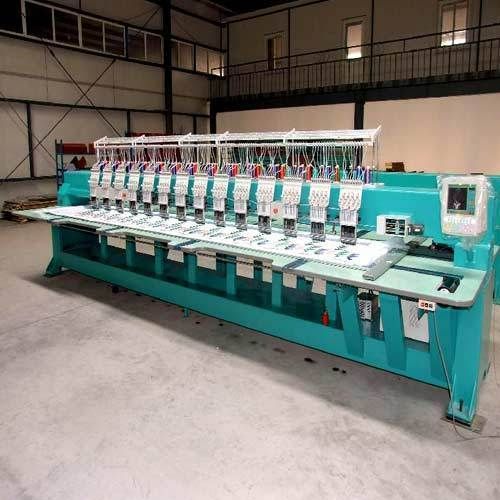
Multi-head machines contain multiple embroidery heads that can process multiple garments or fabric pieces simultaneously.
They are commonly used for:
- Apparel production
- Uniform embroidery
- Home textiles
- Logo embroidery
- Large production runs
Multi-Needle Embroidery Machines
Multi-needle machines contain multiple needle positions, allowing different thread colors to be loaded simultaneously.
This reduces manual thread changes during multicolor designs.
Flat Embroidery Machines
Flat embroidery machines are designed primarily for fabric pieces that can be positioned on a flat embroidery surface.
They can be used for:
- Garments
- Fabrics
- Patches
- Household textiles
- Decorative materials
Tubular Embroidery Machines
Tubular systems use specialized frames that allow embroidery on cylindrical or difficult-to-access garment sections.
Applications can include:
- Shirt sleeves
- Caps
- Trouser legs
- Bags
- Finished garments
Cap Embroidery Machines
Cap systems are designed specifically for embroidery on curved headwear.
Their frame and movement system accommodates the curved shape of the cap.
Chenille Embroidery Machines
Chenille machines create raised, textured embroidery using specialized yarn and stitch formations.
They are commonly associated with patches, lettering, badges, and decorative textile designs.
Major Components of Industrial Embroidery Machines
| Component | Primary Function |
|---|---|
| Needle Bar | Holds and moves needles |
| Needles | Forms stitches |
| Bobbin System | Provides lower thread |
| Embroidery Head | Coordinates needle operations |
| Thread Stand | Holds thread supplies |
| Presser Foot | Helps control fabric |
| Embroidery Frame | Secures the fabric |
| Drive Motor | Powers machine movement |
| Control Panel | Manages machine settings |
| Computer System | Processes design data |
| Thread Trimmer | Removes excess thread |
| Sensors | Detect selected faults and conditions |
Component configuration varies according to machine type and application.
Common Embroidery Stitch Types
Industrial embroidery machines can produce different stitch structures.
Satin Stitch
Satin stitches create dense, smooth areas and are frequently used for lettering, outlines, and decorative details.
Running Stitch
Running stitches use repeated needle movements to create thin lines and fine details.
Fill Stitch
Fill stitches cover larger areas with programmed stitch patterns.
Chain Stitch
Chain-style stitching creates a linked appearance and is used in selected decorative applications.
Tatami Stitch
Tatami-style fills use structured rows of stitches to cover larger embroidered areas.
The appropriate stitch type depends on design geometry, fabric, thread, and desired appearance.
Applications of Industrial Embroidery Machines
Industrial embroidery equipment is used across several textile sectors.
Apparel Manufacturing
Applications include:
- Logos
- Names
- Decorative patterns
- Monograms
- Labels
- Uniform designs
Sportswear
Embroidery machines can create team logos, player names, emblems, and decorative elements on suitable sports garments.
Corporate and Workwear Textiles
Embroidered logos and identification details can be applied to suitable uniforms, jackets, shirts, and other textile products.
Home Textiles
Applications include:
- Curtains
- Cushions
- Bedding
- Towels
- Decorative fabrics
Headwear
Specialized embroidery machines can decorate:
- Caps
- Hats
- Beanies
- Head coverings
Bags and Accessories
Embroidery can be applied to selected:
- Backpacks
- Handbags
- Tote bags
- Pouches
- Textile accessories
Embroidery Machine Specifications
Several specifications should be considered when comparing industrial embroidery machines.
Number of Heads
The number of heads determines how many separate pieces can potentially be embroidered simultaneously.
Number of Needles
More needle positions allow more thread colors to remain loaded during a design.
Embroidery Area
The maximum embroidery field determines the largest design that can be produced in a single frame configuration.
Stitch Speed
Stitch speed indicates the machine's maximum or specified operating rate.
Actual production speed can vary based on design complexity, stitch density, fabric, thread, and machine settings.
Memory Capacity
Computerized machines may have internal or external design storage capabilities.
Frame Sizes
Different frame dimensions allow the machine to accommodate various garment and textile shapes.
Automation in Industrial Embroidery Machines
Computerized control is a central feature of modern industrial embroidery equipment.
Automation can manage:
- Needle selection
- Thread-color changes
- Stitch positioning
- Frame movement
- Thread trimming
- Design sequencing
- Machine stopping
- Error detection
Automatic Thread Trimming
Automatic trimming can reduce manual finishing work and improve consistency.
Thread Break Detection
Sensors can detect selected thread-break conditions and stop the machine to prevent extended stitching errors.
Design Memory
Machines can store multiple embroidery programs for repeated production.
Production Monitoring
Advanced systems may record information such as:
- Stitch count
- Machine runtime
- Error events
- Production cycles
- Thread-break frequency
Fabric and Thread Compatibility
Embroidery performance depends significantly on the relationship between machine settings, fabric, stabilizer, needle, and thread.
Fabric Factors
Important characteristics include:
- Fabric thickness
- Stretch
- Density
- Surface texture
- Weight
- Construction
Thread Factors
Thread selection can consider:
- Thread thickness
- Material
- Strength
- Color stability
- Surface characteristics
Stabilizer Selection
Stabilizers support the fabric during embroidery and can help reduce puckering, shifting, and distortion.
Embroidery Quality Control
Quality checks help identify defects during production.
Common inspection points include:
- Stitch consistency
- Thread tension
- Pattern alignment
- Color sequence
- Thread breaks
- Puckering
- Missing stitches
- Thread trimming
- Design dimensions
- Fabric distortion
For automated production environments, machine monitoring and digital inspection systems can help identify recurring issues.
Common Industrial Embroidery Machine Problems
Thread Breakage
Thread breaks can result from incorrect tension, damaged needles, unsuitable thread, excessive speed, or fabric-related resistance.
Needle Breakage
Needle breakage can be associated with incorrect needle selection, improper installation, frame interference, or mechanical problems.
Fabric Puckering
Puckering can occur when stitch density, stabilization, thread tension, or fabric properties are not appropriately matched.
Design Misalignment
Movement of the fabric or frame can cause the embroidered design to shift from its intended position.
Uneven Stitch Formation
Incorrect tension, worn components, unsuitable thread, or machine settings can affect stitch consistency.
Maintenance of Industrial Embroidery Machines
Routine maintenance helps maintain machine accuracy and reliability.
Typical maintenance activities include:
- Cleaning the needle area
- Cleaning the bobbin area
- Checking thread paths
- Inspecting needles
- Checking embroidery frames
- Lubricating specified components
- Inspecting belts
- Checking drive mechanisms
- Cleaning sensors
- Inspecting electrical connections
- Verifying thread-trimming mechanisms
Maintenance intervals should follow machine documentation and operating conditions.
How to Select Industrial Embroidery Machines
Machine selection should begin with the type of embroidery and production requirements.
Consider:
- Number of embroidery heads
- Number of needles
- Maximum embroidery field
- Machine speed
- Fabric types
- Thread types
- Design complexity
- Flat or tubular operation
- Cap embroidery requirements
- Automatic thread trimming
- Thread-break detection
- Design memory
- Frame sizes
- Control interface
- Machine footprint
- Maintenance requirements
For specialized applications, testing representative fabrics and designs can help confirm machine compatibility.
Multi-Head vs Single-Head Embroidery Machines
| Factor | Single-Head | Multi-Head |
|---|---|---|
| Embroidery Heads | One | Multiple |
| Production Capacity | Lower | Higher |
| Flexibility | High for varied designs | Suited to repeated designs |
| Floor Space | Generally lower | Generally higher |
| Suitable Applications | Sampling and smaller batches | Larger production runs |
| Workflow | One piece or location at a time | Multiple pieces simultaneously |
The appropriate configuration depends on design variety, production requirements, workspace, and machine utilization.
How to Evaluate Industrial Embroidery Machine Manufacturers
When evaluating industrial embroidery machine manufacturers, consider their machine technology and technical capabilities.
Important factors include:
- Number of heads
- Needle configuration
- Maximum embroidery area
- Stitch speed
- Frame options
- Thread-trimming technology
- Thread-break detection
- Design-control software
- Tubular and cap capabilities
- Automation
- Sensor systems
- Technical documentation
- Maintenance requirements
The manufacturer should be able to match the machine configuration with the required fabric types, embroidery designs, production volume, and operating environment.
Frequently Asked Questions
What are industrial embroidery machines used for?
Industrial embroidery machines create programmed decorative and functional embroidery on garments, fabrics, home textiles, headwear, bags, uniforms, and other suitable textile materials.
What is the difference between single-head and multi-head embroidery machines?
A single-head machine has one embroidery head, while a multi-head machine contains multiple heads that can process several pieces simultaneously. The appropriate configuration depends on production requirements and design repetition.
How many needles does an industrial embroidery machine have?
Needle configurations vary by machine. Multi-needle systems can keep several thread colors loaded simultaneously, reducing the need for manual thread changes during multicolor designs.
What causes puckering during machine embroidery?
Puckering can result from unsuitable stabilization, excessive stitch density, incorrect thread tension, fabric movement, or a mismatch between the design and fabric characteristics.
How do I select an industrial embroidery machine?
Evaluate the required embroidery area, number of heads and needles, fabric types, design complexity, stitch speed, frame configuration, automation, thread management, machine footprint, and maintenance requirements.
Conclusion
Industrial embroidery machines provide computerized methods for producing consistent and detailed embroidery across a wide range of textile applications. Single-head, multi-head, multi-needle, flat, tubular, cap, and specialized embroidery systems address different production and design requirements.
Machine performance depends on thread selection, needle configuration, fabric characteristics, stabilization, stitch density, frame control, and operating parameters. Automation features such as thread-break detection, automatic trimming, computerized design control, and production monitoring can further improve process consistency.
When selecting industrial embroidery equipment, manufacturers should evaluate embroidery requirements, fabric compatibility, machine configuration, production volume, automation, maintenance, and available workspace. Matching the machine technology with the intended textile application is essential for consistent embroidery quality.