Industrial mixing equipment is used to combine, blend, disperse, dissolve, or homogenize different materials into a consistent mixture.
These systems are widely used in food processing, chemical manufacturing, pharmaceuticals, cosmetics, paints, coatings, plastics, construction materials, and other industrial processes.
The appropriate mixer depends on material characteristics, batch size, viscosity, mixing intensity, required uniformity, temperature, and production method. Equipment may be designed for liquids, powders, pastes, slurries, or combinations of different material phases.
What Is Industrial Mixing Equipment?
Industrial mixing equipment consists of machines and processing systems designed to combine materials under controlled mechanical conditions.
A mixing system can perform several functions, including:
- Blending liquids
- Mixing powders
- Dispersing solids into liquids
- Combining viscous materials
- Suspending particles
- Dissolving ingredients
- Emulsifying immiscible liquids
- Maintaining uniform temperature
- Producing consistent formulations
The mixer design determines how effectively mechanical energy is transferred into the material.
How Does Industrial Mixing Equipment Work?
Although designs differ, most industrial mixers follow a basic processing sequence.
1. Material Loading
Raw materials are introduced into a vessel, hopper, chamber, or continuous feed system.
2. Mechanical Agitation
A motor drives an impeller, blade, rotor, screw, paddle, or other mixing element.
3. Material Movement
The mixing element creates one or more flow patterns inside the vessel.
These can include:
- Axial flow
- Radial flow
- Tangential flow
- Turbulent flow
4. Ingredient Distribution
The movement distributes materials throughout the mixture and reduces concentration differences.
5. Processing Completion
Mixing continues until the required uniformity, viscosity, particle dispersion, or formulation condition is achieved.
6. Discharge
The finished mixture is transferred to storage, filling, packaging, heating, cooling, or another production stage.
Types of Industrial Mixing Equipment
Different mixer designs are suited to specific materials and processes.
Industrial Agitators
Agitators are commonly used for liquid mixing and maintaining uniformity within tanks.
They can help with:
- Blending
- Suspension
- Heat transfer
- Dissolution
- Low- to medium-viscosity liquid processing
Impeller selection depends on viscosity and desired flow characteristics.
High-Shear Mixers
High-shear mixers generate intense localized mechanical forces.
They are commonly used for:
- Emulsification
- Dispersion
- Particle-size reduction
- Powder wetting
- Suspension preparation
Rotor-stator systems are a common high-shear configuration.
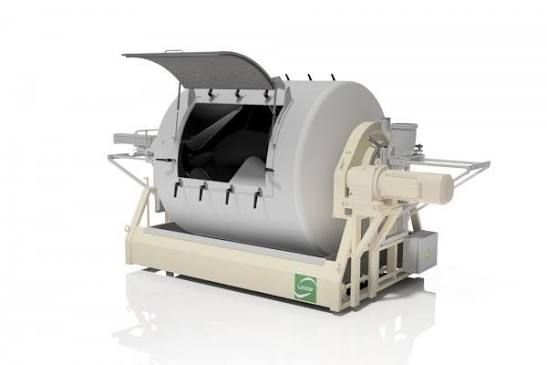
Industrial Ribbon Mixers
Ribbon mixers use helical blades positioned around a horizontal shaft.
They are particularly suitable for powders and dry materials.
Common applications include:
- Food ingredients
- Chemicals
- Animal feed
- Pharmaceutical powders
- Industrial compounds
Paddle Mixers
Paddle mixers use broad blades to move materials through a mixing chamber.
They can be suitable for powders, granules, slurries, and other materials requiring relatively gentle mixing.
Planetary Mixers
Planetary mixers use one or more mixing tools that rotate around their own axes while simultaneously moving around the mixing vessel.
They are useful for:
- High-viscosity materials
- Pastes
- Adhesives
- Sealants
- Compounds
- Creams
Double-Arm Mixers
Double-arm mixers use two mixing elements operating inside a trough or vessel.
They are often used for highly viscous materials that require strong mechanical processing.
Static Mixers
Static mixers have no externally driven moving mixing element.
Instead, internal elements divide and recombine the flowing material as it passes through the mixer.
They are commonly used for continuous liquid-liquid or liquid-gas mixing.
Continuous Mixers
Continuous mixing equipment receives ingredients continuously and produces a continuous output stream.
These systems can be integrated with automated feeding, dosing, conveying, and downstream processing equipment.
Key Components of Industrial Mixing Equipment
| Component | Main Function |
|---|---|
| Motor | Provides mechanical power |
| Gearbox | Controls speed and torque |
| Mixing Shaft | Transfers rotational force |
| Impeller | Creates material movement |
| Mixing Vessel | Contains the materials |
| Baffles | Control unwanted swirling |
| Seal Assembly | Helps contain process material |
| Heating/Cooling Jacket | Controls temperature |
| Control Panel | Manages operating parameters |
| Sensors | Monitor process conditions |
Component selection depends on the material, vessel geometry, operating conditions, and mixing objective.
Mixing Methods
Liquid-Liquid Mixing
Two or more liquids are combined to create a uniform formulation.
The mixer must generate sufficient circulation without causing excessive air incorporation.
Solid-Liquid Mixing
Powders or solid particles are introduced into a liquid.
The process may require strong agitation to prevent floating, clumping, or sedimentation.
Powder Mixing
Dry powders are blended to distribute ingredients uniformly.
Ribbon, paddle, tumble, and other specialized mixers can be used according to powder characteristics.
Gas-Liquid Mixing
Gas is introduced into a liquid to promote mass transfer or chemical reactions.
Impeller design and gas-distribution configuration influence performance.
High-Viscosity Mixing
Highly viscous products require mixers capable of generating significant torque.
Planetary, double-arm, sigma-blade, and other heavy-duty designs may be used.
Applications of Industrial Mixing Equipment
Industrial mixing systems are used across numerous industries.
Food Processing
Food manufacturers use mixing equipment for:
- Sauces
- Dressings
- Batters
- Dairy formulations
- Beverage ingredients
- Seasonings
- Confectionery mixtures
- Bakery ingredients
Hygienic design and controlled processing are important for food applications.
Chemical Processing
Mixers are used for:
- Chemical formulations
- Pigment dispersions
- Coatings
- Adhesives
- Resins
- Detergents
- Slurries
- Solvent-based formulations
Materials of construction must be compatible with the chemicals being processed.
Pharmaceutical Manufacturing
Mixing systems can process:
- Powders
- Suspensions
- Liquid formulations
- Creams
- Ointments
- Granules
- Pharmaceutical intermediates
Equipment configuration must accommodate applicable cleanliness and process-control requirements.
Cosmetic Manufacturing
Cosmetic production can involve mixing:
- Creams
- Lotions
- Gels
- Shampoos
- Conditioners
- Serums
- Emulsions
High-shear and vacuum mixing systems can be used for selected formulations.
Paints and Coatings
Mixers help combine pigments, binders, solvents, additives, and other formulation components.
High-shear systems are often used when pigment dispersion and uniformity are important.
Construction Materials
Industrial mixers can process:
- Mortar
- Grout
- Cementitious materials
- Dry construction compounds
- Adhesive formulations
Heavy-duty mixing equipment is often required for high-density or abrasive materials.
Important Industrial Mixer Specifications
Several technical parameters should be reviewed when selecting equipment.
Mixing Capacity
Capacity may be specified as:
- Liters per batch
- Cubic meters per batch
- Kilograms per batch
- Kilograms per hour
- Liters per hour
The appropriate measurement depends on whether the system is batch or continuous.
Motor Power
Motor power must correspond to the material characteristics and mixing intensity.
High-viscosity materials generally require greater torque than low-viscosity liquids.
Mixing Speed
Mixer speed affects shear, circulation, energy consumption, and processing time.
Some applications require variable-speed operation to accommodate different stages of the process.
Viscosity Range
Viscosity is a critical selection parameter.
A mixer designed for low-viscosity liquids may not generate sufficient torque for heavy pastes or dense compounds.
Material of Construction
Common materials include:
- Stainless steel
- Carbon steel
- Specialized alloys
- Polymer-lined surfaces
The material should be compatible with the process environment and product characteristics.
Batch vs Continuous Mixing
| Factor | Batch Mixing | Continuous Mixing |
|---|---|---|
| Material Feeding | Batch-based | Continuous |
| Production Method | Individual batches | Continuous stream |
| Process Flexibility | Generally high | Suited to consistent formulations |
| Automation | High potential | High potential |
| Residence Time | Batch-defined | Flow-defined |
| Typical Integration | Tanks and batch lines | Continuous production lines |
The appropriate configuration depends on production volume, formulation changes, process requirements, and downstream equipment.
Automation in Industrial Mixing Equipment
Modern mixing systems can incorporate automated controls for repeatable processing.
Automation may regulate:
- Mixing speed
- Mixing duration
- Temperature
- Material level
- Ingredient dosing
- Pressure
- Vacuum
- Motor load
- Discharge timing
PLC-Based Control
A programmable logic controller can coordinate motors, pumps, valves, sensors, and dosing equipment.
Recipe Management
Automated systems can store process recipes for different formulations.
A recipe may define:
- Ingredient sequence
- Mixing speed
- Mixing time
- Temperature
- Dosing quantity
- Vacuum level
- Discharge conditions
Variable-Frequency Drives
Variable-frequency drives allow motor speed adjustment according to process requirements.
This can help optimize mixing intensity during different processing stages.
Temperature Control
Many industrial mixing processes require controlled heating or cooling.
A mixing vessel may incorporate a jacket or internal heat-transfer system.
Temperature control can be important for:
- Dissolution
- Viscosity management
- Chemical reactions
- Product stability
- Crystallization
- Heat-sensitive formulations
Temperature sensors can provide feedback to an automated control system.
Vacuum Mixing
Vacuum mixing removes or reduces air within the mixing vessel during processing.
It can be useful when entrapped air affects product quality, appearance, density, or formulation consistency.
Vacuum systems may be integrated with planetary mixers, high-shear systems, and other specialized equipment.
Factors Affecting Mixing Performance
Mixing performance depends on both equipment design and material properties.
Important factors include:
- Material viscosity
- Density differences
- Particle size
- Solids concentration
- Liquid properties
- Mixing speed
- Impeller geometry
- Vessel dimensions
- Baffle configuration
- Temperature
- Batch volume
- Mixing time
A mixer should be evaluated based on the complete process rather than motor power alone.
Common Industrial Mixing Problems
Incomplete Mixing
Insufficient circulation, unsuitable impeller geometry, incorrect speed, or inadequate processing time can produce concentration variations.
Excessive Foaming
High-speed agitation can introduce air into some liquid formulations.
Reducing excessive turbulence or using suitable vessel and impeller configurations can help control this issue.
Powder Clumping
Poor powder wetting can cause agglomerates.
Controlled addition, appropriate shear, and suitable powder-introduction systems can improve dispersion.
Sedimentation
Heavy particles may settle when suspension forces are insufficient.
Impeller selection and mixing speed should be matched to particle density and concentration.
Excessive Heat Generation
Mechanical energy can increase product temperature.
Temperature monitoring and cooling systems may be required for heat-sensitive materials.
Maintenance of Industrial Mixing Equipment
Regular maintenance helps maintain consistent operation.
Typical maintenance activities include:
- Inspecting the motor
- Checking gearbox lubrication
- Inspecting shafts
- Checking seals
- Inspecting bearings
- Examining impellers
- Checking vessel condition
- Cleaning product-contact surfaces
- Inspecting sensors
- Checking electrical connections
- Testing safety systems
Maintenance intervals should follow the equipment manufacturer's technical documentation and operating conditions.
How to Select Industrial Mixing Equipment
Selection should begin with the material and desired mixing result.
Consider:
- Material type
- Liquid or solid phase
- Viscosity
- Density
- Particle size
- Solids concentration
- Batch size
- Throughput
- Required mixing intensity
- Temperature range
- Pressure or vacuum requirements
- Material compatibility
- Cleaning requirements
- Automation level
- Available installation space
Pilot testing can be useful for difficult formulations, especially when viscosity, particle dispersion, or phase separation presents a challenge.
How to Evaluate Industrial Mixing Equipment Manufacturers
When evaluating industrial mixing equipment manufacturers, examine both technical capability and equipment configuration.
Important factors include:
- Mixer technology
- Capacity range
- Viscosity range
- Motor and gearbox configuration
- Impeller design
- Material of construction
- Heating and cooling systems
- Vacuum capability
- Automation
- Hygienic design
- Safety systems
- Testing procedures
- Documentation
- Maintenance requirements
A suitable manufacturer should be able to match the mixing technology with the material characteristics and production objectives.
Frequently Asked Questions
What is industrial mixing equipment used for?
Industrial mixing equipment is used to blend, disperse, dissolve, suspend, emulsify, or combine materials into a consistent mixture across industries such as food, chemicals, pharmaceuticals, cosmetics, coatings, and construction.
What types of industrial mixers are available?
Common types include agitators, high-shear mixers, ribbon mixers, paddle mixers, planetary mixers, double-arm mixers, static mixers, and continuous mixers.
How do I select an industrial mixer?
Consider material viscosity, density, particle size, solids concentration, batch size, throughput, required mixing intensity, temperature, material compatibility, cleaning requirements, and automation.
What is the difference between batch and continuous mixing?
Batch mixing processes a defined quantity of material during each cycle, while continuous mixing feeds ingredients continuously and produces a continuous output stream.
Can industrial mixers process high-viscosity materials?
Yes. Specialized designs such as planetary, double-arm, sigma-blade, and other high-torque mixers are designed for demanding high-viscosity applications.
Conclusion
Industrial mixing equipment plays an important role in producing uniform formulations across food, chemical, pharmaceutical, cosmetic, coating, construction, and other manufacturing processes. Different technologies—including agitators, high-shear mixers, ribbon mixers, paddle mixers, planetary mixers, static mixers, and continuous systems—address different material and production requirements.
Mixer performance depends on viscosity, density, particle size, solids concentration, impeller design, speed, vessel geometry, temperature, and processing time. Selecting equipment based on these factors can help achieve the required degree of uniformity and process consistency.
Modern industrial mixing systems can incorporate PLC controls, automated dosing, variable-speed drives, temperature management, vacuum processing, sensors, and recipe-based operation. Proper equipment selection, process validation, and routine maintenance are important for reliable long-term operation.