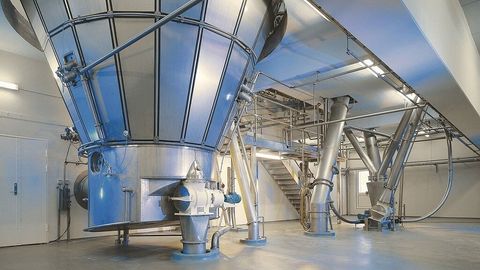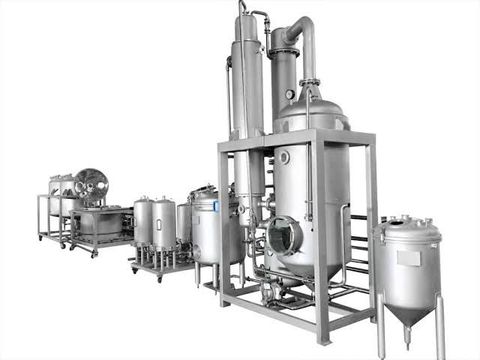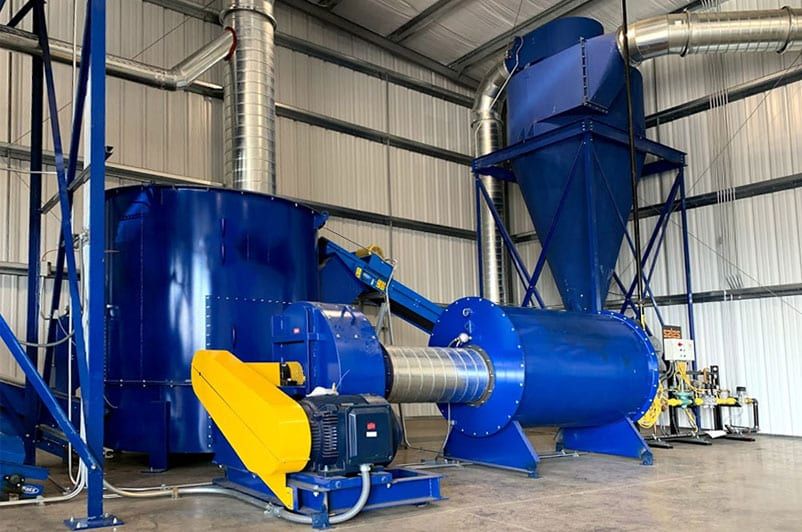
Industrial fluid bed dryers are processing machines designed to remove moisture from solid materials by suspending particles in a controlled stream of heated air.
The technique is used in industries such as food processing, chemicals, minerals, agriculture, and other manufacturing environments where moisture levels influence handling, storage, or further processing.
The basic principle is relatively straightforward. Moist material is placed on a perforated surface while air moves upward through the particles. When the airflow reaches an appropriate velocity, the particles become suspended or partially fluidized, creating greater contact between the material and heated air.
How Fluid Bed Drying Works
A typical industrial fluid bed dryer includes an air handling system, heating arrangement, drying chamber, perforated distribution plate, airflow controls, and exhaust system. Depending on the design, the equipment may operate continuously or in batches.
The drying process generally involves these stages:
- Air preparation: Incoming air is filtered and heated to the required operating range.
- Fluidization: Air passes through the material and creates movement among individual particles.
- Moisture removal: Heat transfers into the particles while moisture moves into the surrounding air.
- Exhaust: Moist air leaves the drying chamber through a controlled outlet.
- Moisture control: Sensors or process measurements can help determine when the material reaches the required condition.
Importance
Moisture control is an important part of many industrial processes. Excess moisture can influence product stability, flow behavior, weight, texture, storage conditions, and subsequent processing steps. Industrial fluid bed dryers provide a controlled method for addressing these requirements.
The technology is particularly useful when materials contain relatively small particles or granules that can interact effectively with moving air. Food ingredients, fertilizers, detergent granules, chemical materials, and agricultural products are among the materials that may be processed using fluidized drying systems.
Factors That Influence Drying
Drying performance depends on several variables rather than temperature alone. Material characteristics, airflow, particle size, initial moisture, residence time, and air humidity can all influence the process.
| Factor | General Influence |
|---|---|
| Air temperature | Affects heat transfer and moisture evaporation |
| Airflow | Influences particle movement and drying uniformity |
| Particle size | Changes the surface area exposed to air |
| Initial moisture | Determines the amount of moisture that must be removed |
| Residence time | Affects the extent of drying |
| Air humidity | Influences the driving force for moisture removal |
Industrial fluid bed dryers therefore require process conditions suited to the material being handled. Excessive heat or airflow may affect sensitive materials, while insufficient conditions can result in incomplete drying.
Common Industrial Applications
Fluid bed drying can be applied across several processing environments. In food production, it may be used for granules, grains, ingredients, and particulate materials. In chemical processing, the technology can help dry crystalline or granular materials before additional processing.
Agricultural and mineral processing applications can also involve fluidized drying when the material has suitable particle characteristics. The specific equipment configuration depends on factors such as material density, particle size, moisture content, throughput, and thermal sensitivity.
Tools and Resources
Several resources can help users understand and evaluate fluid bed drying processes. Equipment manufacturers' technical documentation can explain chamber configurations, airflow arrangements, temperature ranges, and control systems. Engineering textbooks and industrial drying references can provide background on heat and mass transfer.
Process calculations can also be useful for estimating drying requirements. Common calculations may consider:
- Moisture content before and after drying
- Required moisture removal
- Air temperature and humidity
- Airflow rate
- Material throughput
- Estimated residence time
Spreadsheet templates can help organize these variables for preliminary process analysis. Industrial process-control platforms may also provide temperature, pressure, airflow, and humidity measurements for monitoring drying conditions.
FAQs
What are industrial fluid bed dryers used for?
Industrial fluid bed dryers are used to reduce moisture in suitable particulate materials. Applications can include food ingredients, agricultural materials, chemical granules, fertilizers, and other solid particles.
How do industrial fluid bed dryers remove moisture?
They move heated air through a perforated distribution surface and into the material. The airflow promotes particle movement and transfers heat, allowing moisture to evaporate into the air and leave through the exhaust system.
What affects industrial fluid bed dryer performance?
Temperature, airflow, particle size, moisture content, residence time, air humidity, and material characteristics all influence drying behavior. Operating conditions need to match the material and process requirements.
Are fluid bed dryers suitable for every material?
No. Fluidization depends on particle characteristics, including size, density, shape, and flow behavior. Materials that do not fluidize properly may require another drying approach or a different equipment configuration.
What measurements are important when operating a fluid bed dryer?
Temperature, airflow, pressure, humidity, material moisture, and residence time can be important measurements. The relevant parameters depend on the equipment design and the material being processed.
Conclusion
Industrial fluid bed dryers use controlled airflow and heat to remove moisture from suitable particulate materials. Their operation depends on interactions between temperature, airflow, particle characteristics, moisture content, and residence time. Understanding these factors helps explain how fluidized drying is applied across food, agricultural, chemical, and manufacturing processes. Proper process analysis considers both the material characteristics and the operating conditions.