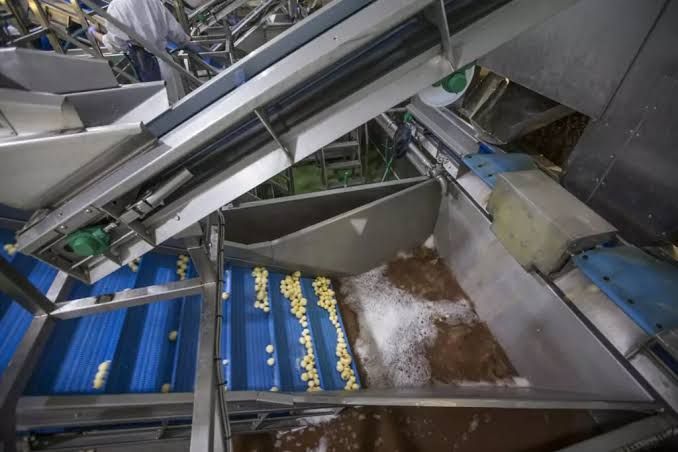
Industrial peeling machines are food-processing systems designed to remove the outer skin or peel from fruits.
They are widely used in food-processing plants, frozen-food production, canning facilities, prepared-food operations, and commercial kitchens.
Compared with manual peeling, industrial equipment can process large quantities of raw material using controlled mechanical, abrasive, steam, or other peeling methods. Machine selection depends on the product type, peel thickness, desired yield, production capacity, product condition, and downstream processing requirements.
What Are Industrial Peeling Machines?
An industrial peeling machine is equipment designed to separate the outer peel from a food product while minimizing unnecessary removal of edible material.
Depending on the product and technology, peeling can be performed using:
- Abrasive surfaces
- Rotating knives
- Blades
- Steam
- Hot water
- Mechanical friction
- Specialized cutting systems
The objective is to achieve consistent peeling while maintaining product quality and reducing product loss.
How Do Industrial Peeling Machines Work?
The exact operating sequence depends on the peeling technology.
1. Product Feeding
Raw fruits, vegetables, or tubers are introduced into the machine manually or through an automated feeding system.
2. Product Positioning
The machine directs the products toward the peeling mechanism. Feed systems can use conveyors, rotating drums, hoppers, or other mechanisms.
3. Peeling
The outer layer is removed using the selected peeling technology. Mechanical systems generally rely on controlled contact between the product and blades or abrasive surfaces.
4. Peel Separation
Removed peel is separated from the processed product through screens, water flow, air movement, or mechanical discharge.
5. Washing
Some machines incorporate water sprays to remove loose peel and surface residue.
6. Inspection
The peeled product can be inspected manually or through automated vision systems before entering cutting, slicing, cooking, freezing, or packaging operations.
Types of Industrial Peeling Machines
Different products require different peeling technologies.
Abrasive Peeling Machines
Abrasive peelers use rough internal surfaces to remove the outer layer through controlled friction.
They are commonly used for products such as:
- Potatoes
- Carrots
- Root vegetables
- Selected tubers
The abrasive surface and processing time must be controlled to balance peel removal and product yield.
Knife Peeling Machines
Knife peelers use rotating or stationary blades to remove the skin from suitable fruits and vegetables.
They can provide relatively controlled peeling and may be designed for specific product shapes.
Steam Peeling Machines
Steam peeling uses high-temperature steam to loosen the skin before mechanical separation.
The process can provide rapid peeling for certain vegetables and fruits used in large-scale food processing.
Lye Peeling Systems
Certain food-processing operations use alkaline solutions to loosen the outer skin. This approach requires carefully controlled chemical concentration, temperature, residence time, and subsequent washing or neutralization.
Flame Peeling Systems
Flame peeling uses controlled heat to remove or loosen the outer layer of selected products. It is commonly associated with specific vegetable-processing applications.
Fruit Peeling Machines
Fruit peelers are designed around product geometry and skin characteristics. Some systems use blades, rotating mechanisms, or specialized positioning equipment.
Key Components of Industrial Peeling Machines
| Component | Primary Function |
|---|---|
| Feed Hopper | Receives raw products |
| Conveyor | Moves products through the machine |
| Peeling Chamber | Contains the peeling mechanism |
| Abrasive Roller | Removes peel through friction |
| Blade Assembly | Cuts and removes skin |
| Rotating Drum | Positions and processes products |
| Water Spray System | Removes loose peel and residue |
| Peel Outlet | Discharges removed skin |
| Product Outlet | Transfers peeled products |
| Control Panel | Manages machine operation |
| Sensors | Monitor process conditions |
The component arrangement varies according to peeling technology and product characteristics.
Products Processed by Industrial Peeling Machines
Industrial peelers can be designed for a variety of products.
Potatoes
Potatoes are among the most common products processed with industrial abrasive peeling systems.
Applications include:
- French fries
- Frozen potato products
- Chips
- Diced potatoes
- Prepared foods
Carrots
Mechanical peeling equipment can remove the outer layer before slicing, cutting, freezing, or further processing.
Beets
Beets can require specialized peeling or surface-removal systems depending on their size and processing requirements.
Apples
Fruit peeling systems can remove apple skin before slicing, pureeing, canning, or other processing operations.
Tomatoes
Selected tomato-processing lines use controlled heat or other methods to loosen and remove the skin before further processing.
Industrial Peeling Machine Specifications
Several technical specifications should be considered during equipment selection.
Processing Capacity
Capacity may be expressed as:
- Kilograms per hour
- Tonnes per hour
- Pieces per minute
- Batch size
The appropriate measurement depends on the product and production process.
Product Size Range
The machine should accommodate the dimensions and shape variation of the intended raw material.
Peeling Efficiency
Peeling efficiency describes the ability to remove the desired outer layer while limiting unnecessary product removal.
Yield
Yield is particularly important in food processing. Excessive peeling can remove edible material and increase product waste.
Water Consumption
Wet peeling systems can require significant water for peeling, washing, and residue removal. Water usage should therefore be considered during process planning.
Applications of Industrial Peeling Machines
Industrial peeling machines are used throughout the food-processing sector.
Frozen Food Production
Peeling equipment can prepare vegetables and potatoes before cutting, blanching, freezing, and packaging.
Canning
Fruits and vegetables can be peeled before cooking, processing, and canning.
Snack Food Production
Potatoes and selected vegetables can be peeled before slicing or processing into snack products.
Ready-to-Eat Food Production
Prepared-food manufacturers can use peeling systems before cutting, cooking, mixing, or portioning ingredients.
Juice and Puree Processing
Certain fruits and vegetables can be peeled before pulping, pureeing, or juice processing, depending on the product and recipe.
Automation in Industrial Peeling Machines
Modern peeling equipment can be integrated with automated food-processing lines.
Automation can support:
- Product feeding
- Speed control
- Peeling duration
- Water flow
- Product detection
- Peel removal
- Product transfer
- Production counting
- Alarm monitoring
PLC-Based Controls
Programmable logic controllers can coordinate motors, conveyors, valves, sensors, and other machine functions.
Variable-Speed Drives
Variable-frequency drives can adjust conveyor or peeling mechanism speed according to product requirements.
This can help operators adapt processing conditions to different product sizes and peeling characteristics.
Quality Control in Industrial Peeling
Quality control focuses on peel removal, product yield, appearance, and hygiene.
Peeling Consistency
Products should have a consistent surface appearance without excessive remaining skin.
Product Loss
Excessive removal of edible material can reduce yield. Peeling parameters should therefore be optimized for the particular product.
Surface Damage
Excessive mechanical force or incorrect blade settings can damage the product.
Foreign Material Control
Machine components should be inspected regularly to prevent damaged parts or other unwanted materials from entering the food stream.
Hygiene and Sanitation
Food-processing peeling machines must be designed for effective cleaning and sanitation.
Important design considerations include:
- Stainless-steel construction
- Smooth food-contact surfaces
- Accessible internal components
- Washable machine areas
- Proper drainage
- Reduced product accumulation points
- Corrosion-resistant components
- Easy removal of residue
Cleaning schedules should be established according to the equipment design, processed product, facility sanitation program, and applicable food-safety requirements.
Common Industrial Peeling Problems
Incomplete Peeling
Incomplete peeling may result from incorrect processing time, unsuitable machine speed, product variation, worn abrasive surfaces, or incorrect blade positioning.
Excessive Product Loss
Excessive edible-material removal can occur when peeling pressure, abrasive action, blade depth, or processing time is too high.
Uneven Peeling
Differences in product size, shape, or surface condition can lead to inconsistent results.
Product Damage
Excessive mechanical force or poorly adjusted blades can cause cuts, bruising, or surface damage.
Water and Residue Build-Up
Poor drainage or insufficient cleaning can result in accumulation of peel and organic material inside the machine.
Maintenance of Industrial Peeling Machines
Regular maintenance helps maintain consistent peeling performance and hygienic operation.
Important activities include:
- Inspecting abrasive surfaces
- Checking blades
- Inspecting bearings
- Checking conveyor components
- Cleaning product-contact areas
- Inspecting water spray nozzles
- Checking pumps
- Inspecting motors
- Checking sensors
- Cleaning drains
- Inspecting electrical connections
- Testing safety controls
Worn blades and abrasive components should be replaced according to their condition and the equipment manufacturer's recommendations.
Energy and Water Efficiency
Resource efficiency is an important consideration in industrial food processing.
Water efficiency can be improved through:
- Controlled spray systems
- Efficient nozzles
- Water recirculation where appropriate
- Automated flow control
- Proper filtration
- Preventive maintenance
Energy consumption can be influenced by motor efficiency, conveyor speed, pump operation, heating requirements, and overall process design.
Steam and thermal peeling systems require additional evaluation of energy use and heat-recovery opportunities.
How to Select Industrial Peeling Machines
The appropriate machine depends on the product and processing objective.
Consider:
- Product type
- Product size
- Product shape
- Peel characteristics
- Required throughput
- Peeling method
- Desired yield
- Surface-quality requirements
- Water consumption
- Energy requirements
- Automation level
- Cleaning requirements
- Available floor space
- Integration with downstream equipment
Testing with representative raw materials can help determine whether a particular peeling technology is appropriate.
Industrial Peeling Machines vs Manual Peeling
| Factor | Industrial Peeling Machines | Manual Peeling |
|---|---|---|
| Processing Capacity | High | Low |
| Peeling Consistency | Mechanically controlled | Operator-dependent |
| Production Integration | High | Limited |
| Product Throughput | Suitable for large volumes | More limited |
| Process Monitoring | Sensors and controls available | Primarily manual |
| Labor Requirement | Lower direct handling | Higher manual involvement |
| Yield Control | Machine parameters can be optimized | Depends on operator technique |
The appropriate approach depends on production volume, product type, quality requirements, and facility configuration.
How to Evaluate Industrial Peeling Machine Manufacturers
When evaluating manufacturers, consider both equipment capabilities and food-processing expertise.
Important factors include:
- Peeling technology
- Product compatibility
- Capacity range
- Construction materials
- Automation capabilities
- Water-management systems
- Hygiene design
- Blade or abrasive technology
- Product-yield performance
- Testing procedures
- Cleaning access
- Maintenance requirements
- Production-line integration
Manufacturers should be able to explain how their equipment handles product variation and how peeling parameters can be adjusted for different production requirements.
Frequently Asked Questions
What are industrial peeling machines used for?
Industrial peeling machines remove the outer skin from fruits, vegetables, potatoes, and other suitable food products before further processing such as cutting, cooking, freezing, canning, or packaging.
What types of industrial peeling machines are available?
Common types include abrasive peelers, knife peelers, steam peelers, lye peeling systems, flame peelers, and specialized fruit-peeling equipment.
Which products can be processed using industrial peeling machines?
Depending on the machine design, products can include potatoes, carrots, beets, apples, tomatoes, and various other fruits and vegetables.
How can product loss be reduced during mechanical peeling?
Product loss can be reduced through appropriate abrasive intensity, blade depth, processing time, machine speed, and proper adjustment for product size and shape.
What should be considered when selecting an industrial peeling machine?
Important factors include product type, size, shape, peel characteristics, processing capacity, peeling method, yield, water usage, automation, hygiene, maintenance, and integration with downstream equipment.
Conclusion
Industrial peeling machines provide mechanized methods for removing skins from fruits, vegetables, potatoes, and other food products at production scale. Abrasive, knife, steam, chemical, flame, and specialized peeling technologies can address different product characteristics and processing requirements.
Peeling performance depends on product size, shape, skin characteristics, machine speed, processing time, peeling mechanism, and equipment adjustment. Maintaining a balance between complete peel removal and product yield is particularly important in commercial food processing.
Modern systems increasingly incorporate automated feeding, PLC controls, variable-speed drives, sensors, water management, and production monitoring. When properly integrated with washing, cutting, blanching, freezing, cooking, and packaging equipment, industrial peelers can form an important part of an efficient food-processing line.