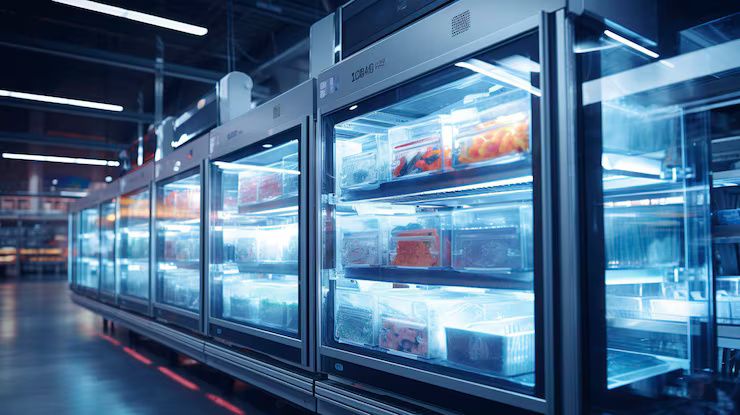
Industrial refrigerators are large-scale cooling systems designed to maintain controlled temperatures in commercial and industrial environments. Unlike household units, these systems are engineered for continuous operation, high cooling capacity, and precise temperature control across larger volumes.
Industrial refrigerators are designed to support temperature-sensitive processes where stability, hygiene, and reliability are essential. They are widely used in food processing plants, pharmaceutical facilities, laboratories, and logistics hubs.
These systems operate using heat transfer and thermodynamic principles. They remove heat from stored products and release it outside, ensuring controlled temperature conditions.
Core Purpose of Industrial Refrigeration
The primary goal is to maintain consistent temperatures for safety and quality. Their design focuses on durability, energy efficiency, and compliance with industry standards.
This makes them essential for operations that depend on controlled environments.
Importance: Why Industrial Refrigerators Matter Today
Industrial refrigeration plays a key role in maintaining product quality and operational efficiency. Temperature control directly impacts shelf life, chemical stability, and process reliability.
Key Reasons for Importance
- Prevents food spoilage and contamination
- Maintains stability of pharmaceuticals and chemicals
- Supports continuous industrial operations
- Influences overall energy consumption
- Ensures compliance with safety standards
These systems are critical for maintaining safe and efficient industrial processes.
Industries That Depend on Refrigeration
- Food and beverage production
- Cold chain logistics and warehousing
- Healthcare and life sciences
- Chemical and petrochemical industries
- Research and testing laboratories
Without effective refrigeration, industries may face product loss and compliance challenges.
Key Components of an Industrial Refrigerator
Industrial refrigeration systems consist of multiple components working together to regulate temperature.
Compressor
The compressor increases refrigerant pressure, enabling heat transfer.
Common types include:
- Reciprocating compressors
- Screw compressors
- Scroll compressors
- Centrifugal compressors
Condenser
The condenser releases heat into the surrounding environment and converts refrigerant gas into liquid.
Types include:
- Air-cooled
- Water-cooled
- Evaporative
Evaporator
The evaporator absorbs heat from inside the refrigerated space. This process removes heat from products or air.
Expansion Valve
The expansion valve controls refrigerant flow and reduces pressure before it enters the evaporator.
Types include:
- Thermostatic expansion valves
- Electronic expansion valves
Refrigerant
Refrigerant is the working fluid responsible for transferring heat.
Examples include:
- Ammonia-based systems
- Carbon dioxide systems
- Hydrofluorocarbon alternatives
Insulated Enclosure
High-quality insulation reduces thermal loss and improves energy efficiency. Materials are selected for durability and hygiene.
Functional Operation Overview
Industrial refrigerators operate through a continuous refrigeration cycle. This cycle ensures stable internal temperatures under varying conditions.
Refrigeration Cycle Steps
- Refrigerant absorbs heat in the evaporator
- Compressor increases pressure and temperature
- Condenser releases heat externally
- Expansion valve regulates flow and pressure
This cycle repeats continuously to maintain cooling performance.
Recent Trends in Industrial Refrigeration (2024–2025)
Advancements in refrigeration systems focus on sustainability, efficiency, and digital integration.
Key Trends
- Use of environmentally friendly refrigerants
- Smart monitoring systems for real-time tracking
- Improved compressor efficiency
- Integration with energy management platforms
- Advanced insulation materials
These developments support better performance and reduced environmental impact.
Laws, Policies, and Regulations
Industrial refrigeration systems must comply with safety, environmental, and efficiency regulations.
Key Regulatory Areas
- Refrigerant handling and leakage control
- Energy efficiency standards
- Workplace safety requirements
- Environmental emission regulations
Standards and Compliance
In India, systems align with standards set by regulatory authorities such as the Bureau of Indian Standards. Global frameworks also guide system design and operation.
Benefits of Compliance
- Reduced environmental impact
- Safer working conditions
- Consistent operational performance
Compliance ensures safe and responsible system operation.
Tools and Resources
Various tools help monitor, maintain, and optimize industrial refrigeration systems.
Useful Tools
- Energy efficiency calculators
- Temperature data logging software
- Preventive maintenance planning tools
- Technical manuals and guides
- Compliance checklists
These resources support reliability and long-term system performance.
Key Components and Functions
| Component | Primary Function | Operational Impact |
|---|---|---|
| Compressor | Increases refrigerant pressure | Enables heat transfer |
| Condenser | Releases heat externally | Stabilizes temperature |
| Evaporator | Absorbs internal heat | Maintains cooling |
| Expansion valve | Controls refrigerant flow | Improves efficiency |
| Insulation panels | Reduce thermal loss | Lowers energy consumption |
Performance Considerations
| Factor | Influence on System |
|---|---|
| Ambient temperature | Affects condenser efficiency |
| Load variability | Determines compressor choice |
| Insulation quality | Impacts energy usage |
| Refrigerant type | Affects safety and efficiency |
| Maintenance | Influences reliability |
These factors help determine overall system performance and efficiency.
FAQs About Industrial Refrigerators
What makes industrial refrigerators different?
They operate at higher capacities and are designed for continuous use in industrial environments.
How is temperature stability maintained?
Through controlled airflow, expansion valves, and automated monitoring systems.
Why is refrigerant selection important?
It affects energy efficiency, environmental impact, and operational safety.
What role does insulation play?
Insulation reduces heat entry, lowering energy demand and improving system efficiency.
How often should systems be inspected?
Regular inspection and maintenance are essential for reliability and compliance.
Conclusion
Industrial refrigerators are essential for maintaining controlled environments across various industries. Their performance depends on coordinated components such as compressors, condensers, and evaporators.
Recent advancements emphasize sustainability, digital monitoring, and energy efficiency. At the same time, regulations ensure safe and responsible operation.
Understanding these systems provides a strong foundation for evaluating performance, ensuring compliance, and supporting long-term operational stability.