Industrial textile manufacturing machinery forms the mechanical backbone of large-scale fabric production.
From opening and preparing fibers to spinning, weaving, knitting, dyeing, finishing, and inspection, modern production depends on equipment that can maintain consistent material handling and process control.
Textile manufacturers increasingly connect individual machines into coordinated production systems rather than treating every operation as an isolated stage. Automation, electronic controls, sensors, machine vision, and production monitoring now play important roles in maintaining consistency across complex manufacturing lines.
Understanding these systems requires looking beyond individual machines. The interaction between fiber preparation, yarn formation, fabric construction, finishing, quality control, and data management determines how effectively a modern textile plant operates.
How the Modern Textile Production Process Is Organized
Textile manufacturing generally begins with raw fibers and progresses through several transformation stages. The exact sequence depends on whether the facility produces yarn, woven fabric, knitted fabric, finished textiles, or specialized industrial materials.
Fiber preparation removes unwanted material and creates a more uniform feedstock. Carding and related preparation equipment then separates and aligns fibers before they move toward spinning or another forming process.
In spinning operations, machinery transforms prepared fibers into yarn. Ring spinning, open-end spinning, and air-jet spinning use different mechanical and aerodynamic principles, producing yarns with different characteristics and production requirements.
The yarn may then move into weaving or knitting. Weaving forms fabric by interlacing warp and weft yarns, while knitting creates interconnected loops. Modern machines use electronic control systems to maintain precise movement and consistent fabric formation.
Subsequent processes can include bleaching, dyeing, printing, coating, drying, heat setting, and finishing. Each stage can alter the fabric's appearance, dimensional stability, texture, strength, or functional properties.
Key Machinery Used Across Production Stages
The equipment used in an industrial textile plant varies according to its product and manufacturing route. However, several machinery groups form the foundation of many production systems.
Fiber preparation machinery handles opening, blending, cleaning, and carding. These machines establish the material consistency needed for subsequent processes.
Spinning machinery converts prepared fibers into yarn. Modern spinning frames and alternative spinning systems use automated controls to regulate parameters such as drafting, twist, tension, and yarn formation.
Weaving machinery uses looms to construct woven fabrics. High-speed electronic looms can coordinate shedding, picking, beat-up, and yarn tension while monitoring operating conditions.
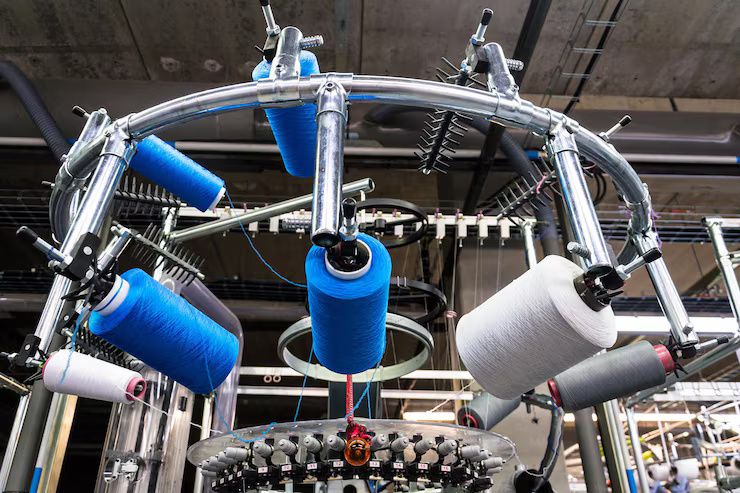
Knitting machinery produces fabrics through controlled needle and yarn movements. Circular and flat knitting machines support different fabric structures and production requirements.
Dyeing and finishing equipment treats fabric after construction. Processing can involve washing, coloration, drying, coating, calendaring, compacting, or other finishing operations.
Inspection and testing equipment evaluates yarn and fabric characteristics. Automated inspection systems can identify visual defects and irregularities that might be difficult to detect consistently through manual examination.
Automation Is Changing Machine-Level Control
Modern textile machinery increasingly incorporates automation directly into the production equipment. Sensors can monitor variables such as temperature, pressure, vibration, speed, tension, humidity, and material movement.
Controllers use this information to regulate machinery and detect deviations from defined operating conditions. Instead of relying entirely on manual adjustments, operators can work with automated control systems that continuously respond to production data.
Human operators remain essential because textile production involves material behavior that can vary with fiber characteristics, environmental conditions, machine configuration, and process history. Automation provides control and visibility, while experienced personnel interpret unusual conditions and make operational decisions.
Another important development is centralized monitoring. Production teams can view information from multiple machines through supervisory systems, dashboards, or manufacturing execution platforms. This creates greater visibility across interconnected processes.
Digital Monitoring and Industrial Connectivity
Connectivity allows individual machines to become part of a broader production information system. Industrial communication networks can transmit operating data from machine controllers and sensors to monitoring platforms.
A connected textile production system may collect information about:
- Machine operating status
- Production quantities
- Process parameters
- Downtime events
- Fault conditions
- Energy consumption
- Maintenance indicators
- Quality measurements
This information can help production teams identify recurring interruptions or process variations. Historical records also provide a basis for analyzing equipment performance over time.
Industrial Internet of Things technologies can extend this approach by connecting machines, sensors, and analytical systems. In larger facilities, standardized communication architectures can help integrate equipment from different production stages.
The practical value of connectivity depends on data quality and how the information is used. Simply collecting large quantities of machine data does not automatically improve manufacturing. Clear measurement objectives and appropriate analysis are necessary.
Quality Control Is Integrated Into Production
Textile quality is influenced by many variables, so inspection cannot always be treated as a final-stage activity. Modern manufacturing systems increasingly incorporate quality monitoring throughout production.
In spinning, sensors can detect yarn irregularities and other deviations. During weaving and knitting, monitoring systems can identify interruptions or fabric-forming problems. In finishing operations, process controls help maintain consistent treatment conditions.
Machine vision is particularly useful for fabric inspection. Cameras and image-processing systems can scan moving material and identify visible defects according to defined detection criteria.
Laboratory testing remains important for properties that cannot be evaluated through visual inspection alone. Depending on the textile, testing may examine dimensions, tensile characteristics, color consistency, abrasion behavior, moisture-related properties, or other performance attributes.
Combining process monitoring with laboratory and machine-vision inspection creates a more complete quality-control framework.
Energy and Resource Management in Textile Plants
Textile production can involve substantial mechanical, thermal, and electrical processes. Motors, compressors, heating systems, drying equipment, pumps, and ventilation systems all contribute to plant energy consumption.
Modern machinery can incorporate variable-speed drives, automated controls, efficient motors, and process optimization features to regulate energy use according to operating requirements.
Resource management also extends beyond electricity. Water-intensive processes such as dyeing and finishing require careful control of water circulation, heating, chemical dosing, and wastewater handling.
Monitoring resource consumption at individual process stages can help manufacturers understand where significant usage occurs. This makes resource management a measurable operational activity rather than a broad plant-level estimate.
Maintenance Is Becoming More Data-Driven
Maintenance planning has traditionally relied on scheduled inspections and operator observations. Modern textile machinery can supplement these practices with condition-monitoring data.
Sensors can track vibration, temperature, motor behavior, lubrication conditions, or other indicators associated with equipment performance. When analyzed over time, changes in these measurements may provide early indications of developing mechanical problems.
Predictive maintenance does not mean every failure can be predicted precisely. Its purpose is to use equipment-condition information to identify abnormal patterns and support better maintenance timing.
For textile plants, this can be particularly relevant because an interruption in one machine may affect downstream operations. A problem in yarn preparation, for example, can influence subsequent weaving or knitting processes.
Designing an Integrated Production System
Selecting individual machines is only one part of establishing a modern textile manufacturing system. Equipment must also work together physically, electronically, and operationally.
Material flow is a major consideration. Poorly planned movement between processes can create bottlenecks even when individual machines operate efficiently. Production layouts therefore need to consider material handling, storage points, operator access, maintenance areas, and process sequencing.
Control integration is another consideration. Machines should be able to provide the information required by plant monitoring systems without creating unnecessary complexity. Compatibility between controllers, communication protocols, software platforms, and data structures can affect integration efforts.
Workforce capability also matters. Operators and maintenance personnel need appropriate knowledge to interpret machine information, respond to alarms, conduct adjustments, and maintain automated equipment.
A modern production system therefore combines machinery, controls, data, material flow, maintenance, and human expertise rather than depending on equipment alone.
Frequently Asked Questions
What machinery is used in industrial textile manufacturing?
Common equipment includes fiber preparation machines, spinning systems, looms, knitting machines, dyeing and finishing equipment, material-handling systems, and automated inspection technologies.
How does automation improve textile production?
Automation can regulate process parameters, monitor machine conditions, detect deviations, reduce repetitive manual adjustments, and provide production information for operators and supervisors.
What role does machine vision play in textile manufacturing?
Machine-vision systems use cameras and image processing to inspect moving textile materials and identify specified visual defects during production.
Why is machine connectivity important?
Connected equipment can share operating and production information with monitoring systems. This improves visibility across manufacturing stages and supports analysis of downtime, quality, maintenance, and process conditions.
Is predictive maintenance suitable for textile machinery?
Condition monitoring can support maintenance planning by identifying changes in equipment behavior. It works as a complement to established inspection and maintenance practices rather than replacing them.
Conclusion
Industrial textile manufacturing machinery has evolved from individual mechanical units into increasingly connected production systems. Fiber preparation, spinning, weaving, knitting, finishing, inspection, automation, and maintenance now interact through coordinated processes.
The most useful way to understand modern textile manufacturing is therefore as an integrated system. Machine capability matters, but so do process control, data connectivity, quality monitoring, resource management, maintenance practices, and skilled human oversight.