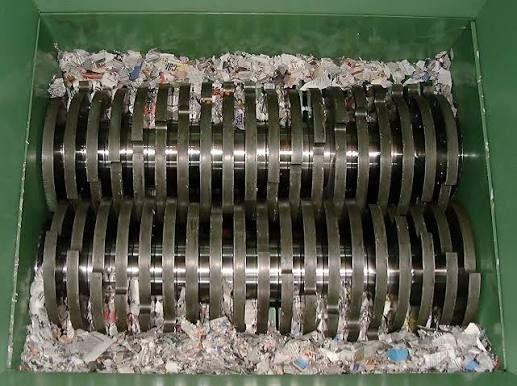
Industrial waste shredders are heavy-duty machines designed to reduce the size of waste materials through cutting, tearing, shearing, and compression.
They are used in waste-processing facilities, recycling plants, manufacturing operations, municipal waste management, and specialized material-recovery processes.
Different shredder configurations are designed for different waste streams. Plastic, wood, rubber, paper, textiles, packaging materials, industrial residues, and other materials can require different rotor designs, cutting systems, drive configurations, and discharge arrangements.
What Are Industrial Waste Shredders?
Industrial waste shredders are mechanical size-reduction machines that process waste into smaller and more manageable pieces.
Unlike simple cutting machines, industrial shredders are designed to handle substantial material loads and varying feed characteristics.
They can be used to:
- Reduce waste particle size
- Prepare materials for downstream separation
- Improve material handling
- Prepare waste for recycling
- Produce alternative fuel feedstock
- Reduce material volume
- Process mixed industrial waste
Shredding is often one stage within a larger waste-processing system.
How Do Industrial Waste Shredders Work?
The basic shredding process consists of several stages.
1. Material Feeding
Waste material enters the shredder through a hopper or conveyor system.
2. Material Engagement
Rotating cutters, shafts, or other cutting elements capture the incoming material.
3. Size Reduction
The material is subjected to shearing, tearing, compression, or cutting forces.
4. Particle Discharge
Processed material exits through the discharge opening.
5. Size Control
Some shredders use screens or sizing systems to control the maximum particle dimensions.
Oversized material may remain inside the cutting chamber until it reaches the required size.
Types of Industrial Waste Shredders
Different shredder designs are selected according to waste characteristics and desired output.
Single-Shaft Shredders
Single-shaft shredders generally use one rotating rotor combined with stationary counter knives.
A hydraulic ram or feed mechanism can push material toward the rotor.
They are commonly used for:
- Plastics
- Wood
- Rubber
- Industrial waste
- Packaging materials
Double-Shaft Shredders
Double-shaft shredders use two counter-rotating shafts fitted with cutting discs or knives.
They can provide strong tearing and shearing action for bulky materials.
Applications include:
- Mixed waste
- Packaging waste
- Industrial residues
- Textiles
- Bulky materials
Four-Shaft Shredders
Four-shaft systems use multiple cutting shafts to achieve controlled size reduction.
They can be configured for applications requiring greater particle-size control.
Primary Shredders
Primary shredders are designed to process large or bulky waste into smaller pieces.
They are commonly positioned near the beginning of a waste-processing line.
Secondary Shredders
Secondary shredders process material that has already undergone initial size reduction.
They are often used when a smaller or more consistent output is required.
Granulators
Granulators use high-speed cutting mechanisms to produce relatively smaller particles.
They are frequently associated with plastics and other suitable recyclable materials.
Major Components of Industrial Waste Shredders
| Component | Primary Function |
|---|---|
| Feed Hopper | Receives waste material |
| Rotor | Supports rotating cutting elements |
| Cutting Knives | Reduce material size |
| Counter Knives | Provide opposing cutting surfaces |
| Drive Motor | Provides mechanical power |
| Gearbox | Transfers and controls torque |
| Hydraulic System | Supports feeding or ram movement |
| Screen | Controls output size |
| Discharge Conveyor | Transfers processed material |
| Control Panel | Manages machine operation |
| Sensors | Monitor operating conditions |
| Safety System | Helps protect operators and equipment |
Component configurations vary according to shredder design.
Shredding Mechanisms
Shearing
Material is cut between moving and stationary cutting surfaces.
Shearing is effective for many flexible and semi-rigid waste materials.
Tearing
Counter-rotating shafts can pull and tear bulky waste apart.
Compression
Hydraulic feeding systems can compress material against the rotor to improve engagement.
Cutting
Sharp cutting elements divide material into smaller pieces.
Most industrial shredders combine several of these mechanisms.
Applications of Industrial Waste Shredders
Plastic Waste Processing
Industrial shredders can process suitable:
- Plastic containers
- Packaging materials
- Plastic sheets
- Production scrap
- Large plastic components
The shredded material can then move to washing, sorting, extrusion, or other downstream processes.
Wood Waste Processing
Wood shredders can process:
- Pallets
- Wood offcuts
- Boards
- Crates
- Forestry residues
- Furniture waste
Processed wood may be directed toward further material processing or energy-related applications where appropriate.
Rubber Waste Processing
Industrial shredders can reduce suitable rubber materials into smaller pieces.
Applications can include:
- Rubber manufacturing residues
- Rubber products
- Selected tire-processing stages
Additional granulation or separation may be required to reach a specific particle size.
Paper and Cardboard
Shredders can process paper-based waste from manufacturing and commercial operations.
Size reduction can facilitate downstream sorting, baling, or recycling processes.
Textile Waste
Textile shredders can process suitable:
- Fabric scraps
- Garment waste
- Fibers
- Production offcuts
Material properties influence knife selection and machine configuration.
Municipal and Commercial Waste
Heavy-duty shredders can process selected mixed waste streams.
A complete processing line may combine shredding with screening, magnetic separation, air classification, and other technologies.
Industrial Production Waste
Manufacturing facilities can use shredders to process production residues and rejected materials.
The appropriate machine depends heavily on the material composition and contamination level.
Shredder Specifications
Several technical specifications should be evaluated when selecting an industrial waste shredder.
Throughput
Throughput indicates the quantity of material the machine can process over a defined period.
Actual throughput depends on material density, moisture, particle size, feed method, and desired output size.
Motor Power
Motor power affects available cutting energy.
Higher-power systems may be appropriate for dense, bulky, or difficult materials, although power requirements depend on machine design.
Rotor Speed
Rotor speed affects cutting behavior, throughput, noise, heat generation, and energy consumption.
Cutting Chamber
The chamber dimensions determine the approximate size and volume of material that can enter the machine.
Output Size
Output size depends on cutter geometry, rotor configuration, screen dimensions, and material characteristics.
Automation in Industrial Waste Shredders
Modern shredders can incorporate automated controls and monitoring systems.
Automation may control:
- Feed rate
- Rotor speed
- Hydraulic ram operation
- Motor load
- Reversing cycles
- Temperature
- Vibration
- Conveyor operation
- Automatic shutdown
Automatic Reversing
Some systems can temporarily reverse the rotor when excessive resistance or material blockage is detected.
Load Monitoring
Motor-current or torque monitoring can identify changing load conditions.
PLC Control
A programmable logic controller can coordinate the shredder with conveyors, feeders, screens, and downstream equipment.
Shredder Blade and Cutter Selection
Cutting elements must be matched to the material being processed.
Important considerations include:
- Material hardness
- Abrasiveness
- Moisture
- Thickness
- Material shape
- Contamination
- Desired output size
Blade geometry and material composition influence cutting performance and wear resistance.
Replaceable cutters can simplify maintenance when wear occurs.
Common Industrial Waste Shredder Problems
Material Jamming
Oversized objects, unsuitable feed materials, or excessive loading can cause blockages.
Excessive Blade Wear
Abrasive contaminants, hard materials, or prolonged operation can accelerate cutter wear.
Motor Overload
High material resistance, excessive feed rate, or mechanical problems can increase motor load.
Uneven Output Size
Incorrect screen selection, worn cutters, or inconsistent feed material can affect output-size uniformity.
Excessive Vibration
Vibration may result from rotor imbalance, bearing wear, damaged cutters, or material accumulation.
Hydraulic Problems
Hydraulic systems can experience pressure loss, leakage, overheating, or component wear.
Maintenance of Industrial Waste Shredders
Regular maintenance helps preserve machine performance and reliability.
Typical maintenance activities include:
- Inspecting cutting knives
- Checking rotor condition
- Monitoring bearing temperature
- Checking gearbox lubrication
- Inspecting hydraulic components
- Checking motor condition
- Cleaning the cutting chamber
- Inspecting screens
- Checking conveyors
- Testing sensors
- Inspecting safety systems
- Checking electrical connections
Wear components should be inspected according to material type, operating hours, and machine specifications.
Safety Considerations
Industrial shredders contain powerful rotating and cutting mechanisms.
Important safety measures can include:
- Guarding around moving components
- Emergency-stop systems
- Interlocked access doors
- Feed-zone protection
- Lockout/tagout procedures
- Overload protection
- Proper electrical protection
- Safe maintenance procedures
- Operator training
Waste streams should also be evaluated for hazardous or unsuitable materials before processing.
How to Select Industrial Waste Shredders
Selection should begin with a detailed assessment of the waste stream.
Consider:
- Material type
- Material density
- Material size
- Moisture content
- Abrasiveness
- Contamination
- Required throughput
- Required output size
- Feed method
- Motor power
- Rotor configuration
- Cutter design
- Screen requirements
- Automation
- Maintenance access
- Available installation space
Representative material testing can help determine the appropriate cutter configuration and machine capacity.
Single-Shaft vs Double-Shaft Shredders
| Factor | Single-Shaft Shredder | Double-Shaft Shredder |
|---|---|---|
| Number of Rotors | One | Two |
| Cutting Action | Rotor and counter knives | Counter-rotating shafts |
| Feed Assistance | Often hydraulic | Often gravity or assisted |
| Size Control | Can use screen | Depends on configuration |
| Typical Materials | Plastic, wood, rubber | Bulky and mixed waste |
| Output Consistency | Generally higher with screen | Depends on design |
The best configuration depends on the waste characteristics and desired processing result.
How to Evaluate Industrial Waste Shredder Manufacturers
When evaluating industrial waste shredder manufacturers, consider their engineering capabilities and machine configurations.
Important factors include:
- Shredder technology
- Rotor design
- Cutter materials
- Motor and gearbox configuration
- Hydraulic system
- Feed arrangement
- Screen configuration
- Throughput range
- Output-size options
- Automation
- Safety systems
- Wear-component design
- Testing procedures
- Technical documentation
- Maintenance requirements
The manufacturer should be able to match the shredder configuration with the material type, feed dimensions, throughput, output-size requirements, and downstream process.
Integrating Shredders Into Waste-Processing Lines
Industrial shredders are often part of a larger material-processing system.
A typical line may include:
Receiving → Feeding → Primary Shredding → Screening → Secondary Shredding → Separation → Storage
Depending on the waste stream, additional equipment may include:
- Magnetic separators
- Eddy-current separators
- Air classifiers
- Trommel screens
- Wash systems
- Granulators
- Conveyors
- Compaction equipment
Proper integration helps maintain material flow between processing stages.
Frequently Asked Questions
What are industrial waste shredders used for?
Industrial waste shredders reduce the size of waste materials such as plastics, wood, rubber, paper, textiles, packaging, and selected industrial residues.
What are the main types of industrial waste shredders?
Common types include single-shaft, double-shaft, four-shaft, primary, secondary, and specialized granulating systems.
What determines shredder output size?
Output size depends on cutter geometry, rotor design, screen configuration, feed characteristics, and machine operating parameters.
How do I select an industrial waste shredder?
Evaluate the waste material, dimensions, density, moisture, abrasiveness, contamination, required throughput, target output size, feed system, cutter configuration, automation, and maintenance requirements.
Why is blade selection important?
Cutter design and material influence cutting performance, wear behavior, maintenance intervals, and suitability for different waste materials.
Conclusion
Industrial waste shredders provide mechanical size reduction for a wide range of industrial, commercial, and recycling applications. Single-shaft, double-shaft, four-shaft, primary, and secondary shredders can be configured for different material characteristics and output requirements.
Machine performance depends on material composition, feed size, density, moisture, cutter configuration, rotor speed, motor power, and desired particle size. Automated load monitoring, reversing systems, PLC controls, and integrated conveyors can improve process coordination and operational control.
When selecting industrial waste shredders, manufacturers and processing facilities should evaluate the complete waste stream rather than relying on material names alone. Testing representative materials, matching cutter and rotor designs, and integrating the shredder with appropriate screening and separation equipment can help create an effective waste-processing system.