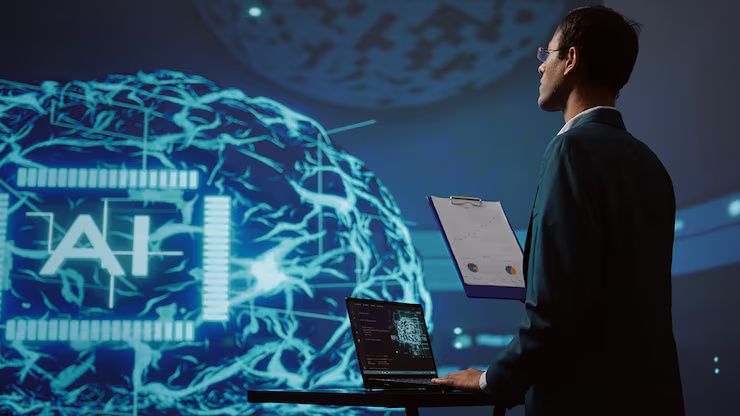
Deep learning is a subset of artificial intelligence (AI) and machine learning that focuses on training computer systems to learn patterns from large amounts of data using structures called neural networks. These networks are inspired by how the human brain processes information, using layers of interconnected units to analyze data step by step. The term “deep” refers to the presence of multiple layers that allow systems to learn increasingly complex representations.
Deep learning exists because traditional programming struggles with unstructured data such as images, audio, video, and natural language. Earlier methods required manually defined rules, which limited flexibility and accuracy. Deep learning systems, however, learn directly from data, enabling tasks like image recognition, language translation, and speech understanding.
Its growth accelerated with advancements in computing power, availability of large datasets, and improved algorithms. Technologies like GPUs and cloud computing made it practical to train complex neural networks.
Importance: Why Deep Learning Matters Today
Deep learning is important because it enables computers to perform complex tasks that were previously difficult or impossible. It plays a major role in modern digital systems and innovation.
Who It Affects
- Students learning artificial intelligence
- Researchers developing advanced models
- Engineers building intelligent systems
- Organizations analyzing large datasets
- Healthcare professionals using data insights
- Transportation planners using predictive tools
- Everyday users interacting with smart devices
Why It Matters
Deep learning matters because it:
- Improves accuracy in image and speech recognition
- Supports natural language processing and translation
- Enables predictive analytics and pattern discovery
- Enhances automation in complex systems
- Extracts insights from large datasets
- Improves safety and efficiency in digital environments
Problems It Helps Solve
- Difficulty processing unstructured data
- Limited accuracy of rule-based systems
- Challenges in recognizing complex patterns
- Scalability issues in traditional analysis
- Need for systems that improve over time
Traditional Programming vs Deep Learning
| Traditional Programming | Deep Learning Systems |
|---|---|
| Rules defined manually | Patterns learned from data |
| Limited flexibility | Adaptive and scalable |
| Struggles with images | Strong with unstructured data |
| Manual feature design | Automatic feature learning |
| Static behavior | Improves with more data |
Recent Updates and Trends (2024–2025)
Deep learning continues to evolve with new capabilities and applications.
Multimodal Models
Models that process text, images, audio, and video together have become more common, enabling richer understanding.
Efficiency Improvements
Techniques such as model compression and optimization reduce size and energy usage while maintaining performance.
Responsible AI Practices
There is increasing focus on fairness, transparency, and explainability in model design and deployment.
Scientific Applications
Deep learning is widely used in climate modeling, medical imaging, drug discovery, and materials research.
Edge Computing Integration
More models are running directly on devices like smartphones and sensors, improving speed and privacy.
Laws and Policies: Governance of Deep Learning
Deep learning operates within legal and ethical frameworks that ensure responsible use.
Key Regulatory Areas
- Data privacy and protection laws
- AI governance and accountability frameworks
- Sector-specific compliance (healthcare, finance, etc.)
- Intellectual property considerations
- Bias detection and fairness guidelines
These frameworks help ensure transparency, accountability, and user protection.
Tools and Resources for Deep Learning
Various tools support learning, development, and experimentation in deep learning.
Development Tools
- Deep learning frameworks
- Notebook environments for coding
- GPU-enabled platforms
- Model visualization tools
Learning Resources
- Online tutorials and documentation
- Open datasets for experimentation
- Interactive simulations
Data and Analysis Tools
- Data preprocessing libraries
- Statistical analysis tools
- Model evaluation utilities
Collaboration Resources
- Code-sharing platforms
- Research paper repositories
- Community forums
Frequently Asked Questions
What is deep learning?
It is a method where computers learn patterns from data using layered neural networks.
How is it different from machine learning?
Deep learning is a subset of machine learning focused on multi-layer neural networks.
What data can it use?
It can process images, text, audio, video, and structured data.
Is it used in daily life?
Yes, in voice assistants, recommendation systems, translation tools, and more.
Do you need advanced math?
Basic understanding is possible without advanced math, but deeper work involves mathematics.
Conclusion: Deep Learning in Modern Technology
Deep learning is a core part of modern artificial intelligence, enabling systems to learn from data and perform complex tasks. It has transformed how computers process information and interact with the world.
Recent trends highlight efficiency, multimodal learning, ethical responsibility, and broader applications. With growing tools and resources, deep learning continues to expand its role in shaping technology and society.