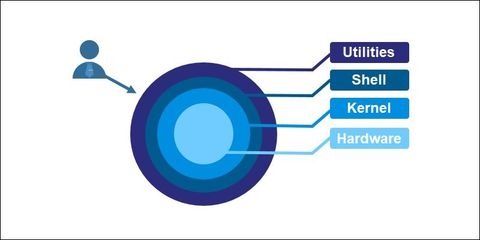
An IoT operating system (IoT OS) is software designed to control and coordinate the hardware, networking, applications, and data-processing functions of connected devices.
IoT devices can range from sensors and smart appliances to industrial controllers, medical equipment, vehicles, and agricultural monitoring systems. Many have limited memory, processing power, battery capacity, or connectivity compared with computers and smartphones.
An IoT operating system provides the underlying software environment that allows these devices to perform their intended functions.
Depending on the device, an IoT OS may manage:
- Sensors and actuators
- Processors and memory
- Wireless communication
- Device drivers
- Power consumption
- Real-time operations
- Network connections
- Security functions
- Data collection
- Application execution
- Firmware updates
Common IoT operating-system approaches include real-time operating systems (RTOS), embedded Linux, lightweight operating systems, and specialized microcontroller operating systems.
Examples include Zephyr, FreeRTOS, Mbed OS, RIOT, and Linux-based embedded platforms.
The appropriate operating system depends on factors such as hardware architecture, memory availability, real-time requirements, connectivity, security needs, and application complexity.
Why IoT Operating Systems Matter
IoT devices increasingly operate in environments where reliability, security, and efficient resource use are important.
A sensor powered by a battery may need to remain operational for an extended period while transmitting small amounts of data. An industrial controller may need to respond to an event within a predictable time period. A connected appliance may need network connectivity and secure firmware updates.
An IoT OS helps provide the software foundation for these requirements.
Real-time performance is particularly important in industrial automation, robotics, automotive systems, and other applications where predictable response times matter.
Power management is important for battery-operated sensors and portable devices. An operating system can coordinate sleep modes, processor states, and communication activity.
Connectivity is another major consideration. IoT platforms may need support for Wi-Fi, Bluetooth Low Energy, cellular networks, Thread, Zigbee, Ethernet, or other communication technologies.
Security is equally important because connected devices can become targets for unauthorized access, malware, data interception, or manipulation.
| IoT OS Capability | Why It Matters |
|---|---|
| Real-time scheduling | Provides predictable task execution |
| Power management | Helps reduce energy consumption |
| Network support | Enables device communication |
| Hardware abstraction | Simplifies hardware development |
| Security features | Helps protect devices and data |
| Device drivers | Connects software with hardware |
| OTA updates | Supports remote firmware maintenance |
| Memory management | Handles limited device resources |
| Connectivity protocols | Supports different IoT networks |
| Edge computing | Enables local data processing |
IoT operating systems therefore affect embedded developers, manufacturers, industrial organizations, researchers, cybersecurity teams, and companies developing connected products.
Recent Developments in IoT Operating Systems
IoT operating systems continue to evolve alongside edge computing, connected devices, IoT cybersecurity, and edge AI.
In March 2026, the Zephyr Project announced Zephyr 4.4, adding new capabilities and continuing the project's development of an open-source real-time operating system for resource-constrained devices. The release included improvements across architecture support, networking, drivers, and system functionality. (zephyrproject.org)
Zephyr has increasingly focused on making its RTOS suitable for a broad range of embedded systems, including connected IoT devices.
FreeRTOS also continues to be developed as a real-time operating system for microcontrollers and small processors. Its ecosystem includes networking, security, and device-management capabilities designed for connected embedded systems. (freertos.org)
The Linux Foundation's Yocto Project remains an important part of embedded Linux development. It provides tools and processes for creating customized Linux-based systems for embedded products rather than functioning as a conventional desktop Linux distribution. (yoctoproject.org)
The growth of edge AI is also influencing IoT operating-system requirements. More devices are processing information locally instead of sending every piece of data to a cloud platform. This can reduce network dependency and enable faster responses for selected applications.
Security has become another major development area. IoT operating systems increasingly incorporate secure boot, cryptographic libraries, hardware security features, signed firmware, access controls, and secure update mechanisms.
The overall trend is toward operating systems that combine low-resource computing with stronger networking, cybersecurity, remote management, and edge-processing capabilities.
Laws, Regulations, and Policies in India
IoT operating systems can be affected by Indian requirements concerning cybersecurity, personal data, telecommunications, product security, and sector-specific regulation.
The Digital Personal Data Protection Act, 2023 is relevant when connected devices collect or process personal data covered by the legislation. The Ministry of Electronics and Information Technology published the Digital Personal Data Protection Rules, 2025 on November 14, 2025. Different provisions have different commencement timelines under the rules. (meity.gov.in)
This can be relevant to IoT systems that collect information associated with identifiable individuals, particularly where sensor data, device identifiers, location information, or other personal information is processed.
Cybersecurity requirements are also important. CERT-In's directions issued under Section 70B of the Information Technology Act, 2000 establish requirements relating to cybersecurity incident reporting and information-security practices. The directions include requirements concerning the maintenance of ICT system logs for a rolling period of 180 days in the specified circumstances. (cert-in.org.in)
For telecommunications and connected-device ecosystems, organizations may also need to consider requirements administered by the Department of Telecommunications and other relevant authorities.
Different industries can have additional requirements. Connected medical devices, automobiles, financial systems, industrial infrastructure, and consumer electronics may be subject to different regulatory frameworks.
Organizations should therefore evaluate the applicable requirements based on the device, data, industry, network, and deployment environment rather than treating all IoT devices as subject to identical rules.
Tools and Resources for IoT Operating Systems
Developers and organizations can use several established resources when evaluating or developing IoT operating systems.
- Zephyr Project: Open-source RTOS designed for resource-constrained embedded systems.
- FreeRTOS: Real-time operating system for microcontrollers and small embedded processors.
- Yocto Project: Tools and methodology for building customized embedded Linux systems.
- RIOT OS: Open-source operating system designed for IoT and constrained devices.
- Mbed OS: Embedded operating-system technology developed for connected microcontrollers.
- Linux kernel: Provides the foundation for many embedded Linux environments.
- QEMU: Can emulate different hardware architectures for development and testing.
- PlatformIO: Development environment supporting embedded programming and multiple hardware platforms.
- Wireshark: Network-analysis tool that can help examine IoT communications.
- OWASP IoT resources: Security guidance covering common risks associated with connected devices.
- NIST IoT cybersecurity guidance: Provides security recommendations and frameworks for connected-device environments.
When selecting an IoT operating system, technical teams commonly evaluate processor architecture, memory requirements, real-time capabilities, networking support, security architecture, update mechanisms, hardware compatibility, development tools, and long-term maintenance requirements.
Frequently Asked Questions
What is an IoT operating system?
An IoT operating system is software designed to manage the hardware, applications, networking, memory, power, and other functions of connected embedded devices.
What is the difference between an IoT OS and a normal operating system?
An IoT OS is generally designed for devices with more limited resources and specialized requirements. It may prioritize low power consumption, predictable response times, small memory footprints, hardware control, and embedded networking.
Is Linux an IoT operating system?
Linux can be used as the foundation of an IoT operating system. Embedded Linux distributions can be customized for specific hardware and applications. However, Linux is generally more resource-intensive than lightweight RTOS platforms.
What is an RTOS?
An RTOS, or real-time operating system, is designed to execute tasks within predictable timing constraints. RTOS platforms are commonly used where consistent response times are important, including industrial control, robotics, automotive systems, and embedded IoT applications.
Why is IoT security important?
IoT devices are connected to networks and may collect, process, or control sensitive information and physical systems. Security weaknesses can potentially expose data or allow unauthorized interaction with devices. Secure boot, authentication, encryption, protected updates, access controls, and monitoring can help reduce these risks.
The Future of IoT Operating Systems
IoT operating systems are becoming an important software layer between connected hardware and increasingly intelligent applications.
The development of edge computing and edge AI is changing what connected devices can do locally. Instead of sending every sensor reading to a remote cloud platform, some devices can process information near the point where it is generated.
This creates new requirements for operating systems. They increasingly need to combine efficient resource management with networking, cybersecurity, remote updates, hardware acceleration, and local data processing.
The expansion of connected devices also makes long-term security increasingly important. An IoT device can remain deployed for years, meaning its operating system and firmware may need regular security maintenance throughout its operational life.
Recent releases such as Zephyr 4.4 demonstrate continued development of lightweight real-time operating systems for embedded and connected devices. (zephyrproject.org)
For organizations operating in India, IoT development also needs to account for applicable privacy, cybersecurity, telecommunications, and sector-specific requirements.
Overall, IoT operating systems provide the foundation for connected devices by coordinating hardware, software, networking, security, and resource management. As IoT moves toward more capable edge computing and AI-enabled devices, the operating system will remain an important part of reliable and secure connected-device architecture.