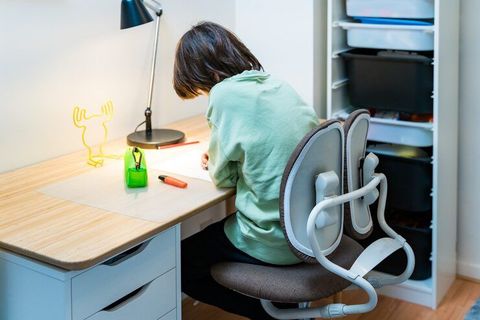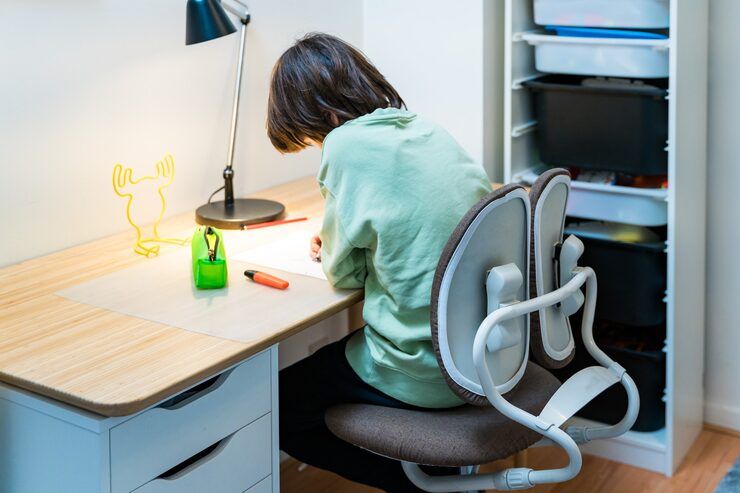
Kids’ height-adjustable study desks are designed to accommodate children as they grow. Unlike fixed-height desks, these desks allow the working surface to be raised or lowered to suit a child's height, seating arrangement, and learning activities.
They are used in homes, schools, libraries, tutoring rooms, and other educational environments. Their main purpose is to create a practical workspace for reading, writing, drawing, homework, and computer-based learning.
Children's furniture requires particular attention because body proportions change throughout childhood. A desk that fits a younger child may become uncomfortable as the child grows. Adjustable furniture can help address this challenge by allowing the workspace to change without replacing the entire desk whenever a height adjustment becomes necessary.
Understanding Height-Adjustable Study Desks
A height-adjustable study desk has a working surface that can be moved vertically. Depending on its design, the adjustment mechanism may be manual or powered by an electric motor.
Manual models may use knobs, locking pins, cranks, or telescopic legs. Electric models typically use motorized lifting mechanisms and control buttons.
Some desks also include adjustable desktop angles, storage compartments, cable-management features, or integrated shelves. These additional features can help organize books, stationery, electronic devices, and other learning materials.
Common types include:
Manual adjustable desks: Height changes through a mechanical adjustment system.
Electric adjustable desks: Motorized mechanisms raise or lower the desktop.
Tilt-top study desks: The writing surface can be angled for selected activities.
School desks: Designed for classroom use and frequent adjustments.
Compact study desks: Intended for bedrooms or smaller learning areas.
Convertible desks: Designed to support different working positions or activities.
The most suitable design depends on the child's age, height, available space, intended activities, and the desk's adjustment range.
How Adjustable Study Desks Work
Most adjustable desks use legs or support columns that extend or retract to change the desktop height.
A manual desk relies on mechanical components to maintain the selected position. An electric model uses motors and a control system to adjust the height, although its operating range and lifting capacity depend on the model.
When choosing a desk, it is important to consider the lowest and highest usable settings rather than relying only on a general age recommendation.
The desk should also provide enough surface area for books, notebooks, writing materials, and any electronic devices used for learning.
Why Height-Adjustable Study Desks Matter
A properly arranged study environment can help children complete learning activities more comfortably. Desk height is one part of this environment, alongside chair dimensions, lighting, screen placement, and the organization of study materials.
Supporting Ergonomic Posture
Ergonomics concerns how furniture and equipment fit the people using them. For children, a suitable desk height helps reduce the need to lean excessively forward, raise the shoulders, or adopt awkward arm positions while writing.
A practical workstation arrangement generally aims for:
Feet supported by the floor or a suitable footrest
Knees positioned comfortably
Shoulders relaxed while writing
Elbows close to the body
Forearms supported comfortably by the work surface
Reading materials positioned for clear visibility
These guidelines should be adapted to the child's proportions and activity. Adjustability alone does not guarantee good posture; the chair and the overall workspace must also fit.
Supporting Different Learning Activities
Children use study desks for several purposes, including handwriting, reading, drawing, puzzles, and computer-based assignments.
A suitable desk can provide enough room to arrange these materials without excessive clutter. Models with adjustable angles may also help position certain books or drawing materials more conveniently.
However, a tilted surface is not necessary for every activity. A level work surface is generally practical for many writing and computer tasks.
Making Furniture Useful as Children Grow
Children grow at different rates, so chronological age is not a reliable measurement of the correct desk height.
An adjustable design allows caregivers to change the workspace as a child's measurements and learning needs change. The adjustment range should still be checked carefully because some desks are designed for younger children while others accommodate a wider range of heights.
Comparing Desk Types
| Desk Type | Main Advantage | Important Consideration |
|---|---|---|
| Manual adjustable | Simple mechanical operation | Adjustment may require more effort |
| Electric adjustable | Convenient height changes | Requires power and motor maintenance |
| Tilt-top desk | Flexible surface angle | Needs a secure locking mechanism |
| Compact adjustable | Suitable for limited space | Desktop area may be restricted |
| Classroom adjustable | Supports different users | Durability and stability are important |
Recent Developments and Trends
Children's study furniture has increasingly reflected interest in ergonomic design, flexible learning environments, compact home workspaces, and furniture that can adapt over time.
Ergonomic Learning Environments
During 2025 and 2026, ergonomic workspace design continued to be relevant as schools and households balanced traditional study activities with computer-based learning.
An important consideration is that furniture should be matched to the individual child rather than selected solely because it is labelled ergonomic. Appropriate dimensions, stable construction, suitable seating, and regular movement remain important.
Flexible Furniture Design
Height-adjustable desks are part of a wider trend toward flexible furniture for homes and educational settings. Adjustable components can help accommodate different users, changing room layouts, and a mixture of sitting and standing activities.
For children, adjustment should be straightforward, secure, and appropriate to their developmental stage. Complex mechanisms may be less practical when frequent supervision is required.
Materials and Sustainability
Furniture manufacturers have continued to explore materials such as engineered wood, steel frames, durable laminates, and recycled-content components.
Material selection involves trade-offs between durability, weight, maintenance, environmental impact, and structural performance. Claims about recycled content or environmental benefits should be evaluated using product-specific documentation rather than general marketing descriptions.
Technology and Study Organization
Modern study areas may incorporate cable-management channels, device holders, task lighting, and organized storage.
These features can help reduce clutter, but they should not interfere with desk stability or introduce accessible pinch points, exposed electrical components, or loose cables that create tripping hazards.
Laws, Standards, and Child Safety Policies
Requirements for children's study desks vary by country and product category. Applicable rules may cover furniture safety, chemical content, structural stability, electrical components, and general consumer product safety.
Furniture Safety Standards
In the United States, the Consumer Product Safety Commission administers federal consumer product safety requirements. Depending on the product and its intended use, general safety obligations may apply to children's furniture.
ASTM International also publishes voluntary technical standards covering furniture safety and performance. The relevance of a particular standard depends on the type of furniture and its intended setting.
In Europe, furniture may be subject to applicable product safety rules, chemical restrictions, and other requirements under European Union legislation. Electric desks may have additional requirements related to electrical safety and electromagnetic compatibility.
A desk marketed for children should be assessed against the rules applicable in its destination market.
Stability and Mechanical Safety
Height-adjustable desks contain moving components that can create pinch or crush hazards if they are poorly designed or used incorrectly.
Important safety considerations include:
Stable legs and a secure frame
Reliable height-locking mechanisms
Appropriate load capacity
Smooth and controlled adjustment
Protection from accessible moving parts
Safe cable routing for powered models
Assembly according to the manufacturer's instructions
Electric models should also be checked for relevant safety features, such as obstruction detection, where provided.
Safe Use at Home and School
Adults should supervise children when adjusting mechanisms that could trap fingers or cause the desktop to move unexpectedly.
Heavy objects should be distributed according to the desk's load instructions. Children should not climb or sit on the desktop, and desks should be positioned so that cables and accessories do not create additional hazards.
Tools and Resources for Choosing a Study Desk
Several practical resources can help families and schools evaluate children's adjustable furniture.
Desk Height Measurement
Measure the child's height while standing and seated. Check the desk's minimum and maximum adjustment settings against the child's actual working posture.
A simple measurement record can include:
Child's standing height
Seated elbow height
Chair seat height
Desk's minimum height
Desk's maximum height
Available desktop width and depth
The seated elbow measurement can help assess whether the work surface is positioned appropriately when the child is seated with relaxed shoulders.
Ergonomic Assessment Checklist
Before using a desk regularly, check that:
The child can sit with supported feet.
The desktop does not force the shoulders upward.
There is enough knee and leg clearance.
Books and screens can be positioned comfortably.
The adjustment mechanism operates securely.
Lighting is sufficient for reading and writing.
Product Documentation
Manufacturer specifications can help establish the adjustment range, desktop dimensions, maximum load, assembly requirements, materials, warranty terms, and maintenance instructions.
For schools and larger educational facilities, a furniture assessment spreadsheet can compare dimensions, durability, adjustment mechanisms, and accessibility requirements across different desk models.
Frequently Asked Questions
What is a height-adjustable study desk for children?
It is a desk whose working surface can be raised or lowered to accommodate a child's height and study activities. Adjustment mechanisms may be manual or electric.
What desk height is suitable for a child?
The correct height depends on the child's body measurements, chair height, and working posture. The child's shoulders should remain relaxed, and the forearms should rest comfortably when writing. Manufacturer height recommendations can be used as a starting point, not a substitute for checking the actual fit.
Are electric adjustable desks suitable for children?
They may be suitable when designed for the intended age group and used with appropriate supervision. Safety features, stable construction, movement controls, electrical protection, and the manufacturer's age guidance should be reviewed before use.
Is a height-adjustable desk better than a fixed desk?
An adjustable desk can accommodate changes in a child's height and may suit households with multiple users. A fixed desk can also work well if its dimensions fit the child correctly. The choice depends on adjustment needs, space, durability, and overall workspace design.
How should a children's adjustable desk be maintained?
Inspect the frame, fasteners, adjustment mechanism, desktop surface, and cables periodically. Follow the manufacturer's cleaning and maintenance instructions, avoid exceeding the specified load, and discontinue use if the desk becomes unstable or develops a mechanical fault.
Conclusion
Kids' height-adjustable study desks provide a flexible way to organize learning spaces as children grow. Their main advantages include adaptable working height, support for different study activities, and the potential to reduce the need for repeated furniture replacement when a child's dimensions change.
However, adjustment alone does not guarantee an ergonomic or safe workspace. The desk must fit the child, work with the chair, provide sufficient room, and maintain structural stability throughout its adjustment range.
Understanding desk dimensions, mechanical features, material quality, safety requirements, and maintenance needs helps families and educational institutions make informed decisions. A well-planned study environment combines suitable furniture with appropriate lighting, organized materials, comfortable posture, and regular movement during learning activities.