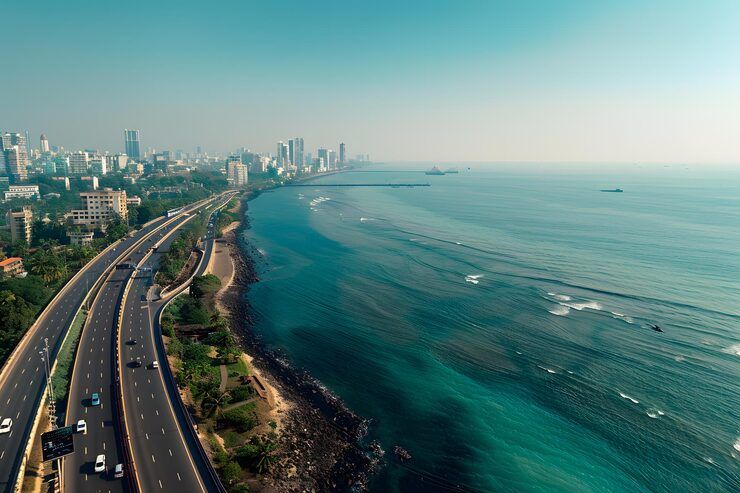
Mumbai’s Marine Drive is one of the city’s most recognizable waterfront areas. The broad promenade follows a curved stretch of the Arabian Sea and provides views of the coastline, urban skyline, changing light, and evening activity.
Known for its distinctive curved shape, Marine Drive connects the southern part of Mumbai with several important neighborhoods and landmarks. Its open seafront environment also makes it a useful place for understanding how a dense coastal city interacts with public space, transportation, tourism, and environmental conditions.
The Geography Behind Marine Drive
Marine Drive is located along Mumbai’s South Mumbai coastline. The road and promenade form part of a reclaimed coastal area, reflecting Mumbai’s long history of modifying land and infrastructure around the Arabian Sea.
The waterfront faces west, making the area particularly notable around sunset. The combination of the sea, curved road, high-rise buildings, and illuminated streets creates the visual character commonly associated with the location.
The promenade is approximately 3.6 kilometers long and is often associated with the nickname “Queen’s Necklace,” referring to the curved line of streetlights visible from elevated viewpoints at night.
What Visitors Can See
A walk along Marine Drive can provide several different perspectives of Mumbai:
- Arabian Sea horizons and changing coastal conditions
- Mumbai’s southern skyline
- The curved waterfront road and promenade
- Sunset and evening city lighting
- Passing pedestrians, runners, and cyclists
- Views toward nearby coastal landmarks
- Changing scenery during monsoon weather
The experience varies considerably by time of day. Early mornings tend to have a quieter atmosphere, while evenings generally bring greater pedestrian activity.
Marine Drive and Mumbai’s Urban Landscape
Marine Drive is more than a scenic location. It is part of a densely developed urban environment where residential, commercial, cultural, transportation, and recreational activities exist close together.
Its waterfront illustrates an important feature of Mumbai: limited land availability combined with a large metropolitan population. Public coastal spaces therefore have both recreational and environmental importance.
Why Marine Drive Views Matter Today
Marine Drive provides an accessible way to observe Mumbai's relationship with its coastline. The promenade is used by residents, visitors, photographers, walkers, runners, and people seeking an open public environment within the city.
A Public Waterfront Space
Large open waterfront areas can be particularly significant in dense cities. Marine Drive gives people an opportunity to spend time outdoors without needing to travel far from central neighborhoods.
The location also contributes to Mumbai's tourism identity. Images of the curved waterfront and skyline are frequently associated with the city internationally.
Tourism and Local Mobility
Marine Drive is connected with several major South Mumbai destinations. Visitors can combine a waterfront walk with nearby cultural, architectural, and recreational attractions.
Its location also makes it relevant to urban mobility. Public transportation and road networks around South Mumbai provide connections between Marine Drive and other parts of the metropolitan region.
Environmental Awareness
Because Marine Drive directly faces the Arabian Sea, it also provides a visible example of coastal exposure. High tides, heavy rainfall, strong winds, and monsoon conditions can change the appearance and accessibility of the waterfront.
Climate-related coastal risks have increased the importance of planning, drainage, shoreline management, and public safety in Mumbai.
Typical Conditions by Time
| Period | General Character | Possible Considerations |
|---|---|---|
| Early morning | Quieter promenade | Good visibility and walking conditions |
| Afternoon | Brighter, warmer environment | Heat and sun exposure |
| Sunset | High visual interest | Greater pedestrian activity |
| Evening | Illuminated skyline | More crowded in popular areas |
| Monsoon | Dramatic coastal conditions | Rain, waves, wind, and slippery surfaces |
Recent Developments and Trends
Mumbai's coastline has remained an important focus of urban planning and infrastructure discussions during 2025 and 2026. One major development affecting the wider coastal landscape is the Mumbai Coastal Road project.
Mumbai Coastal Road
The Mumbai Coastal Road has progressively changed transportation patterns and the appearance of parts of the western coastline. The project includes road infrastructure, tunnels, interchanges, coastal protection measures, and public spaces.
The northbound section toward Marine Drive was opened to traffic in 2024, while subsequent phases and related connectivity have continued to influence travel around the western waterfront.
The project is significant because it combines transportation infrastructure with coastal engineering and public-realm planning.
Promenade and Public-Space Improvements
Marine Drive and nearby waterfront areas continue to require regular maintenance because they experience heavy public use and exposure to saltwater, rain, wind, and seasonal weather.
Recent urban planning discussions have increasingly emphasized pedestrian movement, public accessibility, drainage, coastal resilience, and integration between major infrastructure projects and public spaces.
Changing Visitor Patterns
Digital mapping, social media, smartphone photography, and travel applications have also changed how visitors experience Marine Drive. Sunset viewpoints and nighttime skyline photography remain particularly prominent forms of visitor activity.
However, online photographs do not always represent typical conditions. Weather, crowd levels, construction activity, and visibility can change substantially from one day to another.
Laws, Regulations, and Coastal Policies
Marine Drive is affected by India's broader coastal and environmental framework as well as regulations implemented by Maharashtra and Mumbai authorities.
Coastal Regulation Zone Framework
India's Coastal Regulation Zone, or CRZ, framework establishes rules for development and environmental management in coastal areas.
The Ministry of Environment, Forest and Climate Change issued the Coastal Regulation Zone Notification, 2019, which provides the regulatory framework for activities in designated coastal zones.
The framework is relevant to Mumbai because infrastructure, construction, land reclamation, and other activities near the coast can require consideration of applicable coastal regulations and environmental permissions.
Mumbai Municipal Regulations
The Municipal Corporation of Greater Mumbai is responsible for numerous aspects of the city's public infrastructure and urban management.
Rules concerning public spaces, traffic, waste management, pedestrian areas, construction activity, and public safety can affect conditions around Marine Drive.
Visitors should follow posted instructions and temporary restrictions, particularly during severe weather, major public events, infrastructure work, or other situations requiring temporary access controls.
Coastal Resilience
Mumbai's coastal planning increasingly considers risks associated with flooding, intense rainfall, high tides, and long-term climate change.
This makes coastal infrastructure more than a transportation issue. Drainage, shoreline protection, public access, and environmental management are interconnected parts of urban planning.
Useful Tools and Resources
Several digital resources can help people understand conditions around Marine Drive before visiting.
Maps and Navigation
Digital mapping platforms can help identify Marine Drive entrances, nearby landmarks, transportation connections, walking routes, and road conditions.
Useful information includes:
- Walking directions
- Public transportation connections
- Traffic conditions
- Nearby landmarks
- Estimated travel times
- Location of public facilities
Weather and Tide Information
Weather applications are particularly useful for coastal visits. Checking rainfall, wind, temperature, and weather alerts can provide a better indication of conditions.
Tide information can also be relevant when planning time near the waterfront, particularly during periods of strong weather or unusual coastal conditions.
Government and Civic Resources
Mumbai's municipal and Maharashtra government websites can provide information about infrastructure projects, civic announcements, environmental regulations, and public notices.
The Ministry of Environment, Forest and Climate Change is another useful source for national coastal regulations and environmental policy documents.
Photography Planning
For photography, visitors can consider:
- Sunset timing
- Cloud conditions
- Visibility
- Wind conditions
- Direction of natural light
- Expected pedestrian activity
The best viewpoint can change depending on the intended subject. A wide coastal photograph and a skyline photograph may require different positions and times.
Frequently Asked Questions
What is Marine Drive known for?
Marine Drive is known for its curved Arabian Sea waterfront, promenade, skyline views, street lighting, and association with Mumbai's urban identity. It is commonly called the “Queen’s Necklace” because its nighttime lights resemble a necklace when viewed from an elevated position.
How long is the Marine Drive promenade?
The Marine Drive waterfront extends for roughly 3.6 kilometers. The area includes a broad promenade alongside the road, although the practical walking experience can vary depending on pedestrian movement, weather, and temporary conditions.
When are Marine Drive views most visually distinctive?
Sunset and early evening are particularly popular because the west-facing coastline can provide changing sunset light followed by views of Mumbai's illuminated skyline. Morning conditions can provide a quieter atmosphere.
Is Marine Drive affected by monsoon weather?
Yes. Marine Drive faces the Arabian Sea and can experience heavy rain, strong winds, high waves, and wet surfaces during Mumbai's monsoon season. Visitors should check current weather information and follow any local safety instructions.
What regulations affect development around Marine Drive?
Coastal development is subject to India's coastal regulatory framework, including the Coastal Regulation Zone Notification, 2019, along with applicable state and municipal planning requirements. Specific projects can also be subject to environmental and infrastructure approvals.
Conclusion
Mumbai Marine Drive provides a distinctive view of how a major coastal city combines public space, transportation infrastructure, tourism, and environmental considerations. Its curved waterfront, Arabian Sea horizon, urban skyline, and evening lights have made it an important part of Mumbai's visual identity.
At the same time, Marine Drive is a functioning part of a large metropolitan environment rather than simply a scenic viewpoint. Coastal regulations, infrastructure projects, weather conditions, pedestrian activity, and long-term resilience planning all influence how the area develops.
Understanding these different dimensions provides a broader perspective on Marine Drive and its role in Mumbai's changing coastal landscape.