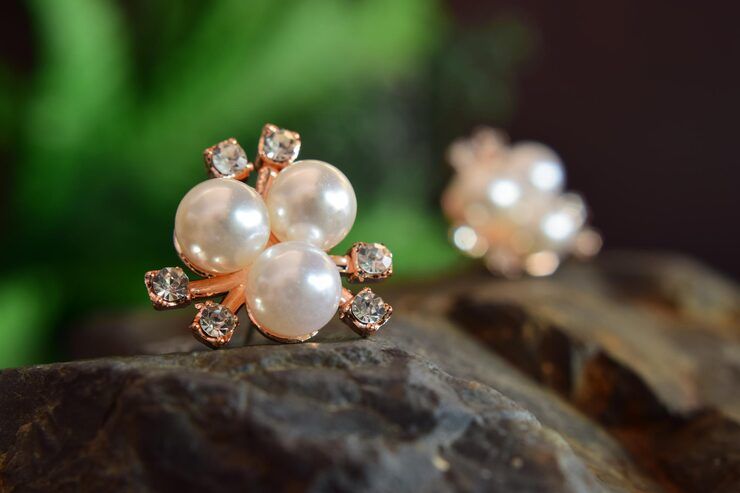
Pearl studs are a classic type of jewellery featuring a single pearl attached to an earring setting. Their simple design makes them suitable for everyday wear, formal occasions, professional environments, and traditional celebrations. Unlike elaborate earrings with multiple decorative elements, pearl studs focus attention on the pearl's natural appearance, surface quality, shape, and lustre.
Pearls form when molluscs produce layers of nacre around an irritant or implanted nucleus. Most pearls used in contemporary jewellery are cultured, meaning that pearl farmers introduce the conditions necessary for pearl formation and allow the mollusc to develop the pearl over time.
Understanding Pearl Stud Earrings
Pearl studs generally consist of a pearl, a mounting, and a fastening mechanism. The pearl is usually secured to a metal post, which passes through the earlobe and is held in place by a backing.
Common setting materials include yellow gold, white gold, platinum, and sterling silver. The choice of metal affects the appearance, durability, maintenance requirements, and overall design of the earrings.
Pearl studs are available in different sizes, colours, shapes, and levels of surface quality. White and cream pearls are widely recognized, while natural and cultured pearls can also display pink, silver, golden, grey, and darker overtones.
Main Types of Pearls
Different pearl varieties develop under different conditions and have distinctive characteristics.
Freshwater pearls: Produced by freshwater mussels, commonly in lakes, rivers, and managed freshwater environments.
Akoya pearls: Traditionally associated with Japanese pearl cultivation, these saltwater pearls are known for their reflective lustre and often round shapes.
South Sea pearls: Produced by large saltwater pearl oysters, these pearls can develop substantial sizes and white, silver, or golden colours.
Tahitian pearls: Cultivated in black-lipped oysters, they commonly display grey, green, peacock, and other dark overtones.
Natural pearls: Form without deliberate human implantation and are comparatively uncommon in the contemporary jewellery market.
Cultured pearls are genuine pearls. The term describes how they formed, not whether they are artificial.
Why Pearl Studs Remain Relevant
Pearl studs remain relevant because their understated design can complement a wide range of clothing styles and occasions. They can also be incorporated into traditional jewellery collections, contemporary minimalist designs, and formal accessories.
Versatility and Personal Style
A small white pearl can create a subtle appearance, while larger pearls can become a more noticeable feature. Coloured pearls and distinctive metal settings provide additional design possibilities.
Pearl studs can complement:
Business and professional clothing
Formal dresses and evening wear
Traditional and cultural clothing
Minimalist everyday outfits
Wedding and celebration attire
Coordinated pearl necklaces or bracelets
The best design depends on personal preference, comfort, clothing, and the occasion.
Understanding Quality
Pearl quality is assessed through several characteristics rather than a single universal grading scale. Important factors include lustre, surface condition, shape, size, colour, nacre quality, and matching between earrings.
Lustre describes the way light reflects from the pearl's surface. Strong lustre can produce crisp reflections, while weaker lustre may appear softer or less defined.
Surface quality refers to visible marks, spots, bumps, or other irregularities. Natural variations are common, and a pearl does not need to have a perfectly uniform surface to be genuine.
| Quality Factor | What to Examine | Why It Matters |
|---|---|---|
| Lustre | Sharpness and brightness of reflections | Influences visual appearance |
| Surface | Spots, pits, bumps, and blemishes | Affects overall finish |
| Shape | Roundness or intentional irregularity | Influences design consistency |
| Size | Diameter measured in millimetres | Changes visual prominence |
| Colour | Body colour and overtones | Affects coordination with clothing |
| Matching | Similarity between the two pearls | Creates a balanced pair |
| Nacre | Thickness and structural quality | Influences durability and appearance |
Pearl grading terminology varies between laboratories and jewellery businesses. Buyers and researchers should therefore examine the stated criteria rather than assuming that labels such as “AAA” represent one internationally standardized system.
Recent Trends and Developments
Pearl jewellery has continued to appear in contemporary fashion through minimalist designs, mixed materials, coloured pearls, and combinations with precious metals and gemstones.
During 2025 and 2026, broader jewellery design discussions have continued to emphasize versatility, personal expression, and the combination of traditional materials with modern settings. Pearl studs fit these preferences because their basic form can be adapted without changing the underlying pearl.
Minimalist Jewellery
Minimalist pearl studs use simple settings and restrained proportions. Small pearls mounted on delicate gold or silver posts can provide a subtle appearance suitable for different clothing styles.
This approach also allows pearl earrings to coordinate with other jewellery without competing for attention.
Mixed Materials and Modern Settings
Contemporary designs sometimes combine pearls with diamonds, coloured gemstones, textured gold, or geometric metal shapes.
These combinations create a contrast between the pearl's smooth surface and the reflective or angular qualities of other materials.
Interest in Pearl Origins
Consumers and jewellery researchers have shown continuing interest in the origins of cultured pearls, the conditions under which they are produced, and the materials used in jewellery settings.
However, sustainability claims should be assessed individually. Pearl cultivation methods, farming conditions, processing, transportation, and metal sourcing can vary, so the presence of a pearl alone does not establish that a piece has a lower environmental impact.
Specific 2026 fashion claims should be checked against dated runway reports, jewellery-industry publications, and documented collection announcements rather than treated as universal trends.
Laws, Standards, and Jewellery Disclosure
Pearl jewellery is affected by consumer-protection rules, precious-metal regulations, product descriptions, and restrictions on misleading claims. The applicable requirements depend on the country where jewellery is produced, marketed, or sold.
Pearl Identification and Disclosure
Jewellery descriptions should distinguish natural pearls, cultured pearls, imitation pearls, and other manufactured materials accurately.
Imitation pearls may be made from glass, plastic, ceramic, or coated materials. Although they can resemble genuine pearls, their composition and formation are different.
The United States Federal Trade Commission's Jewelry Guides provide guidance on accurate descriptions of pearls, gemstones, precious metals, and jewellery treatments. These guides are intended to help prevent misleading representations in the US marketplace.
Precious-Metal Standards
Metal purity is another important consideration. Gold jewellery may be described using karat markings, while platinum and silver jewellery may use different purity designations.
Marking, hallmarking, and disclosure requirements differ by jurisdiction. For example, the United Kingdom operates a statutory hallmarking system for specified precious-metal articles, subject to applicable exemptions.
Consumers examining pearl studs with gold or platinum settings should check the stated metal purity and understand whether the description refers to the entire setting or only certain components.
Gemstone and Pearl Reports
Gemological laboratories can assess pearl identity and selected characteristics. Depending on the laboratory and report type, documentation may address whether a pearl is natural or cultured, its species or origin where determinable, and certain treatments.
A laboratory report is not automatically available for every pearl, and reports differ in scope. Documentation should be evaluated according to the questions it actually answers.
Helpful Tools and Resources
Several resources can help people learn about pearl quality and jewellery materials.
Gemological References
The Gemological Institute of America (GIA) publishes educational material about pearl formation, identification, quality factors, and treatments. Its pearl resources are useful for understanding why two pearls of similar size can have different appearances.
Jewellery Measurement Tools
A simple ruler or millimetre measuring gauge can help compare pearl diameters. A magnifying loupe can make surface features easier to examine, although it cannot independently establish whether a pearl is natural, cultured, or imitation.
Useful observations include:
Pearl diameter in millimetres
Lustre and reflection clarity
Visible surface irregularities
Similarity between the two earrings
Metal markings on the setting
Condition of posts and backings
Care and Storage Resources
Pearls are relatively soft compared with many gemstones and can be damaged by chemicals, abrasion, or unsuitable storage.
A soft cloth, a separate jewellery pouch, and clear care instructions can help maintain their appearance. Professional assessment may be appropriate if a pearl becomes loose or its mounting is damaged.
Frequently Asked Questions
Are cultured pearl studs genuine pearls?
Yes. Cultured pearls form inside molluscs under conditions initiated by human intervention. They are genuine pearls, unlike imitation pearls manufactured from materials such as glass or plastic.
Which pearl type is suitable for stud earrings?
Freshwater, Akoya, South Sea, and Tahitian pearls can all be used for studs. The choice depends on preferred colour, size, lustre, shape, design, and available documentation.
How should pearl studs be cleaned?
Gently wipe them with a soft, clean cloth after wearing. Avoid abrasive cleaners, harsh chemicals, ultrasonic cleaners, and prolonged exposure to cosmetics or perfumes unless a qualified professional confirms that a particular method is appropriate.
What determines pearl quality?
Important factors include lustre, surface condition, shape, size, colour, nacre quality, and matching. Their relative importance depends on pearl type and the criteria used for evaluation.
Can pearl studs be worn every day?
They can be suitable for regular wear when handled carefully. Removing them before swimming, exercising, applying cosmetics, or using household chemicals can help reduce exposure to damaging substances and physical impact.
Conclusion
Pearl studs combine a simple design with a wide range of natural colours, pearl varieties, sizes, and metal settings. Understanding the differences between freshwater, Akoya, South Sea, Tahitian, natural, and imitation pearls helps explain their appearance and construction.
Quality depends on several factors, particularly lustre, surface condition, shape, matching, and nacre characteristics. Accurate descriptions, appropriate documentation, and awareness of precious-metal standards also help clarify what a particular pair contains.
With careful handling and suitable storage, pearl studs can remain a useful part of a jewellery collection across changing styles and occasions. Their lasting appeal comes from the combination of natural variation, restrained design, and adaptability to different personal preferences.