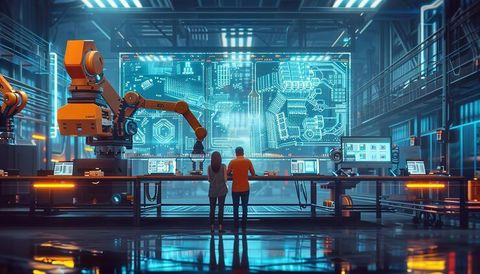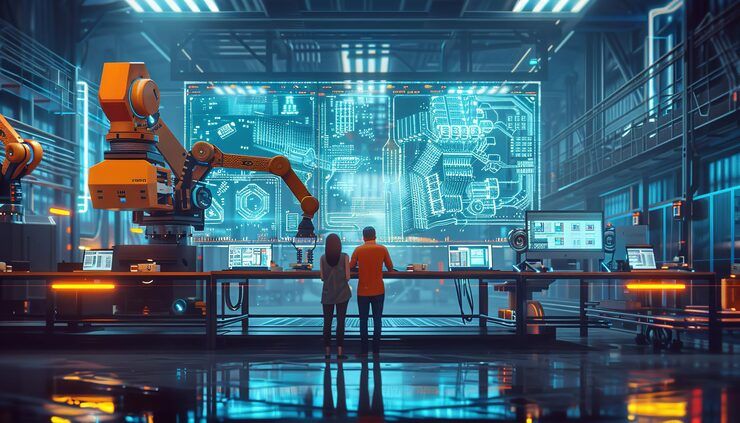
Manufacturing industries are increasingly adopting digital technologies to improve production planning, equipment performance, and operational efficiency. One important development is the digital twin, a virtual representation of a physical machine, production line, facility, or complete manufacturing system.
A digital twin uses information from sensors, industrial equipment, software platforms, and operational records to represent the condition and behaviour of its physical counterpart. Unlike a basic 3D model, it can receive continuous or periodic data and reflect changes occurring in the real manufacturing environment.
The concept exists to help manufacturers understand complex industrial processes without relying entirely on physical testing. Engineers can examine production conditions, evaluate different operating scenarios, and identify potential problems through digital simulations.
A manufacturing digital twin may represent:
Individual machines, including motors, pumps, and robotic equipment.
Production lines and assembly operations.
Entire factories and industrial facilities.
Supply chain processes and material movement.
Energy consumption and equipment performance.
Digital twins are closely connected with Industrial Internet of Things (IIoT), artificial intelligence (AI), machine learning, cloud computing, and industrial automation. Together, these technologies support the development of smart manufacturing environments.
How Digital Twin Technology Works
A digital twin generally operates through a continuous information exchange between physical equipment and its virtual representation.
The process typically involves:
Data collection: Sensors collect information about temperature, vibration, pressure, speed, energy consumption, and equipment activity.
Data transmission: Industrial networks transfer operational information to connected computing platforms.
Digital modelling: Software creates a virtual representation of the machine or manufacturing process.
Simulation and analysis: Engineers examine performance, test scenarios, and identify unusual operating conditions.
Operational improvements: Insights from the digital model help technical teams make informed adjustments to physical operations.
The level of connection varies. Some digital twins update information continuously, while others receive data at scheduled intervals.
Why Digital Twins Matter in Modern Manufacturing
Manufacturing operations involve interconnected machines, materials, employees, and production schedules. Even a small equipment failure can affect multiple stages of production. Digital twin technology helps manufacturers understand these relationships and make decisions using operational data.
Major areas of importance include:
Predictive maintenance: Machine learning algorithms analyse equipment conditions to identify unusual behaviour before it develops into a major breakdown.
Production efficiency: Virtual production line simulations help identify delays, bottlenecks, and unnecessary equipment movements.
Industrial automation: Digital twins support the coordination of robotic systems, automated assembly lines, and connected machinery.
Quality control: Manufacturers can examine production variables and identify conditions that may contribute to defects.
Energy management: Digital models help monitor electricity consumption, equipment loads, and energy-intensive processes.
Product development: Engineers can evaluate product designs and manufacturing methods through virtual testing before physical production.
Supply chain visibility: Connected models can represent inventory movement, material availability, and production dependencies.
Industries Using Digital Twin Technology
Digital twins are relevant across several manufacturing sectors.
Industry | Digital twin application |
|---|---|
Automotive | Vehicle assembly and robotic production |
Aerospace | Aircraft components and manufacturing simulations |
Electronics | PCB assembly and quality monitoring |
Pharmaceuticals | Production environments and process monitoring |
Food processing | Temperature control and production lines |
Heavy machinery | Equipment performance and predictive maintenance |
Chemicals | Process simulation and industrial safety |
Energy equipment | Turbine monitoring and energy performance |
These applications demonstrate how virtual manufacturing models can support different operational requirements.
Digital Twin Technology and Industrial Simulation
Industrial simulation allows engineers to study how manufacturing systems behave under different conditions.
For example, a factory planning to increase production can create a virtual representation of its existing assembly line. Engineers can examine whether additional robotic equipment, faster conveyor systems, or modified production schedules could improve output.
A digital twin can also help evaluate scenarios such as:
Equipment operating at different production speeds.
Changes in raw material availability.
Unexpected machine interruptions.
Increased electricity consumption.
Different factory layouts.
Changes in production demand.
The results depend on the accuracy of the underlying data and simulation models. A digital twin should therefore be regularly validated against actual equipment performance.
Recent Developments and Emerging Trends in Digital Twins
Digital twin technology has continued to develop during 2025 and 2026. Recent progress focuses on standardisation, artificial intelligence integration, interoperability, and connections between different industrial systems.
Artificial intelligence and predictive analytics
AI-powered digital twins are becoming increasingly important in industrial automation. Machine learning models can examine historical and live equipment information to identify unusual patterns, estimate potential failures, and support production planning.
Combining AI with digital twin technology also allows engineers to examine more complex operating scenarios. However, predictions must be evaluated against real-world measurements.
Developments in international manufacturing standards
Several important standards were published in 2026:
In June 2026, ISO published ISO 23247-5:2026, which addresses the digital thread connecting manufacturing digital twins across design, planning, production, and testing.
In July 2026, ISO published ISO 23247-6:2026, covering digital twin composition and the integration of multiple digital twins.
In August 2026, ISO published ISO/TS 25271:2026, defining an interface architecture connecting the physical twin, digital twin, and their interface.
These developments support more consistent approaches to industrial digital twin architecture and communication.
Research into trustworthy digital twins
On July 21, 2026, the US National Institute of Standards and Technology (NIST) published its Digital Twins Workshops Summary Report. It highlighted interoperability, cybersecurity, verification, validation, uncertainty measurement, and workforce readiness as important areas for future manufacturing research.
Industry maturity assessment
IEEE 3144-2025, published on September 8, 2025, introduced a digital twin maturity model and assessment methodology for industry. It provides a structured way to evaluate industrial digital twin capabilities and maturity levels.
Future Trends in Smart Manufacturing
Several developments are likely to influence digital twin adoption:
Integration of generative AI with industrial simulation.
Greater use of edge computing for faster equipment data processing.
Connected digital twins across multiple factory locations.
More advanced robotics and autonomous production systems.
Increased attention to industrial cybersecurity.
Improved energy monitoring and sustainable manufacturing.
Wider adoption of standardised data architectures.
These developments indicate a gradual movement towards connected, data-driven industrial environments.
Laws, Regulations, and Government Policies Affecting Digital Twins
Digital twin technology does not have one universal regulatory framework. Its implementation is influenced by existing laws covering industrial safety, data protection, artificial intelligence, cybersecurity, and machinery operations.
Manufacturers operating internationally should consider the regulations applicable to their facilities and the information they process.
European Union regulations
EU Artificial Intelligence Act: Regulation (EU) 2024/1689 establishes requirements for certain AI systems. It became applicable on August 2, 2026, with specific exceptions and extended implementation timelines. Manufacturers using AI-powered digital twins should assess whether their applications fall within regulated categories.
EU Data Act: Applicable from September 12, 2025, this legislation establishes rules concerning access to and use of data generated by connected products and related systems. It can be relevant when industrial machinery generates information used by digital twins.
Machinery Regulation (EU) 2023/1230: This regulation establishes safety requirements for machinery placed on the European market. It generally applies from January 20, 2027, and is relevant when digital technologies influence machinery functions and safety.
United States regulations and standards
NIST cybersecurity framework: Provides guidance for identifying, managing, and reducing cybersecurity risks in industrial environments.
Occupational Safety and Health Administration (OSHA): Industrial facilities must continue meeting applicable workplace safety requirements when introducing automated machinery and digital monitoring.
NIST manufacturing research: Supports the development of trustworthy digital twin frameworks, measurement methods, and interoperability standards.
India's regulatory environment
Manufacturers implementing digital twins in India should consider:
The Digital Personal Data Protection Act, 2023, where personal data is processed.
Information Technology Act, 2000, and applicable cybersecurity requirements.
CERT-In cybersecurity directions applicable to relevant organisations.
Factories Act, 1948, and applicable occupational safety requirements, alongside the evolving occupational safety framework under India's labour codes.
Regulatory obligations depend on the technology, industry, location, and nature of the information being processed. Digital twin implementation does not automatically replace existing industrial safety or compliance responsibilities.
Tools and Resources for Manufacturing Digital Twins
Several software platforms and technical resources support digital twin development, industrial simulation, and smart factory operations.
Tool or platform | Main application |
|---|---|
Siemens Xcelerator | Industrial digitalisation and connected manufacturing |
Dassault Systèmes 3DEXPERIENCE | Product lifecycle management and virtual modelling |
PTC ThingWorx | Industrial IoT and digital twin applications |
Microsoft Azure Digital Twins | Connected environments and digital modelling |
NVIDIA Omniverse | Industrial simulation and 3D collaboration |
ANSYS Twin Builder | Engineering simulation and system modelling |
MATLAB and Simulink | System simulation and predictive modelling |
Autodesk Fusion | Product design and engineering simulation |
Helpful technical resources
ISO 23247: Manufacturing digital twin framework.
IEEE 3144-2025: Industrial digital twin maturity assessment.
NIST publications: Manufacturing digital twin research and implementation guidance.
OPC UA: Industrial communication and interoperability.
MQTT: Messaging protocol for connected industrial devices.
When evaluating these resources, manufacturers should consider compatibility with existing machinery, data security, integration requirements, scalability, and technical expertise.
Frequently Asked Questions
1. What is a digital twin in manufacturing?
A digital twin is a virtual representation of a physical manufacturing asset, machine, production line, or facility. It uses operational data and digital models to represent real-world conditions and support monitoring, simulation, and decision-making.
2. How does digital twin technology improve manufacturing efficiency?
It helps manufacturers identify production bottlenecks, monitor equipment conditions, evaluate manufacturing scenarios, and improve maintenance planning. These capabilities can support more consistent production operations.
3. What is the difference between a digital twin and a 3D model?
A 3D model primarily represents the physical appearance or geometry of an object. A digital twin goes further by incorporating operational data, behaviour, and sometimes real-time connections with physical equipment.
4. Which technologies are required to develop a manufacturing digital twin?
Common technologies include industrial IoT sensors, cloud computing, edge computing, artificial intelligence, machine learning, 3D modelling, simulation software, and industrial communication protocols.
5. What challenges affect digital twin implementation?
Common challenges include data quality, cybersecurity risks, integration with older machinery, interoperability between software platforms, technical expertise, and the accuracy of simulation models.
Conclusion
Digital twins are becoming an important part of modern manufacturing and industrial transformation. By connecting physical equipment with virtual representations, manufacturers can examine production conditions, understand equipment behaviour, and evaluate operational changes using data.
Their integration with artificial intelligence, industrial IoT, predictive maintenance, robotics, and advanced simulation is expanding their potential across automotive, aerospace, electronics, pharmaceuticals, and other manufacturing sectors.
However, successful implementation requires reliable data, appropriate cybersecurity measures, compatible industrial systems, and clearly defined operational objectives.
As international standards continue to develop and smart factory technologies become more interconnected, digital twins are expected to play an increasingly significant role in improving manufacturing visibility, operational planning, and industrial decision-making.
The long-term development of digital twin technology will depend not only on advanced software but also on interoperability, trustworthy data, regulatory awareness, and effective collaboration between engineers and manufacturing teams.