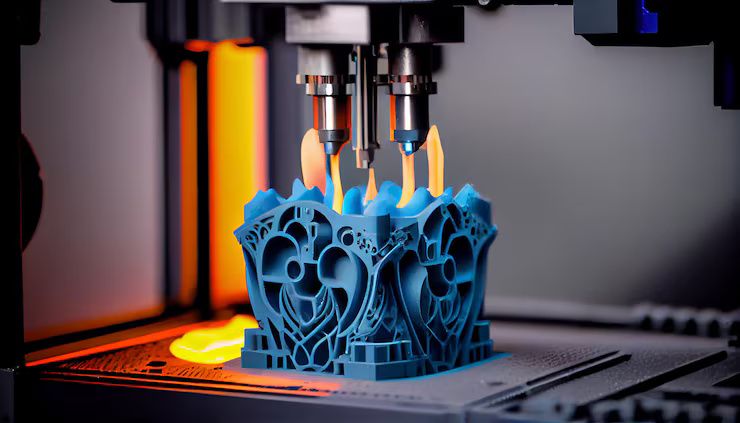
3D printing, also known as additive manufacturing, is a method of creating physical objects by building them layer by layer from a digital design. Unlike traditional manufacturing, which often removes material through cutting or machining, 3D printing adds material only where it is needed.
3D printing developed as an alternative to traditional manufacturing methods, which often require complex tooling, longer production times, and generate material waste. It allows rapid prototyping, flexible design changes, and the creation of complex shapes that are difficult to produce using conventional techniques.
At its core, 3D printing works by building objects layer by layer. A digital model is divided into thin horizontal sections, and each layer is printed sequentially until the final object is formed.
Importance: Why 3D Printing Matters Today
3D printing plays a significant role across industries such as manufacturing, healthcare, education, and research. It enables innovation by supporting customized designs and faster product development.
Key Reasons This Topic Matters
3D printing is important because it:
- Reduces development time for prototypes
- Minimizes material waste compared to traditional methods
- Enables customization in production
- Allows creation of complex geometries
This technology benefits designers, engineers, educators, and researchers. It is especially useful in early design stages and small-scale production.
Recent Updates: Trends and Developments
3D printing has continued to evolve during 2024 and 2025, with improvements in materials, speed, and reliability.
Expanded Material Options
New composite and recycled materials became more widely available, increasing flexibility in applications.
Faster Printing Systems
Advancements in printing speed reduced production time and improved efficiency.
Automation Improvements
Automated calibration and monitoring systems improved ease of use and consistency.
Quality and Consistency
Software updates enhanced layer accuracy and repeatability, supporting more reliable results.
Industrial Adoption
There has been increased use of 3D printing in small-batch manufacturing and production environments.
Laws and Policies: Regulations in 3D Printing
3D printing is influenced by safety, intellectual property, and product standards. These regulations focus on how printed objects are used and managed.
International Standards
The International Organization for Standardization provides guidelines for additive manufacturing terminology, testing, and quality assurance.
Workplace Safety
In the United States, the Occupational Safety and Health Administration offers guidance on safe handling of materials and equipment.
Key Regulatory Considerations
- Safe handling of materials
- Product quality and performance standards
- Documentation and traceability
- Environmental and waste management
Tools and Resources for 3D Printing
Various tools help users move from digital design to physical objects. These resources support design, preparation, and printing processes.
Useful Tools and Resources
- 3D modeling software
- Slicing software for layer generation
- Material reference guides
- Calibration and testing tools
Materials and Their Uses
| Material Type | Key Characteristics | Common Applications |
|---|---|---|
| Thermoplastics | Easy to print, versatile | Prototypes, educational models |
| Resins | High detail, smooth surfaces | Visual models, dental parts |
| Metal powders | Strong and durable | Industrial components |
| Composites | Reinforced and lightweight | Structural applications |
Layers: Building Objects Step by Step
Layers are the foundation of 3D printing. Each layer represents a thin cross-section of the final object.
Factors Influenced by Layer Thickness
- Surface finish quality
- Printing time
- Structural strength
Thinner layers improve surface smoothness but increase print time, while thicker layers speed up printing with reduced detail.
Proper layer adhesion is also essential to ensure strength and prevent print failure.
Materials: What Gets Printed
Materials determine how the final object behaves during and after printing. Different processes require materials in forms such as filaments, liquids, or powders.
Common Material Categories
- Plastics for general use
- Resins for detailed prints
- Metals for strength
- Specialty blends for specific conditions
Material choice affects durability, flexibility, and appearance.
Printing Processes: Different Technologies
3D printing includes multiple technologies, each using layers differently.
Common Printing Methods
- Fused Deposition Modeling (FDM): Melts and deposits filament
- Stereolithography (SLA): Uses light to cure resin
- Selective Laser Sintering (SLS): Fuses powdered materials
Each method offers different advantages depending on the application.
Frequently Asked Questions About 3D Printing
What is layer height?
Layer height refers to the thickness of each printed layer and affects both quality and print time.
Are all materials the same?
No, materials vary in strength, flexibility, and printing requirements.
Is 3D printing only for prototypes?
No, it is also used in production, education, and tooling.
Do all printers work the same way?
No, different printers use different technologies such as extrusion, resin curing, or powder fusion.
Why is slicing software important?
It converts digital models into instructions that guide the printing process.
Conclusion: Understanding 3D Printing
3D printing is a layer-based manufacturing method that combines digital design, materials, and controlled processes. It allows efficient production of complex shapes with reduced waste.
Recent advancements in materials, automation, and process consistency continue to expand its applications. Understanding layers, materials, and processes provides a clear view of how 3D printing works and why it is increasingly important in modern manufacturing and design.