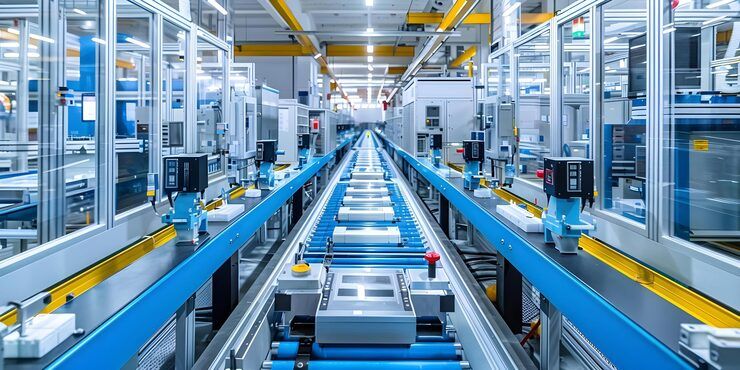
Battery assembly lines are integrated manufacturing systems used to combine individual battery cells and supporting components into finished battery modules or packs. These systems are important in electric vehicles, renewable energy storage, consumer electronics, industrial equipment, and backup power applications.
A battery assembly line can range from a semi-automated workstation to a highly automated production facility. Depending on the product, it may include cell inspection, electrical testing, sorting, stacking, welding, module assembly, battery management system installation, enclosure integration, and final performance verification.
The purpose of these production systems is to create batteries that meet defined electrical, mechanical, safety, and reliability requirements. Consistent assembly is especially important because battery performance depends not only on cell chemistry but also on component quality, electrical connections, thermal management, and manufacturing precision.
Understanding Battery Assembly Line Technology
A battery assembly line typically consists of interconnected workstations arranged according to the manufacturing sequence. Each station performs a specific operation before transferring the battery or its components to the next stage.
Lithium-ion battery production is a major application, although assembly lines can also be designed for lead-acid batteries, nickel-based batteries, and other battery technologies.
Common equipment includes:
Cell inspection systems: Check dimensions, appearance, identification, and selected electrical characteristics.
Cell sorting equipment: Groups cells according to specified electrical or physical parameters.
Stacking and alignment systems: Position cells or electrodes according to the product design.
Welding equipment: Connects electrical terminals and busbars using an appropriate joining process.
Module assembly stations: Combine cells into modules with mechanical supports and electrical connections.
Battery management system integration: Installs or connects electronic systems that monitor battery operation.
End-of-line testing equipment: Checks completed battery assemblies against defined acceptance criteria.
Automated handling systems: Move cells, modules, and packs between workstations.
The exact configuration depends on battery chemistry, cell format, production volume, product dimensions, and required quality standards.
How a Battery Assembly Line Works
Although manufacturing sequences vary, many battery pack assembly lines follow several common stages.
Cell receiving and inspection: Incoming cells are checked for identification, physical condition, and specified electrical parameters.
Cell sorting and preparation: Cells are organized according to the manufacturer's requirements. Automated identification systems can help maintain traceability throughout production.
Module assembly: Cells are positioned in the required arrangement and secured using designed fixtures, supports, or enclosures.
Electrical connection: Welding or another qualified joining process connects terminals and busbars. Connection quality is important for electrical resistance, durability, and safe operation.
Battery management integration: Sensors, wiring, control electronics, and the battery management system are installed as required.
Pack integration: Modules are assembled into the final enclosure, with appropriate electrical insulation, mechanical protection, and thermal management components.
Final testing: The completed battery undergoes specified electrical, functional, and safety-related checks before release.
Importance of Battery Assembly Lines
Battery assembly lines are important because battery performance depends on repeatable manufacturing processes, accurate component placement, reliable electrical connections, and consistent inspection.
Supporting Electric Vehicles and Energy Storage
Electric vehicles rely on battery packs that must deliver the required voltage, capacity, and power while operating within defined temperature and safety limits. Battery assembly equipment helps manufacturers produce packs that meet these specifications.
Stationary energy storage systems also use battery assemblies to store electricity generated by solar panels, wind turbines, and other sources. These systems can support energy management, backup power, and grid stability.
Improving Manufacturing Quality
Automated equipment can reduce variation in repetitive operations and improve traceability. Sensors, machine vision, and digital production records help manufacturers identify problems before a battery reaches the final inspection stage.
Important quality indicators include:
Cell alignment and dimensional accuracy
Electrical connection resistance
Insulation integrity
Temperature monitoring
Battery management system functionality
Pack voltage and electrical performance
Traceability of cells and components
Automation does not eliminate defects entirely. Effective process validation, maintenance, operator training, and quality testing remain necessary.
Recent Developments in Battery Manufacturing
Battery production technology continues to evolve as manufacturers expand capacity and explore new battery chemistries.
India's Battery Manufacturing Expansion
On February 13, 2026, India's Ministry of Heavy Industries reported progress under the Production Linked Incentive programme for Advanced Chemistry Cell battery storage. The programme has an allocated budget of ₹18,100 crore and targets 50 gigawatt-hours of domestic manufacturing capacity. By December 31, 2025, participating companies had reported cumulative investment of ₹3,237 crore and employment generation of 1,118 under the programme.
The initiative is intended to strengthen domestic battery manufacturing and support applications such as electric vehicles and stationary energy storage.
Automation and Digital Production
During 2025 and 2026, battery manufacturing discussions continued to emphasize robotics, machine vision, automated inspection, and manufacturing data systems.
These technologies can support accurate cell placement, consistent welding, automated material handling, and faster identification of production deviations. Digital monitoring can also help manufacturers track equipment performance and investigate defects.
New Battery Chemistries
Manufacturers and research institutions are investigating chemistries beyond conventional lithium-ion formulations, including sodium-ion and lithium-manganese-rich batteries.
Different chemistries may require changes to cell dimensions, electrical connections, thermal management, and testing procedures. Assembly lines therefore need appropriate flexibility to accommodate product design changes without compromising safety or quality.
Laws, Policies, and Manufacturing Standards
Battery assembly facilities must follow applicable manufacturing, environmental, workplace safety, electrical safety, and product regulations. Requirements vary according to the country, battery chemistry, intended use, and whether the facility produces cells, modules, or complete packs.
Battery Manufacturing Policies in India
India's National Programme on Advanced Chemistry Cell Battery Storage supports domestic advanced battery manufacturing through a production-linked incentive framework.
The programme emphasizes manufacturing capacity and domestic value addition. Participating manufacturers must comply with the conditions applicable to their approved projects.
Battery assembly facilities must also consider relevant factory regulations, fire safety requirements, electrical safety provisions, and applicable environmental permissions.
European Union Battery Regulation
The European Union's Battery Regulation, Regulation (EU) 2023/1542, establishes requirements relating to battery sustainability, safety, labeling, collection, recycling, and producer responsibilities.
Some provisions apply according to specific implementation dates and battery categories. Manufacturers supplying products to the European market should determine which obligations apply to their batteries and production operations.
Workplace and Process Safety
Battery manufacturing can involve electrical hazards, moving machinery, chemical exposure, heat, and fire risks.
Facilities should establish appropriate safeguards, including:
Machine guarding and emergency stops
Electrical isolation procedures
Ventilation and temperature monitoring
Fire detection and emergency response arrangements
Safe material handling
Worker training and protective equipment
Inspection and maintenance schedules
Lithium-ion battery handling requires particular attention to damaged cells, short circuits, thermal runaway, and appropriate storage conditions.
Tools and Resources for Battery Assembly Lines
Technical planning tools can help manufacturers evaluate equipment requirements, production performance, and quality standards.
Manufacturing Planning Software
Manufacturing execution systems can record production activities, track individual cells and modules, and document quality checks. Programmable logic controllers and supervisory control systems coordinate machine operations and monitor production equipment.
Quality Control Equipment
Common tools include:
Machine vision systems for component inspection
Laser measurement systems for dimensional checks
Resistance meters for electrical connections
Insulation resistance testers
Battery cyclers for charge and discharge testing
Thermal monitoring equipment
Barcode or identification systems for traceability
The selection of test equipment depends on the battery design and the applicable testing requirements.
Production Evaluation Checklist
Factor | Information to Evaluate |
|---|---|
Battery type | Lithium-ion, lead-acid, sodium-ion, or other chemistry |
Production capacity | Required units or kilowatt-hours per shift |
Automation level | Manual, semi-automated, or fully automated |
Cell format | Cylindrical, prismatic, or pouch |
Quality control | Electrical, mechanical, and thermal checks |
Traceability | Cell identification and production records |
Safety | Fire protection, electrical isolation, and machine guarding |
Flexibility | Ability to accommodate design changes |
Production planning should also account for equipment downtime, changeover time, maintenance, material availability, and quality rejection rates.
Frequently Asked Questions
What is a battery assembly line?
A battery assembly line is a manufacturing system that combines battery cells and supporting components into modules or complete battery packs through a sequence of controlled production and testing operations.
Which industries use battery assembly lines?
Major applications include electric vehicles, renewable energy storage, consumer electronics, industrial equipment, telecommunications backup systems, and uninterruptible power supplies.
What is the difference between battery cell manufacturing and battery pack assembly?
Cell manufacturing produces the electrochemical cells themselves. Battery pack assembly combines manufactured cells with electrical connections, structural components, monitoring electronics, thermal management systems, and protective enclosures.
What determines battery assembly line capacity?
Capacity depends on the production sequence, equipment speed, automation level, product design, changeover requirements, testing duration, and the reliability of individual workstations.
Why is quality testing important in battery assembly?
Testing helps identify defects involving electrical connections, insulation, cell performance, assembly accuracy, and battery management systems. It supports consistent product performance and reduces the risk of unsafe batteries reaching end users.
Conclusion
Battery assembly lines are a central part of modern energy storage and electric mobility manufacturing. They combine mechanical assembly, electrical integration, automation, traceability, and quality testing to produce battery modules and packs that meet defined technical requirements.
Recent developments in India's manufacturing programmes, industrial automation, and alternative battery chemistries demonstrate the continuing evolution of the industry. At the same time, manufacturers must address workplace safety, environmental requirements, product quality, and applicable battery regulations.
A well-planned assembly line requires careful consideration of battery chemistry, production capacity, automation, equipment compatibility, testing procedures, and maintenance. Integrating these elements can help manufacturers establish consistent production processes and support the growing use of batteries in transportation, electronics, and energy storage.