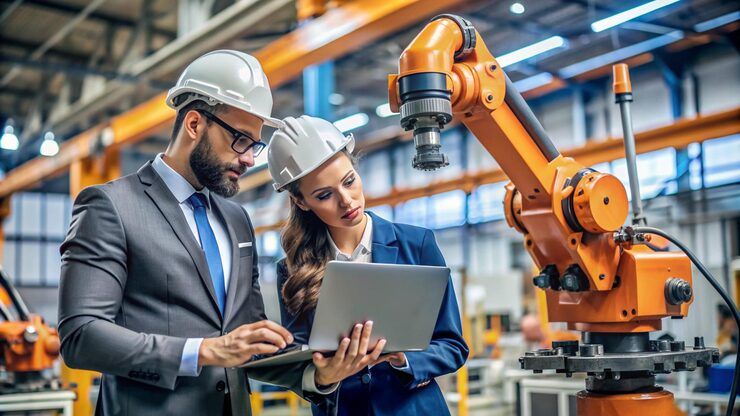
The industrial workforce is experiencing significant changes as manufacturing companies adopt advanced technologies, artificial intelligence (AI), robotics, and automated production systems. Traditional manufacturing activities that once depended heavily on manual operations are increasingly supported by intelligent machines, digital platforms, and connected equipment.
This transformation is creating a new industrial environment where human knowledge and technological capabilities work together. Employees are increasingly expected to understand digital systems, interpret production information, operate automated machinery, and collaborate with AI-powered applications.
The future of industrial work is not simply about replacing human activities with machines. It involves developing a balanced approach in which automation improves productivity while people contribute problem-solving abilities, technical knowledge, creativity, and decision-making.
The Role of Automation and Artificial Intelligence
Industrial automation refers to the use of machines, control systems, robotics, and software to perform manufacturing activities with limited manual intervention.
Artificial intelligence adds another layer of capability by allowing industrial systems to analyze information, identify patterns, predict equipment problems, and support operational decisions.
Common examples include:
Industrial Robotics: Robots perform repetitive assembly, material handling, welding, and packaging activities.
Predictive Maintenance: AI analyzes equipment information to identify possible failures before breakdowns occur.
Smart Manufacturing: Connected machines exchange production information through industrial networks.
Digital Twins: Virtual representations of physical equipment help engineers study performance and test operational changes.
AI-Assisted Quality Control: Computer vision identifies production defects and inconsistencies.
Autonomous Systems: Intelligent machines perform selected activities with limited human intervention.
These technologies are changing the technical knowledge required across manufacturing, engineering, logistics, and industrial management.
Why Industrial Workforce Transformation Matters
Meeting the Needs of Modern Manufacturing
Industrial workforce transformation matters because manufacturing operations are becoming more connected, technology-driven, and dependent on accurate information. Companies must maintain production quality while managing equipment complexity, workforce development, and changing customer requirements.
Several challenges are encouraging this transformation:
Technical Skills Gaps: Modern factories require employees who understand robotics, automation, industrial software, and digital production systems.
Equipment Complexity: Advanced machinery requires specialized knowledge for monitoring, troubleshooting, and maintenance.
Production Efficiency: Automated processes can reduce repetitive activities and improve consistency.
Workplace Safety: Sensors, robotics, and intelligent monitoring systems can help identify operational hazards.
Changing Workforce Expectations: Employees need continuous learning opportunities to remain familiar with evolving industrial technologies.
Skills Required for Future Industrial Careers
The industrial workforce of the future will require a combination of technical, analytical, and interpersonal capabilities.
Skill Category | Important Skills | Industrial Application |
|---|---|---|
Digital literacy | Data analysis, digital systems | Production monitoring |
AI knowledge | Machine learning, AI interpretation | Intelligent manufacturing |
Robotics | Robot programming, system operation | Automated assembly |
Cybersecurity | Network protection, risk awareness | Smart factory protection |
Mechanical skills | Equipment maintenance, troubleshooting | Machinery management |
Human skills | Communication, critical thinking | Team coordination |
Technical knowledge alone will not be sufficient. Employees must also understand how to interpret information, identify unusual production conditions, and make appropriate decisions.
The Importance of Upskilling and Reskilling
Upskilling means improving existing capabilities to perform more advanced activities. Reskilling involves learning different competencies to move into changing industrial responsibilities.
For example, a traditional machine operator may develop additional knowledge of programmable logic controllers (PLCs), sensor technology, and automated production monitoring.
Important workforce development areas include:
Industrial automation training.
Artificial intelligence and machine learning fundamentals.
Robotics programming and maintenance.
Manufacturing data analytics.
Industrial cybersecurity awareness.
Digital twin technology and simulation.
Human-machine interface operation.
Continuous learning helps employees adapt to changing production environments while allowing manufacturers to develop stronger technical capabilities internally.
Recent Developments in Industrial Workforce Technology
Human-Machine Collaboration Framework in 2026
On June 23, 2026, the World Economic Forum introduced its Human-Machine Collaboration Framework for intelligent factories. The framework examines how more than 80 industrial roles across seven manufacturing and supply chain functions are changing.
Its findings indicate that approximately three out of four industrial roles are expected to evolve, while around 40% of future industrial skills are classified as new or emerging. This highlights the importance of preparing employees for responsibilities involving intelligent machines and connected production systems.
Artificial Intelligence Skills in Manufacturing
On June 5, 2026, the Organisation for Economic Co-operation and Development (OECD) published its policy brief, AI and Skills: What We Know So Far.
The report identifies skills shortages as an important barrier to AI adoption. It also explains that most workers do not need advanced AI programming knowledge. Instead, digital literacy and the ability to understand, analyze, and interpret information are increasingly important.
This suggests that AI education should extend beyond specialist engineers to include production operators, maintenance technicians, supervisors, and industrial managers.
Manufacturing Technology Trends in 2026
A KPMG Global Tech Report published on June 24, 2026, examined technology adoption among 258 industrial manufacturing technology leaders across 22 countries and territories.
Its findings highlighted several developments:
49% of surveyed executives reported AI applications already delivering business value.
68% expected to deploy AI at scale within the following 12 months.
89% believed managing AI agents would become an important workplace skill within five years.
76% identified unreliable data as a significant AI-related risk.
These findings demonstrate that workforce readiness, reliable industrial data, and cybersecurity are important considerations alongside automation investment.
AI-Assisted Technician Development
In September 2026, Deloitte published research examining how generative AI and agentic AI could support manufacturing technicians.
The research discussed the potential for AI to provide technical guidance, help employees understand equipment information, and support learning during everyday industrial activities.
Such developments could help technicians build knowledge more efficiently while retaining human oversight of important operational decisions.
Key Trends to Watch
Technology | Emerging Workforce Impact |
|---|---|
Generative AI | Technical documentation and knowledge assistance |
Industrial robotics | Robot supervision and programming |
Digital twins | Virtual testing and simulation |
Predictive maintenance | Data-based equipment monitoring |
Autonomous systems | Human supervision of automated operations |
Industrial IoT | Connected equipment management |
Laws, Regulations and Government Policies
Workplace Safety and Automation Regulations
Industrial automation must operate within applicable workplace safety regulations. Employers are generally responsible for maintaining safe working environments, providing appropriate training, and managing risks associated with machinery.
Important regulatory considerations include:
Machine guarding and emergency shutdown procedures.
Safe operation of industrial robots.
Electrical and equipment safety.
Employee training and risk awareness.
Safe human-robot interaction.
Protection against workplace hazards.
In the United States, the Occupational Safety and Health Administration (OSHA) establishes workplace safety requirements that apply to relevant manufacturing operations.
European Union Artificial Intelligence Act
The European Union's Artificial Intelligence Act, Regulation (EU) 2024/1689, establishes a risk-based framework for AI development and use.
The regulation's general application date was August 2, 2026, although certain provisions have different application dates. Its requirements are relevant to organizations developing or using AI systems in industrial environments.
Depending on the application, manufacturers may need to consider:
AI risk assessment and documentation.
Human oversight of applicable high-risk systems.
Data governance and system monitoring.
Transparency requirements.
Appropriate AI literacy measures for relevant personnel.
The regulation's AI literacy provisions began applying on February 2, 2025, with subsequent legislative changes in 2026.
India's Industrial Skills Development Policies
India is also encouraging workforce development through national skill development and manufacturing initiatives.
Relevant programs and policy areas include:
Skill India Mission: Supports vocational education and technical skills development.
Pradhan Mantri Kaushal Vikas Yojana (PMKVY): Supports structured training and competency development.
National Education Policy 2020: Encourages vocational education, practical learning, and multidisciplinary skills.
Make in India: Encourages manufacturing development and industrial capabilities.
Digital India: Supports digital infrastructure and technology adoption.
The precise eligibility, implementation, and regulatory requirements vary by program and industry. Manufacturers should consider applicable national and regional rules when introducing new industrial technologies.
Tools and Resources for Industrial Workforce Development
Industrial Learning and Technical Training Platforms
Employees and manufacturing organizations can use specialized learning platforms and technical resources to develop relevant industrial capabilities.
Platform or Resource | Main Purpose | Relevant Skills |
|---|---|---|
Siemens SCE | Industrial automation education | PLC programming and automation |
Rockwell Automation Learning+ | Industrial control education | Control systems and robotics |
Autodesk Learning | Engineering and design education | CAD and digital manufacturing |
MATLAB and Simulink | Engineering simulation | Modeling and system analysis |
Microsoft Learn | Digital and AI education | AI fundamentals and data analytics |
NIST Manufacturing Resources | Manufacturing research and guidance | Smart manufacturing and standards |
Important Industrial Software and Technologies
The following technologies are increasingly relevant to modern industrial operations:
Manufacturing Execution Systems (MES): These platforms coordinate and monitor manufacturing activities, including production scheduling, quality information, and operational performance.
Industrial Internet of Things (IIoT): Connected sensors and equipment collect operational information that helps employees understand production conditions.
Predictive Maintenance Software: These applications analyze equipment information to identify potential failures and support maintenance planning.
Industrial Robotics Software: Programming environments help technicians configure, operate, and monitor robotic equipment.
Digital Twin Platforms: These systems create virtual representations of industrial equipment and processes for simulation and performance analysis.
AI-Powered Quality Inspection: Computer vision and machine learning help identify product defects and monitor manufacturing consistency.
A Practical Workforce Development Framework
Organizations can prepare employees for technological changes through a structured development approach.
Assess Existing Skills: Identify current technical capabilities and areas requiring improvement.
Identify Technology Requirements: Understand which automation, robotics, and AI systems will influence industrial activities.
Develop Training Programs: Introduce practical learning in digital manufacturing and industrial technologies.
Encourage Human-AI Collaboration: Teach employees how to interpret AI-generated information and maintain appropriate oversight.
Measure Progress: Evaluate technical competency, production quality, equipment performance, and workplace safety.
Continue Learning: Update training programs as industrial technologies and operational requirements evolve.
Frequently Asked Questions
What is the future of the industrial workforce?
The future industrial workforce will combine human expertise with artificial intelligence, robotics, and automated production systems. Employees will increasingly work with intelligent machinery, analyze operational information, and supervise automated processes.
Which skills will be most important in future manufacturing?
Important skills include AI literacy, robotics programming, industrial automation, data analytics, cybersecurity awareness, predictive maintenance, and digital manufacturing. Communication, critical thinking, and problem-solving will also remain important.
Will artificial intelligence replace industrial workers?
AI may automate certain repetitive and predictable activities, but it does not automatically eliminate the need for human involvement. Manufacturing still requires people for equipment supervision, safety decisions, technical troubleshooting, quality management, and complex problem-solving. The impact will vary across industries and occupations.
How can manufacturing employees prepare for automation?
Employees can prepare by learning industrial software, understanding automated machinery, developing digital literacy, and participating in technical training. Familiarity with PLCs, robotics, industrial IoT, and AI-assisted monitoring can also strengthen their capabilities.
Why is human-AI collaboration important in manufacturing?
Human-AI collaboration combines the analytical capabilities of intelligent systems with human judgment and practical experience. AI can identify patterns and provide recommendations, while employees evaluate information, manage unexpected situations, and oversee safety-critical decisions.
Conclusion
The future of the industrial workforce will be shaped by the relationship between human expertise, artificial intelligence, robotics, and advanced manufacturing technologies. Automation is changing traditional production activities, while digital transformation is creating new expectations for technical knowledge and workplace capabilities.
Developing skills in industrial automation, AI literacy, robotics, cybersecurity, and manufacturing data analytics will become increasingly important. However, human abilities such as critical thinking, communication, adaptability, and decision-making will continue to play an essential role.
Manufacturers, educational institutions, governments, and employees all have responsibilities in preparing for this transformation. By encouraging continuous learning, responsible technology adoption, and effective human-machine collaboration, the industrial sector can develop a workforce that is better prepared for increasingly intelligent manufacturing environments.
The long-term direction of industrial development will depend not only on technological progress but also on how effectively people and machines work together.