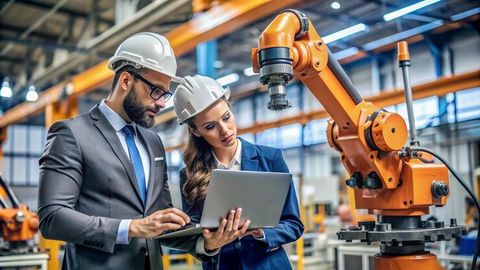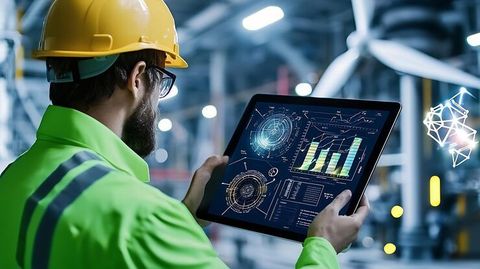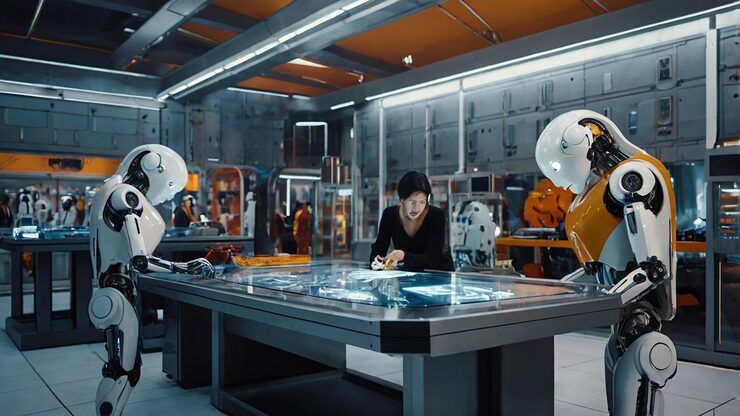
Industry 5.0 represents the next stage of industrial development, where human expertise works alongside advanced technologies such as artificial intelligence (AI), collaborative robots, machine learning, and smart manufacturing systems. Unlike traditional automation models that primarily focus on production speed and efficiency, Industry 5.0 emphasizes the relationship between people, intelligent machines, and sustainable industrial development.
The concept builds on Industry 4.0, which introduced connected machinery, industrial Internet of Things (IIoT), cloud computing, and automated production systems. Industry 5.0 expands this approach by placing human creativity, decision-making, and well-being at the centre of industrial operations.
How Human-Robot Collaboration Works
Human-robot collaboration involves people and robotic systems working within shared or coordinated production environments. Collaborative robots, commonly known as cobots, are designed to support workers with repetitive, physically demanding, or precision-based activities.
For example, a manufacturing worker may inspect a product while a robotic arm handles repetitive assembly tasks. AI-powered manufacturing software can analyse production information and help identify potential equipment problems.
Common technologies involved include:
Collaborative robots for assembly, packaging, and material handling.
Artificial intelligence for production planning and decision support.
Machine vision systems for quality inspection.
Digital twin technology for simulating manufacturing processes.
Predictive maintenance software for monitoring equipment conditions.
Industrial IoT platforms for connecting machinery and production systems.
These technologies create opportunities for combining human judgement with machine accuracy.
Why Industry 5.0 Matters for Modern Manufacturing
Improving Productivity and Operational Efficiency
Modern manufacturers face increasing expectations regarding production quality, flexibility, and resource management. Human-robot collaboration can help address these challenges by distributing tasks according to the strengths of people and machines.
Robots can perform repetitive movements consistently, while employees can concentrate on supervision, problem-solving, product development, and complex decisions.
This combination can improve manufacturing workflow management and support more flexible production environments.
Supporting Worker Safety and Well-Being
Industrial environments may involve heavy materials, repetitive movements, hazardous equipment, and physically demanding activities.
Collaborative robotic systems can assist with lifting, positioning, and repetitive assembly tasks. However, effective implementation requires appropriate safety assessments, protective systems, and worker training.
Industry 5.0 also encourages manufacturers to consider ergonomic workplace design and employee participation when introducing automation technologies.
Enabling Sustainable Manufacturing
Sustainability is another important principle of Industry 5.0. Smart manufacturing technologies can help organisations monitor electricity consumption, material usage, equipment performance, and production waste.
For example, AI-based energy management systems can identify inefficient operating patterns. Digital twins can simulate manufacturing processes before physical changes are introduced.
These approaches support resource efficiency and can contribute to long-term environmental objectives.
Industry 4.0 Compared With Industry 5.0
| Feature | Industry 4.0 | Industry 5.0 |
|---|---|---|
| Main focus | Automation and connectivity | Human-machine collaboration |
| Technology | IoT, AI, robotics | AI, cobots, digital twins |
| Worker involvement | Operating connected systems | Active collaboration and decision-making |
| Production approach | Data-driven automation | Human-centric production |
| Sustainability | Improving efficiency | Environmental responsibility |
| Main objective | Productivity and connectivity | Productivity, resilience, and well-being |
Industry 5.0 does not replace Industry 4.0 technologies. Instead, it builds on them through a broader approach to industrial development.
Recent Developments in Industry 5.0 and Robotics
Growing Adoption of Collaborative Robotics
During 2025 and 2026, collaborative robotics continued to receive attention across manufacturing, automotive production, electronics, logistics, and industrial equipment sectors.
Manufacturers are exploring robotic systems that can adapt to changing production requirements and work alongside human operators. Improvements in sensors, machine vision, and AI-based control are supporting more advanced human-machine interaction.
Updated Industrial Robot Safety Standards in 2025
In February 2025, the International Organization for Standardization published updated editions of ISO 10218-1 and ISO 10218-2. These standards address industrial robot safety and the integration of robotic applications.
The updated framework provides greater attention to risk assessment, functional safety, and the requirements associated with collaborative applications.
This development is relevant to manufacturers introducing industrial automation and human-robot collaboration systems.
Human-Machine Workforce Development in 2026
On June 23, 2026, the World Economic Forum introduced its Human-Machine Collaboration Framework. The initiative examines how industrial roles and workforce skills are changing as intelligent technologies become more integrated into manufacturing and supply chains.
The framework highlights the growing importance of technical knowledge, digital capabilities, problem-solving, and collaboration between workers and intelligent machines.
Increasing Use of AI and Digital Twins
AI-powered quality inspection, predictive maintenance, robotics simulation, and digital twin manufacturing are becoming important areas of industrial development.
These technologies help manufacturers understand equipment performance, evaluate production scenarios, and identify operational issues using data.
However, successful implementation still depends on reliable information, appropriate infrastructure, cybersecurity, and skilled human supervision.
Laws, Regulations, and Government Policies
Industry 5.0 is influenced by industrial safety legislation, workplace regulations, artificial intelligence governance, environmental policies, and international technical standards. Requirements vary according to the country and the type of manufacturing activity.
European Union Regulations
The European Union has promoted Industry 5.0 through its research and innovation strategy, which focuses on three main principles:
Human-centricity: Protecting worker well-being and supporting human capabilities.
Sustainability: Encouraging responsible resource use and environmentally conscious production.
Resilience: Helping industries adapt to economic, technological, and supply-chain disruptions.
The EU Artificial Intelligence Act also establishes requirements for certain AI applications. Its rules have been introduced progressively, with important provisions applying from 2025 and 2026. Specific high-risk AI obligations have later application dates, including December 2027 and August 2028 for relevant categories.
United States Industrial Safety Requirements
In the United States, the Occupational Safety and Health Administration (OSHA) establishes workplace safety requirements that can affect industrial robotics and automated manufacturing environments.
Manufacturers must consider machinery hazards, employee protection, workplace risk assessments, and appropriate safety procedures when implementing robotic systems.
India Manufacturing Policies
India's manufacturing development initiatives, including the SAMARTH Udyog Bharat 4.0 programme, support awareness and adoption of advanced manufacturing technologies.
The National Manufacturing Mission, announced in the 2025 Union Budget, also places emphasis on strengthening manufacturing capabilities, technology adoption, and industrial development.
Manufacturers should consider applicable factory safety requirements, machinery regulations, environmental rules, and relevant national standards when introducing collaborative robotics.
Helpful Tools and Resources for Industry 5.0
Several technology platforms, standards, and educational resources can help organisations understand and implement human-robot collaboration.
Industrial Robotics and Automation Platforms
ABB Robotics: Provides industrial robotic technologies, automation systems, and collaborative robotics information.
Universal Robots: Offers information about collaborative robot applications, programming, and industrial integration.
FANUC: Covers industrial robotics, factory automation, and intelligent manufacturing technologies.
Siemens Digital Industries: Provides industrial automation, digital manufacturing, and digital twin technologies.
AI and Manufacturing Software
NVIDIA Isaac: Supports robotics development, simulation, and AI-based robotic applications.
Siemens NX: Includes engineering, product development, and digital twin capabilities.
Microsoft Azure IoT: Supports connected industrial equipment, data monitoring, and industrial analytics.
IBM Maximo: Supports asset management and predictive maintenance activities.
Important Standards and Learning Resources
ISO 10218: Industrial robot safety requirements.
ISO/TS 15066: Technical guidance for collaborative robot applications.
International Organization for Standardization: Information about industrial standards and technical frameworks.
World Economic Forum: Research on industrial transformation, workforce development, and human-machine collaboration.
Organisations should evaluate these resources according to their production requirements, technical capabilities, and regulatory responsibilities.
Frequently Asked Questions
What Is the Main Difference Between Industry 4.0 and Industry 5.0?
Industry 4.0 focuses on connected technologies, automation, and data-driven production. Industry 5.0 builds on these developments by emphasizing human involvement, sustainability, and industrial resilience.
What Are Collaborative Robots?
Collaborative robots, or cobots, are robotic systems designed for applications where people and robots work in shared or coordinated environments. Their suitability depends on the application, risk assessment, and appropriate safety measures.
Which Industries Can Benefit From Industry 5.0?
Industries such as automotive manufacturing, electronics, pharmaceuticals, food processing, aerospace, logistics, and industrial equipment production can explore Industry 5.0 technologies.
The practical applications depend on production requirements, workplace conditions, and available infrastructure.
Does Industry 5.0 Replace Human Workers?
Industry 5.0 is based on collaboration rather than complete human replacement. Robots can perform repetitive or physically demanding activities, while people contribute creativity, critical thinking, technical knowledge, and decision-making.
However, industrial roles may change as automation and AI become more widely adopted.
What Skills Are Important for Industry 5.0?
Important capabilities include robotics programming, AI literacy, industrial data analysis, cybersecurity awareness, digital manufacturing, equipment maintenance, and problem-solving.
Communication and the ability to work with intelligent technologies are also valuable in modern industrial environments.
Conclusion
Industry 5.0 represents an important development in the future of global manufacturing. By combining human expertise with collaborative robots, artificial intelligence, digital twins, and connected industrial systems, it creates opportunities for more flexible and responsible production environments.
Its approach extends beyond automation by considering worker well-being, environmental sustainability, and industrial resilience. Updated robotics standards, AI regulations, and workforce development initiatives are also influencing how manufacturers introduce these technologies.
As industrial transformation continues, successful human-robot collaboration will depend on appropriate safety measures, technical infrastructure, employee training, and responsible technology adoption. Industry 5.0 therefore represents a broader vision in which people and intelligent machines contribute together to the development of modern industry.