AI-powered robotics combines robotic hardware with artificial intelligence, machine learning, computer vision, sensors, and advanced control software. These technologies allow robotic systems to perceive their surroundings, interpret data, adapt to changing conditions, and perform increasingly complex industrial tasks.
Unlike conventional robots that generally follow predefined instructions, AI-enabled robotic systems can use sensor data and trained models to support perception, object recognition, path planning, quality inspection, and adaptive operation. Their applications span manufacturing, logistics, warehousing, healthcare, agriculture, automotive production, electronics, and other industrial environments.

Context
What Is AI-Powered Robotics?
AI-powered robotics refers to robotic systems that use artificial intelligence technologies to interpret information and support automated physical actions.
A typical system can combine:
- Robotic arms or mobile platforms
- Cameras and machine vision
- Force and torque sensors
- Proximity and position sensors
- AI and machine-learning models
- Motion-control software
- Industrial controllers
- Communication networks
- Safety systems
The combination allows robots to respond to information gathered from their environment rather than relying entirely on fixed sequences.
How Intelligent Robotic Systems Work
An AI-enabled robot generally follows a perception-and-action cycle:
Sense → Interpret → Plan → Act → Monitor
Cameras and other sensors collect information. AI software processes the information and identifies objects, patterns, locations, or conditions. The robotic controller then determines an appropriate movement or action within predefined operating constraints.
Feedback from sensors allows the system to monitor the result and adjust subsequent movements when appropriate.
Major AI Robotics Technologies
| Technology | Primary Function | Industrial Application |
|---|---|---|
| Computer Vision | Object and environment recognition | Inspection and picking |
| Machine Learning | Pattern recognition | Quality analysis |
| Deep Learning | Complex data interpretation | Vision and classification |
| Sensor Fusion | Combines multiple sensor inputs | Navigation and positioning |
| Path Planning | Determines robot movement | Assembly and handling |
| Reinforcement Learning | Learns selected control strategies | Adaptive robotic research |
| Edge AI | Processes data near equipment | Real-time robotic systems |
| Digital Twins | Simulates physical systems | Robot development and testing |
AI-Powered Robotic Arms
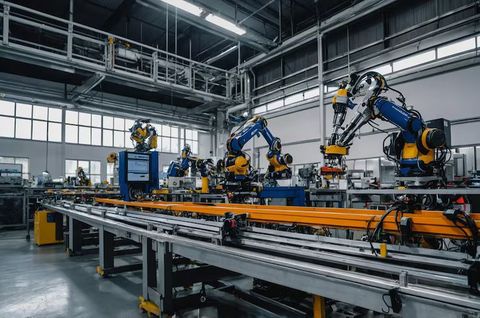
Industrial robotic arms can use AI-based vision and sensing to identify objects, select positions, and adapt movements.
For example, a robotic arm equipped with a camera can identify components arriving in different orientations and determine where they should be grasped.
Autonomous Mobile Robots
Autonomous mobile robots, or AMRs, use sensors, mapping technologies, navigation software, and AI techniques to move through industrial environments.
They can transport materials between production areas, warehouses, storage locations, and assembly stations.
Collaborative Robots
Collaborative robots are designed to operate in environments where people and robots may work in proximity under specified safety conditions.
AI technologies can enhance perception and task adaptation, but the robot's actual safety configuration must be assessed according to its application and operating environment.
Importance
Why AI-Powered Robotics Matters
Industrial environments often contain repetitive handling tasks, variable product arrangements, and complex inspection requirements. AI-powered robotics can combine automation with perception and adaptive decision-making capabilities.
The technology can support applications where fixed automation may have difficulty responding to changes in objects, layouts, or production conditions.
Intelligent Automation
Traditional automation generally follows predefined sequences. AI can add data-driven interpretation to these systems.
For example, a conventional robotic system may place a component at a predefined coordinate, while an AI-enabled vision system can identify the component's actual position and provide information for adaptive movement.
Machine Vision
Computer vision is one of the most common AI technologies used with industrial robots.
Vision systems can identify:
- Object location
- Shape
- Orientation
- Surface characteristics
- Product defects
- Barcode information
- Assembly conditions
Vision performance depends on camera configuration, lighting, image quality, training data, and application-specific algorithms.
Adaptive Manipulation
Robots can use force sensors, tactile information, vision, and other feedback to adjust their movements.
This can be relevant to assembly, insertion, polishing, handling, and other tasks where physical conditions can vary.
Predictive Equipment Monitoring
AI analytics can also be applied to robot operating data. Motor current, vibration, temperature, cycle time, and error information can be analyzed to identify changes in equipment behavior.
Such analysis can support maintenance planning and troubleshooting.
Robotic Systems and Components
Robotic Manipulators
Industrial manipulators can have multiple articulated joints that provide several degrees of movement. Common configurations include articulated, SCARA, delta, and Cartesian robots.
The appropriate design depends on payload, reach, speed, workspace, and task requirements.
Vision Systems
Cameras and image-processing systems provide visual information to AI software. Two-dimensional and three-dimensional vision technologies can be used for different applications.
3D cameras can provide depth information that helps robotic systems understand object position within a workspace.
Force and Torque Sensors
Force and torque sensors measure physical interaction between a robot and its environment.
These measurements can be useful for assembly, insertion, surface processing, and other applications requiring controlled contact.
End Effectors
End effectors are tools attached to robotic arms. Examples include:
- Grippers
- Vacuum tools
- Welding tools
- Screwdriving tools
- Cutting tools
- Inspection devices
- Material-handling attachments
AI-based vision can help determine how an end effector should interact with an object.
Robot Controllers
Robot controllers coordinate motion, sensor information, communication, and application logic.
Modern controllers can interface with vision systems, PLCs, industrial networks, safety systems, and AI computing platforms.
Industrial Applications
Automotive Manufacturing
Automotive production uses robots for welding, painting, assembly, material handling, inspection, and other manufacturing activities.
AI-based vision can help identify components and inspect assemblies during production.
Electronics Manufacturing
Electronics manufacturing requires precise handling of relatively small components. Robotic systems can support assembly, inspection, sorting, and material handling.
Machine vision can help identify component position and orientation.
Warehousing and Logistics
AI-enabled mobile robots can transport materials and products through warehouses. Navigation systems use cameras, lidar, proximity sensors, and mapping technologies to understand the surrounding environment.
Robotic systems can also support sorting, picking, and inventory-related operations.
Food Processing
Robotics can be used for picking, packaging, sorting, inspection, and material handling in food production environments.
Vision systems can identify product characteristics and assist with automated sorting.
Pharmaceutical Manufacturing
Robotic systems can support material handling, inspection, laboratory automation, packaging, and selected manufacturing activities.
Controlled environments require appropriate equipment design, contamination-control measures, and validated operating procedures.
Industrial Inspection
AI-powered vision systems can analyze images to identify selected surface or assembly anomalies.
Applications can include weld inspection, dimensional checking, surface inspection, label verification, and component classification.
Agriculture
Robotic platforms can combine computer vision, navigation, and AI analytics for selected agricultural activities.
Potential applications include crop monitoring, selective harvesting, field mapping, and automated material handling.
Manufacturers and Suppliers
The AI robotics ecosystem includes robot manufacturers, industrial automation companies, vision-system developers, sensor manufacturers, software providers, systems integrators, and specialized robotic equipment producers.
When evaluating manufacturers and suppliers, organizations can examine:
- Robot payload
- Reach and workspace
- Repeatability
- Operating speed
- Vision compatibility
- AI computing requirements
- Communication protocols
- Safety features
- Environmental ratings
- Software capabilities
- Integration requirements
- Maintenance documentation
System integration is particularly important because AI robotics generally involves multiple hardware and software components rather than a single standalone machine.
Recent Updates
Generative AI and Robotics
Generative AI is being investigated for robot programming, natural-language interaction, task planning, documentation, and development workflows.
Research systems are exploring ways for robots to interpret higher-level instructions and translate them into sequences of physical actions. Industrial deployment still requires careful validation of generated actions.
Vision-Language-Action Models
New AI architectures are being developed to connect visual perception, language understanding, and robotic action.
These models can potentially allow robots to interpret instructions while using visual information about their surroundings.
Edge AI
Edge computing allows AI models to operate near robotic equipment instead of depending entirely on remote servers.
Local processing can reduce communication delays and help maintain operation when external network connectivity is limited.
Simulation and Digital Twins
Robotic systems can be developed and tested in simulated environments before physical deployment. Digital twins can represent equipment, workspaces, and production processes.
Simulation can help evaluate robot paths, collision risks, cycle times, and selected operating scenarios.
Multi-Robot Coordination
AI and advanced scheduling systems are being explored for coordinating multiple robots operating within the same production environment.
Coordination can involve task allocation, route planning, workspace management, and production scheduling.
Learning-Based Robot Programming
Machine-learning methods can reduce the amount of manually programmed behavior required for certain tasks.
Demonstration-based learning allows systems to learn selected movements or task patterns from human demonstrations or recorded examples.
Laws or Policies
Industrial Robot Safety
Industrial robotic systems require appropriate safeguards based on their application. Safety measures can include guarding, protective devices, safety-rated controls, emergency stops, speed limitations, and controlled access.
The appropriate configuration depends on the robot, workspace, task, and interaction between people and machines.
Collaborative Robot Requirements
Collaborative applications require assessment of potential contact, force, speed, workspace, tooling, and foreseeable operating conditions.
A robot should not be considered safe for collaborative operation solely because it is marketed as a collaborative model.
Artificial Intelligence Governance
AI-powered industrial systems can also fall within broader organizational policies governing data, cybersecurity, software validation, access control, and automated decision-making.
Organizations should evaluate the regulatory requirements applicable to their industry and jurisdiction.
Industrial Cybersecurity
Connected robots can communicate with production networks, cloud platforms, vision systems, and enterprise software.
Network segmentation, authentication, access controls, secure configuration, software maintenance, and monitoring can help protect connected robotic environments.
Tools and Resources
Robot Simulation Software
Simulation platforms can model robotic workspaces, motion paths, collision conditions, and production sequences.
These tools can help engineers evaluate robot layouts before physical installation.
Machine Vision Platforms
Vision development platforms can configure cameras, image-processing algorithms, object recognition, and inspection workflows.
AI Development Frameworks
Machine-learning frameworks can support development and deployment of models for classification, detection, prediction, and robotic perception.
Industrial Communication Systems
Robots can communicate with PLCs, sensors, HMIs, MES platforms, and other industrial equipment through protocols and network technologies selected for the specific architecture.
Robot Maintenance Platforms
Maintenance-management systems can track robot inspections, component replacement, calibration, alarms, operating hours, and maintenance history.
FAQs
What is AI-powered robotics?
AI-powered robotics combines robotic hardware with artificial intelligence, machine learning, computer vision, sensors, and control software to support perception and adaptive automated operation.
How are AI-powered robots different from traditional industrial robots?
Traditional robots commonly execute predefined programs, while AI-enabled systems can use sensor data and trained models to interpret changing conditions and support adaptive actions.
What industries use AI-powered robotic systems?
Applications include automotive manufacturing, electronics, logistics, warehousing, food processing, pharmaceuticals, industrial inspection, agriculture, and other automated production environments.
What role does computer vision play in AI robotics?
Computer vision allows robots to interpret visual information such as object position, orientation, shape, and selected surface characteristics. This information can support picking, inspection, sorting, and assembly.
What should organizations consider when selecting AI robotics manufacturers?
Important considerations include payload, reach, repeatability, vision integration, AI computing, software architecture, communication protocols, safety features, environmental conditions, integration requirements, and maintenance documentation.
Conclusion
AI-powered robotics combines industrial automation with artificial intelligence, machine vision, advanced sensors, adaptive control, and data analytics. These technologies can support robotic systems in manufacturing, logistics, inspection, pharmaceutical production, food processing, agriculture, and other industrial applications.
Developments in edge AI, simulation, vision-language-action models, learning-based programming, and multi-robot coordination are expanding the capabilities being explored for intelligent automation. Successful deployment requires careful system integration, appropriate training and validation, cybersecurity, machine safeguarding, and alignment with the requirements of the specific industrial application.