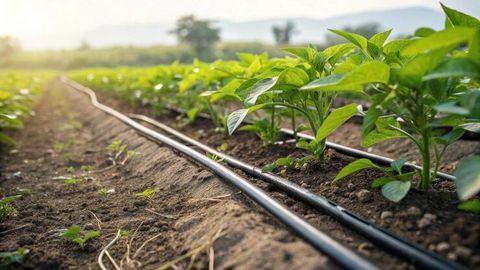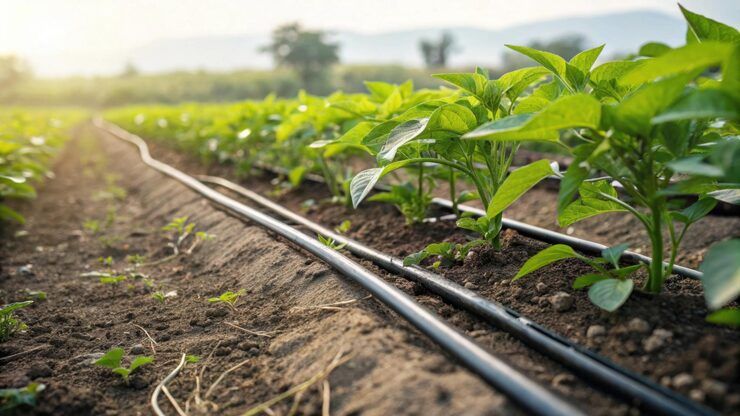
Drip irrigation systems are agricultural and landscape watering systems that deliver water directly to the soil near plant roots. Water travels through a network of pipes, filters, valves, and narrow outlets called emitters. These outlets release water gradually, helping maintain suitable moisture levels around plants.
The technology is used in farms, greenhouses, orchards, vegetable gardens, nurseries, and landscaped areas. It can be particularly useful where water availability is limited, plants are arranged in rows, or precise water application is important.
Unlike conventional flood irrigation, which distributes water across a larger surface, drip irrigation directs water to selected areas. However, its effectiveness depends on proper system design, water quality, maintenance, soil characteristics, and crop requirements.
Understanding Drip Irrigation Technology
A typical drip irrigation system begins at a water source and distributes water through a network of pipes. Filters remove particles that could block small outlets, while pressure regulators help maintain suitable operating pressure.
Water then moves through mainlines and smaller distribution pipes before reaching individual plants through emitters.
Common system components include:
Water source: A well, reservoir, storage tank, or approved water supply.
Pump: Provides the pressure required when gravity alone is insufficient.
Filtration unit: Removes particles that could clog emitters.
Pressure regulator: Maintains pressure within the system's operating range.
Mainline and submain pipes: Carry water across the irrigation area.
Drip lines: Distribute water along crop rows.
Emitters: Release controlled quantities of water near plant roots.
Valves and controllers: Regulate water flow and irrigation schedules.
Fertigation equipment: Introduces suitable dissolved nutrients when the system is designed for this purpose.
Not every installation requires every component. The appropriate configuration depends on the water source, field layout, crop type, soil conditions, and system capacity.
Types of Drip Irrigation Systems
Different drip irrigation arrangements serve different agricultural and landscaping needs.
Surface drip irrigation: Drip lines are placed on the soil surface, making inspection and maintenance relatively straightforward.
Subsurface drip irrigation: Lines are installed below the soil surface to deliver water closer to plant roots. This arrangement requires careful installation and monitoring because leaks and blockages may be harder to detect.
Online emitter systems: Individual emitters are attached to distribution pipes at selected intervals. These are often used for orchards, gardens, and widely spaced plants.
Inline emitter systems: Emitters are built into the drip tubing at regular intervals, making these systems suitable for many row crops and planted beds.
Why Drip Irrigation Systems Matter
Agriculture accounts for a substantial share of global freshwater withdrawals. Improving irrigation efficiency can therefore contribute to more careful water management, particularly in regions experiencing drought, groundwater pressure, or seasonal rainfall shortages.
Water Management and Crop Production
Drip irrigation can reduce water losses associated with surface runoff and evaporation from wetted soil compared with some conventional irrigation methods. The actual savings depend on the existing irrigation method, climate, soil, crop, and operating practices.
Delivering water near the root zone can also help maintain more consistent soil moisture. This is important for crops that respond poorly to large fluctuations between dry and excessively wet conditions.
Potential applications include:
Vegetables and field crops
Fruit orchards
Vineyards
Greenhouses
Nurseries
Commercial landscaping
Home gardens
Plantation crops
Drip irrigation does not automatically increase yields. Crop performance also depends on nutrients, temperature, pests, soil health, and other growing conditions.
Fertilizer and Soil Management
Some drip irrigation systems support fertigation, a process that delivers suitable dissolved fertilizers through irrigation water.
When correctly managed, fertigation can help coordinate nutrient application with plant requirements. It requires compatible fertilizers, appropriate filtration, backflow prevention, and careful control of nutrient concentrations.
Because water is applied to selected soil areas, drip irrigation may also reduce wetting between crop rows. However, salt accumulation can occur near the edges of wetted areas in some soils, making periodic monitoring important.
Comparing Irrigation Methods
| Irrigation Method | Water Application | Main Consideration |
|---|---|---|
| Flood irrigation | Water spreads across the field | Surface runoff and uneven distribution may occur |
| Sprinkler irrigation | Water is sprayed over an area | Wind and evaporation can affect distribution |
| Drip irrigation | Water is delivered near plant roots | Filtration and emitter maintenance are important |
| Subsurface drip | Water is delivered below the surface | Leaks and blockages may be harder to detect |
No single irrigation method is ideal for every farm. Selection should consider crop requirements, soil type, water availability, terrain, energy use, and maintenance capacity.
Recent Developments in Drip Irrigation
Developments during 2025 and 2026 have continued to emphasize precision agriculture, sensor-based irrigation, water conservation, and digital farm management.
Smart Irrigation and Soil Sensors
Modern irrigation systems increasingly combine drip lines with soil-moisture sensors, weather information, and automated controllers. These tools can help farmers adjust irrigation schedules according to soil conditions rather than following a fixed timetable.
Sensor readings require appropriate placement and interpretation. Soil texture, root depth, sensor calibration, and the distribution of moisture around emitters can affect the accuracy of irrigation decisions.
Precision Agriculture
Precision agriculture uses data to guide farming decisions at a more detailed level. Irrigation management can incorporate weather forecasts, crop growth stages, soil measurements, and information about water availability.
During 2025, agricultural technology discussions continued to focus on connecting irrigation equipment with digital farm-management platforms. These approaches aim to make irrigation scheduling more responsive to changing field conditions.
Water-Efficient Agriculture in India
India continues to support micro-irrigation through the Pradhan Mantri Krishi Sinchayee Yojana, including its Per Drop More Crop component. The programme promotes efficient water application technologies such as drip and sprinkler irrigation.
The availability, eligibility criteria, and implementation arrangements of assistance programmes can vary by state and financial year. Farmers should verify current details through their state agriculture or horticulture department.
Laws, Regulations, and Government Programmes
Drip irrigation installations may be affected by agricultural policies, groundwater rules, water-use permissions, electricity regulations, and environmental requirements. The applicable framework depends on the country and local jurisdiction.
Micro-Irrigation Policy in India
The Pradhan Mantri Krishi Sinchayee Yojana has supported improved irrigation efficiency and water-use management. Its Per Drop More Crop component focuses on micro-irrigation technologies, including drip and sprinkler systems.
Implementation is coordinated through government departments and relevant state authorities. Eligibility, documentation, technical standards, and assistance arrangements should be confirmed locally because they can change.
Groundwater and Water-Use Requirements
Farmers using groundwater may need to follow applicable state groundwater regulations, extraction permissions, and reporting requirements. Rules differ according to location, water source, and the type of agricultural activity.
Before installing a new system, landholders should assess whether the planned water source can meet crop requirements without placing excessive pressure on local water resources.
Equipment and Environmental Considerations
Irrigation equipment should be suitable for the operating pressure, water quality, and environmental conditions of the installation.
Important considerations include:
Preventing leaks and uncontrolled discharge
Managing fertilizer injection safely
Preventing backflow into water supplies
Disposing of damaged plastic tubing responsibly
Following electrical safety requirements for pumps
Maintaining filters and pressure-control equipment
Responsible management helps protect water quality and supports reliable irrigation performance.
Tools and Resources for Drip Irrigation Planning
Several tools can help farmers, gardeners, and agricultural planners design and operate drip irrigation systems.
Irrigation Design Calculators
Irrigation calculators can estimate water demand, emitter flow, pipe capacity, and irrigation duration.
For example, if a system has 100 emitters, each delivering 2 litres per hour, the theoretical total flow is:
100 × 2 = 200 litres per hour.
Actual performance may differ because of pressure variation, filtration, pipe friction, and emitter characteristics.
Soil-Moisture Sensors
Soil-moisture sensors help estimate the amount of water present in the root zone. Measurements can support irrigation scheduling when combined with crop requirements and local weather conditions.
Weather and Farm Management Applications
Weather applications provide information about rainfall, temperature, humidity, and forecast conditions. Farm-management tools can combine these observations with irrigation records and crop growth information.
Equipment Planning Checklist
Before installing a system, document the following:
| Planning Factor | Information Required |
|---|---|
| Crop type | Plant species and growth stage |
| Soil | Texture, drainage, and water-holding capacity |
| Water source | Availability and quality |
| Field layout | Area, slope, and crop spacing |
| Emitter flow | Required discharge rate |
| Filtration | Filter type and maintenance needs |
| Pressure | Required operating range |
| Automation | Manual or sensor-based control |
| Maintenance | Inspection and cleaning schedule |
A complete assessment helps determine whether the proposed design can distribute water uniformly across the intended area.
Frequently Asked Questions
What is a drip irrigation system?
A drip irrigation system delivers water gradually through emitters positioned near plant roots. It uses pipes, filters, valves, and related equipment to distribute water in a controlled manner.
Does drip irrigation reduce water consumption?
It can reduce water losses compared with some conventional irrigation methods, particularly where runoff or evaporation is significant. Actual savings depend on the previous irrigation method, climate, crop, soil, and system management.
Which crops are suitable for drip irrigation?
Drip irrigation is commonly used for vegetables, orchards, vineyards, plantation crops, greenhouse production, and landscaped areas. System design should match the crop's root distribution and water requirements.
How often should a drip irrigation system operate?
Irrigation frequency depends on crop type, soil moisture, weather, root depth, and emitter flow. Soil-moisture monitoring and crop-specific guidance can help determine an appropriate schedule.
What causes drip emitters to become blocked?
Blockages can result from sediment, mineral deposits, algae, or biological growth. Appropriate filtration, periodic inspection, and cleaning according to equipment instructions help maintain consistent water delivery.
Conclusion
Drip irrigation systems provide a controlled method of delivering water near plant roots and are used across agriculture, horticulture, and landscape management. Their performance depends on appropriate equipment selection, filtration, pressure control, irrigation scheduling, and regular maintenance.
Recent developments in soil sensing, automated controllers, and precision agriculture are helping users make irrigation decisions based on changing field conditions. Government programmes supporting micro-irrigation also demonstrate the importance of efficient water management in agriculture.
A successful installation begins with an assessment of crop requirements, soil conditions, water quality, available supply, and local regulations. Combining suitable equipment with careful monitoring can support responsible water use and more consistent irrigation management.