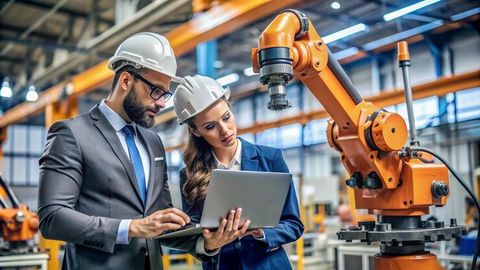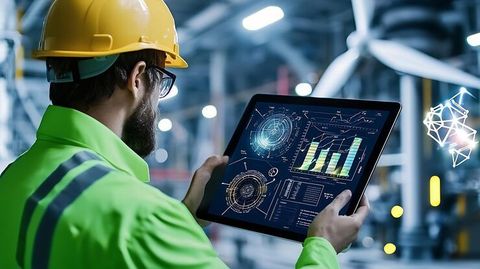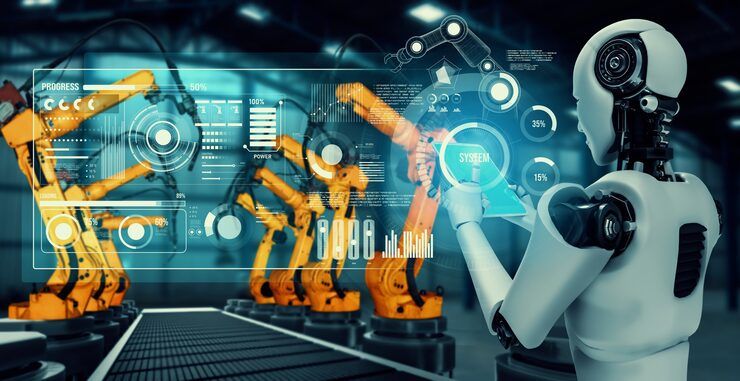
AI-powered manufacturing refers to the use of artificial intelligence (AI), machine learning, robotics, computer vision, and advanced data analytics to improve industrial production processes. These technologies help factories analyse information, identify patterns, detect potential problems, and make better operational decisions.
Traditional manufacturing often depends on predefined instructions, manual inspections, and scheduled equipment maintenance. AI-powered manufacturing introduces systems that can learn from production data and adjust certain operations according to changing conditions.
For example, an AI system can examine information from factory sensors to identify unusual machine vibrations. It can then alert operators about possible equipment problems before a major breakdown occurs.
How Artificial Intelligence Became Important in Manufacturing
Manufacturing industries generate large amounts of information through machinery, production lines, inventory systems, and quality inspections. Analysing this information manually can be difficult, particularly in large industrial facilities.
Artificial intelligence helps process this information more efficiently. Its development has also been supported by improvements in cloud computing, industrial sensors, high-performance processors, and connected manufacturing equipment.
Today, AI applications are appearing across several industries, including:
Automotive and electric vehicle manufacturing.
Electronics and semiconductor production.
Pharmaceutical and medical equipment manufacturing.
Food and beverage processing.
Aerospace and aviation manufacturing.
Textile and chemical production.
Heavy machinery and industrial equipment.
These developments are contributing to the growth of smart factories, where connected machines and intelligent software work together to support production activities.
Why AI-Powered Manufacturing Matters Today
Improving Production Efficiency
One of the main reasons manufacturers are adopting artificial intelligence is the need to improve production efficiency. AI-powered production systems can analyse operating conditions, identify delays, and recommend adjustments.
For example, production planning software can examine equipment availability, material requirements, and manufacturing schedules. This information helps factory managers identify production bottlenecks and organise resources more effectively.
Predictive Maintenance and Equipment Monitoring
Predictive maintenance is an important application of AI in industrial environments. Instead of depending entirely on fixed maintenance schedules, AI systems analyse equipment performance to identify early warning signs.
Common monitoring indicators include:
Machine temperature and vibration.
Motor speed and operating pressure.
Energy consumption patterns.
Equipment performance history.
Unusual operating sounds.
These indicators help maintenance teams investigate potential faults before they interrupt production.
Improving Product Quality
AI-powered quality control systems use machine vision and image recognition to examine manufactured products. Cameras capture images, while machine learning models identify visible defects, incorrect dimensions, surface irregularities, and assembly problems.
This technology is particularly useful in electronics, automotive components, packaging, and precision manufacturing.
Supporting Supply Chain Management
Manufacturers must coordinate raw materials, inventory, transportation, and production schedules. AI supply chain optimization systems analyse historical information and changing demand patterns to support better planning.
They can help businesses:
Forecast material requirements.
Identify inventory shortages.
Monitor production schedules.
Analyse supplier performance.
Evaluate transportation disruptions.
Major Applications and Their Industrial Benefits
AI technology | Manufacturing application | Main benefit |
|---|---|---|
Machine learning | Production analysis | Better operational decisions |
Computer vision | Product inspection | Improved defect detection |
Industrial robotics | Assembly and handling | Greater automation |
Digital twins | Virtual factory modelling | Production simulation |
Predictive analytics | Equipment monitoring | Early fault identification |
Natural language processing | Technical documentation | Faster information retrieval |
Generative AI | Engineering support | Improved design workflows |
These technologies are not intended to replace every manufacturing activity. Their purpose is to support human expertise, improve consistency, and make industrial operations more adaptable.
Recent Developments in AI-Powered Manufacturing
Growing Adoption of Industrial AI in 2025–2026
Artificial intelligence is moving beyond experimental manufacturing projects and becoming part of practical industrial operations. Recent developments show increasing attention to autonomous production, digital twins, intelligent engineering, and AI-based inspection.
Several important developments during the past year include:
1. NIST's Smart Manufacturing AI Roadmap – July 3, 2026
The US National Institute of Standards and Technology (NIST) published its 2026 Roadmap on Artificial Intelligence and Machine Learning for Smart Manufacturing. The roadmap examines industrial data management, advanced sensing, autonomous systems, digital twins, robotics, logistics optimization, and sustainable manufacturing. It also highlights the importance of reliable and explainable AI in industrial environments.
2. Siemens and NVIDIA Expand AI-Driven Factory Technology – October 19, 2026
Siemens announced new developments in its collaboration with NVIDIA to advance AI-driven autonomous factories. The work combines industrial AI, digital twin technology, and agent-based production planning to support more adaptable manufacturing operations. Applications are being tested in Siemens' electronics factory in Erlangen, Germany.
3. AI-Powered PCB Inspection Developments – October 21, 2026
Siemens and NVIDIA announced a collaboration involving AI-powered printed circuit board inspection. Their approach uses digital twins and synthetic data to prepare automated optical inspection systems before physical products reach the production line.
The development demonstrates how virtual manufacturing environments can support inspection planning and electronic component quality control.
4. Generative AI for Engineering and Manufacturing – November 16, 2026
Siemens introduced developments connecting agentic AI workflows with additive manufacturing. The approach supports engineering activities such as adapting product designs, virtual validation, and preparing manufacturing processes. It illustrates how generative AI can connect product development with physical production.
Emerging Manufacturing Trends
Other important trends shaping the industry include:
Autonomous manufacturing: Intelligent systems increasingly coordinate production activities with limited manual intervention.
AI-powered digital twins: Virtual representations of factories help engineers simulate production changes and evaluate performance.
Generative engineering: AI assists with product design, technical documentation, and manufacturing planning.
Smart energy management: Predictive analytics helps monitor industrial electricity consumption and identify inefficient operating patterns.
Human-machine collaboration: Workers increasingly interact with intelligent robots and AI-supported monitoring systems.
These developments indicate that future manufacturing environments will depend on a combination of automation, reliable data, engineering knowledge, and human supervision.
Laws, Regulations, and Government Policies
International Regulatory Environment
AI-powered manufacturing operates within different regulatory frameworks depending on the country, industry, and application. Regulations may cover product safety, workplace protection, cybersecurity, personal data, intellectual property, and artificial intelligence.
European Union: AI Act
The European Union's AI Act establishes a risk-based regulatory framework for artificial intelligence. Its general application date was August 2, 2026, although individual requirements have different implementation dates.
Following the 2026 AI Omnibus amendments:
AI literacy and prohibited-practice requirements have applied since February 2, 2025, subject to the amended provisions.
Rules for general-purpose AI models have applied since August 2, 2025.
Most applicable transparency requirements began on August 2, 2026.
Rules for certain high-risk AI systems are scheduled for December 2, 2027.
Rules for high-risk AI embedded in regulated products, including certain machinery, are scheduled for August 2, 2028.
Manufacturers should assess whether their particular AI applications fall within regulated categories. Not every production optimization system automatically qualifies as high-risk.
United States: NIST AI Risk Management Framework
In the United States, NIST provides the AI Risk Management Framework (AI RMF), which helps organizations identify, assess, and manage risks associated with AI technologies.
On April 7, 2026, NIST released a concept note for a profile focused on trustworthy AI in critical infrastructure. These resources are relevant to manufacturers working with industrial automation, connected equipment, and operational technology.
India: Digital and Industrial Development
India's digital development initiatives, including the IndiaAI Mission, support the broader adoption of artificial intelligence, computing infrastructure, research, and AI capabilities.
Manufacturers operating in India should also consider applicable data protection, cybersecurity, workplace safety, factory regulations, and industrial standards when introducing connected production systems.
Important Compliance Considerations
Manufacturing organizations should evaluate:
Data protection and cybersecurity requirements.
Machinery and workplace safety standards.
Human supervision of automated decisions.
Documentation of AI system performance.
Accuracy and reliability of quality inspection systems.
Applicable industry-specific regulatory requirements.
Regulatory obligations vary across jurisdictions, so manufacturers should evaluate their specific operations before deploying AI technology.
Tools and Resources for AI-Powered Manufacturing
Several technology platforms and industry resources help manufacturers understand, develop, and manage intelligent production environments.
Industrial AI and Automation Platforms
1. Siemens Industrial AI and Digital Industries
Provides industrial software, automation technologies, digital twins, and intelligent manufacturing capabilities.
2. NVIDIA Omniverse
Supports industrial simulation, virtual factory environments, robotics development, and digital twin applications.
3. Microsoft Azure IoT Operations
Provides capabilities for connecting industrial equipment, managing operational data, and developing connected industrial environments.
4. AWS IoT SiteWise
Supports industrial data collection, equipment monitoring, operational analysis, and industrial performance management.
5. PTC ThingWorx
Provides industrial IoT and application development capabilities for connected manufacturing environments.
Research and Planning Resources
NIST AI Risk Management Framework: Guidance for evaluating AI risks and developing trustworthy systems.
OPC UA: An industrial communication standard supporting interoperability between machines and software.
ISA-95: A framework for understanding integration between enterprise systems and manufacturing operations.
ISO 10218: Safety requirements relating to industrial robots.
Digital twin modelling: A useful approach for evaluating production layouts, machine performance, and manufacturing processes.
Manufacturers should select technologies according to their production requirements, existing equipment, data infrastructure, and regulatory responsibilities.
Frequently Asked Questions
How Is Artificial Intelligence Used in Manufacturing?
Artificial intelligence is used for predictive maintenance, automated quality inspection, production planning, robotics, inventory management, and industrial data analysis. It helps manufacturers identify patterns and make informed operational decisions.
What Is a Smart Factory?
A smart factory is a manufacturing facility that uses connected machinery, industrial IoT devices, automation, and AI-powered software to monitor and coordinate production activities. These technologies improve communication between equipment and production systems.
How Does Predictive Maintenance Work?
Predictive maintenance uses machine learning algorithms and sensor information to monitor equipment conditions. It identifies unusual patterns, such as excessive vibration or temperature changes, which may indicate developing mechanical problems.
Can AI Improve Manufacturing Quality Control?
Yes. AI-powered machine vision systems can inspect products, identify defects, measure dimensions, and detect inconsistencies during production. Their effectiveness depends on image quality, training data, system calibration, and appropriate human oversight.
What Are the Main Challenges of AI-Powered Manufacturing?
Common challenges include:
Integrating AI with older industrial equipment.
Maintaining accurate and consistent production data.
Protecting connected machinery from cyberattacks.
Developing appropriate technical skills.
Meeting regulatory and safety requirements.
Maintaining human supervision of automated processes.
Manufacturers should evaluate these challenges before introducing AI into critical production activities.
Conclusion
AI-powered manufacturing is transforming global industries by connecting artificial intelligence with industrial machinery, production systems, robotics, and data analytics. Technologies such as predictive maintenance, machine vision inspection, digital twins, and industrial automation are helping manufacturers improve production planning, equipment monitoring, and product quality.
Recent developments in 2026 demonstrate growing interest in autonomous factories, generative engineering, and intelligent production environments. At the same time, regulatory compliance, cybersecurity, data accuracy, and workplace safety remain important considerations.
The future of manufacturing will likely involve closer collaboration between human expertise and intelligent technologies. Organizations that develop reliable digital infrastructure, understand AI capabilities, and introduce automation responsibly will be better positioned to adapt to changing industrial requirements.
Ultimately, artificial intelligence is not simply changing how products are manufactured. It is reshaping how factories are designed, monitored, managed, and connected across global industrial networks.