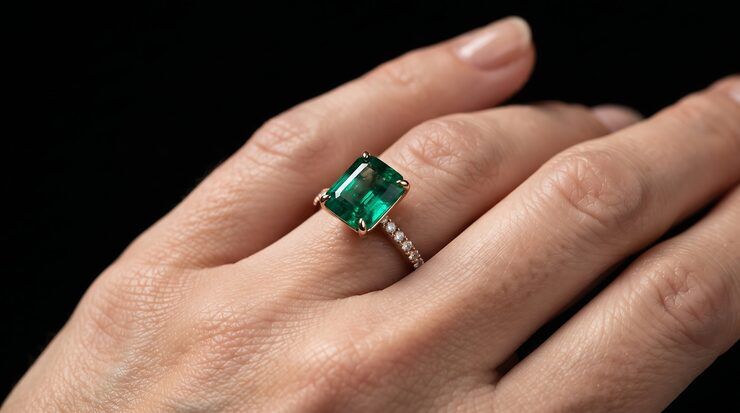
Emerald rings are jewellery pieces featuring emerald, the green variety of the mineral beryl, as a central or accent gemstone. Emeralds are recognized for their green color, which is associated primarily with trace amounts of chromium and vanadium.
The gemstone has been valued for centuries and remains an important part of the colored gemstone market. Emerald rings can range from simple solitaire designs to elaborate pieces combining emeralds with diamonds or other gemstones.
Common ring styles include emerald-cut center stones, oval and cushion shapes, halo designs, three-stone rings, cluster settings, and contemporary geometric arrangements.
What Makes an Emerald Distinctive
Emeralds are different from diamonds in several important ways. Color is particularly important, while internal inclusions are common and can form a distinctive appearance often referred to as jardin, meaning "garden" in French.
GIA notes that emerald has a Mohs hardness of approximately 7.5–8, but its toughness is only fair to good. Internal fractures can make an emerald more vulnerable to impact than some other commonly used gemstones.
Common Emerald Ring Styles
Emerald-cut solitaire rings
Emerald and diamond halo rings
Three-stone emerald rings
Oval emerald rings
Cushion-cut emerald rings
Vintage-inspired emerald rings
Minimalist emerald bands
Emerald and diamond cluster rings
Contemporary geometric designs
The setting plays an important role in protecting the gemstone. Designs that provide additional protection around vulnerable corners can be useful for rings intended for frequent wear.
Natural, Treated and Laboratory-Grown Emeralds
Natural emeralds form through geological processes, while laboratory-grown emeralds are created under controlled conditions.
Natural emeralds frequently contain fractures and inclusions. GIA explains that fracture filling using oils, waxes, or artificial resins is a common treatment intended to reduce the visibility of surface-reaching fractures and improve apparent clarity.
Treatment information is therefore an important part of understanding an emerald ring.
Why Emerald Rings Matter Today
Emerald rings occupy an important position within the wider colored gemstone jewellery, emerald engagement rings, fine gemstone rings, and luxury jewellery categories.
Their appeal comes from the combination of distinctive green color, geological character, historical significance, and design flexibility.
Emerald as an Engagement-Ring Gemstone
Colored gemstone engagement rings have become an increasingly visible part of the broader jewellery conversation. GIA's recent educational material on diamond alternatives describes emerald as a prominent colored gemstone option and highlights its distinctive color and historical significance.
Emerald can provide a strong visual contrast with diamonds or work independently as a center stone. However, its durability characteristics mean that ring design and wearing habits deserve careful consideration.
Color and Clarity
For emeralds, color is one of the most important quality characteristics. Buyers and collectors commonly consider hue, tone, and saturation together rather than looking only at whether a stone is simply "green."
Inclusions are common in natural emeralds. A completely inclusion-free natural emerald is unusual, so clarity needs to be interpreted differently from diamond clarity.
Emerald Quality Factors
| Factor | What It Indicates |
|---|---|
| Color | Hue, tone and saturation of green |
| Clarity | Presence and character of inclusions |
| Cut | Proportion, symmetry and light appearance |
| Carat weight | Weight and overall gemstone size |
| Treatment | Oil, resin or other clarity enhancement |
| Origin | Geographic source when independently established |
| Durability | Resistance to scratching and physical damage |
| Certification | Laboratory assessment of relevant characteristics |
An independent gemological report can provide information about gemstone identity, treatments, and, when applicable, geographic origin.
Recent Emerald Jewellery Developments
The colored gemstone segment continued to attract attention during 2025 and 2026, particularly in engagement-ring and fine-jewellery discussions.
Colored Gemstones in Engagement Rings
GIA published updated educational material in 2025 discussing colored gemstone engagement rings and diamond alternatives. Emerald was highlighted as a distinctive green gemstone, while its comparatively delicate toughness was emphasized as an important consideration for rings intended for frequent wear.
This reflects a broader interest in engagement rings that use colored gemstones as alternatives to traditional colorless center stones.
Lightweight Jewellery Trends
The wider gold jewellery market has also experienced significant changes. High gold prices during 2025 and 2026 encouraged greater attention to lightweight jewellery in several markets.
This trend can influence emerald ring design through thinner bands, smaller accent stones, streamlined settings, and designs that use metal efficiently.
The effect is particularly relevant to 18K gold emerald rings, 14K gold emerald rings, and other fine-jewellery categories where the metal and gemstone are considered together.
Interest in Gemstone Transparency
Treatment disclosure and gemstone documentation remain important topics within the modern colored gemstone market.
GIA explains that gemstone treatments can influence appearance and durability and that treatment information is an important part of gemological identification.
For emeralds, this is especially relevant because fracture filling is widespread.
Origin Documentation
Geographic origin can be an important characteristic for certain emeralds. Colombia, Zambia, Brazil, Pakistan, and Afghanistan are among known emerald-producing regions.
GIA notes that an independent origin determination from a respected laboratory can add provenance information for emeralds when such an assessment is possible.
Origin alone does not determine gemstone quality; individual stones from the same region can vary substantially.
Laws, Hallmarking and Jewellery Policies in India
India provides an important regulatory example because gold jewellery is subject to BIS hallmarking requirements in covered categories and districts.
Hallmarking concerns the precious-metal component of jewellery rather than the emerald itself. Consequently, a gold emerald ring can involve two separate areas of evaluation: gemstone identification and metal purity.
BIS Gold Hallmarking
The Bureau of Indian Standards explains that hallmarking is the official determination and recording of precious-metal content in covered articles. Gold and silver currently fall under India's hallmarking framework.
BIS identifies six permitted gold fineness grades under IS 1417:
14K — 585
18K — 750
20K — 833
22K — 916
23K — 958
24KS — 995
For a gold emerald ring, the hallmark relates to the gold component and does not certify the emerald's natural origin, treatment, or gemstone quality.
HUID and Recent 2026 Updates
India's hallmarking framework has continued to develop during 2025 and 2026. BIS lists amendments dated July 31, 2025, March 2, April 28, and August 3, 2026. The current mandatory-hallmarking page was updated September 1, 2026.
On March 2, 2026, an additional seven districts were included in the sixth phase of mandatory hallmarking coverage. The districts were in Punjab, Uttar Pradesh, Maharashtra, Tripura, Bihar, Rajasthan, and Madhya Pradesh.
The Hallmark Unique Identification number can help identify applicable hallmarked gold articles and can be checked through the BIS Care App.
Gemstone Documentation
Hallmarking should not be confused with a gemstone identification report. A gemstone laboratory report can address characteristics such as whether a stone is natural or laboratory-grown, detectable treatments, and potentially geographic origin.
For higher-value emerald rings, these forms of documentation answer different questions and can be considered separately.
Tools and Resources for Emerald Rings
Understanding emerald rings requires knowledge of gemstone characteristics, metal purity, measurements, treatments, and care.
Useful Resources
GIA Colored Stone Reports: Provide laboratory information about gemstone identity and detectable characteristics.
GIA Emerald Buyers Guide: Explains emerald quality factors, treatment, origin, and care.
BIS Care App: Useful for checking HUID information on applicable hallmarked gold jewellery.
BIS Hallmarking Portal: Provides current information about India's gold hallmarking framework.
Gemstone loupe: Helps examine inclusions and surface characteristics.
Digital calipers: Useful for measuring gemstone dimensions.
Carat scales: Measure gemstone weight.
Gemstone reference charts: Help compare hue, tone, saturation, and common treatments.
Ring-size guides: Help understand the relationship between ring dimensions and finger measurements.
Jewellery CAD software: Allows designers to visualize emerald settings before production.
Emerald Care
GIA recommends gentle cleaning for emerald jewellery. Warm, soapy water and gentle scrubbing are considered the safest general approach. Ultrasonic and steam cleaning can be risky because many emeralds contain fracture-filling materials.
Emerald rings should also be protected from:
Strong chemicals
Sudden temperature changes
High heat
Hard impacts
Abrasive cleaning materials
Improper ultrasonic cleaning
GIA notes that heat and chemicals can affect oils, resins, and polymers used to fill emerald fractures.
Frequently Asked Questions
What is an emerald ring?
An emerald ring is a jewellery piece containing an emerald as a center or accent gemstone. The ring can use gold, platinum, silver, or another metal and may include additional gemstones.
Are emeralds durable enough for rings?
Emerald has a Mohs hardness of about 7.5–8, but hardness does not fully describe toughness. Natural emeralds often contain fractures and inclusions, making them more vulnerable to impact than some other gemstones. Protective settings and careful handling are therefore important.
Are emeralds usually treated?
Many emeralds undergo clarity enhancement using oils, resins, waxes, or related materials. Treatment can reduce the visibility of fractures and improve apparent clarity. A gemological report can provide information about detectable treatment.
What should be considered when selecting an emerald ring?
Important factors include color, clarity, cut, carat weight, treatment, gemstone durability, setting design, metal purity, and documentation. Geographic origin can also be relevant when independently established.
How should an emerald ring be cleaned?
Gentle cleaning with warm, soapy water is generally recommended. Ultrasonic and steam cleaners should be avoided unless a qualified professional has confirmed that the particular emerald and treatment are appropriate for that method.
Conclusion
Emerald rings combine the distinctive green character of emerald with a wide range of jewellery designs, from classic solitaire settings to contemporary geometric and diamond-accented arrangements.
Understanding an emerald ring requires looking beyond color alone. Natural inclusions, clarity enhancement, cut, carat weight, setting design, metal purity, and laboratory documentation can all contribute to a more complete understanding of the piece.
Recent jewellery discussions have also highlighted colored gemstones as alternatives within the engagement-ring market, while changing gold-market conditions have encouraged greater attention to lightweight jewellery designs.
For Indian jewellery, BIS hallmarking provides an important framework for identifying the purity of applicable gold components. The hallmark does not certify the emerald itself, so gemstone documentation and metal-purity information should be understood as separate forms of identification.
For anyone researching emerald engagement rings, natural emerald rings, 18K gold emerald rings, or fine emerald jewellery, the most useful approach is to evaluate the gemstone, treatment, setting, metal, documentation, and care requirements together.
Emerald's combination of vivid color, natural character, geological rarity, and distinctive inclusions ensures that each well-documented stone can have a character that is different from another emerald, even when both are used in similar ring designs.