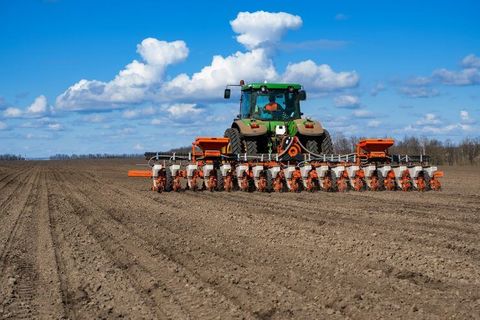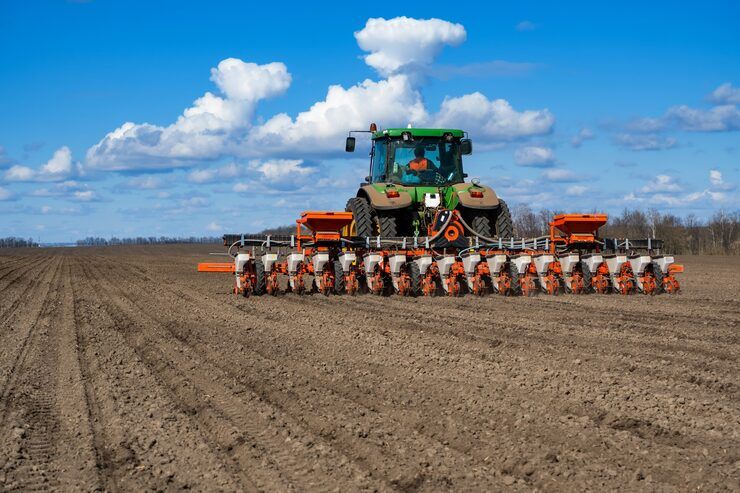
Seed drills are agricultural machines designed to place seeds into the soil at controlled depths and spacing. They help farmers establish crops more consistently than many traditional broadcasting methods, in which seeds are scattered across the soil surface.
Seed drilling technology is used for crops such as wheat, barley, oats, rice, pulses, and selected oilseeds, depending on the machine's design. Modern systems can combine seed metering, soil opening, seed placement, covering, and soil firming into one coordinated operation.
The main purpose of a seed drill is to improve control over where seeds are placed. Appropriate seed depth and spacing can support uniform germination, reduce unnecessary seed use, and make crop establishment easier to manage.
Understanding Seed Drill Machinery
A conventional seed drill consists of a seed hopper, metering mechanism, seed tubes, soil-opening components, covering devices, and a frame connected to a tractor or another power source.
The hopper stores the seed, while the metering mechanism regulates how much seed enters each delivery tube. Openers create furrows, the tubes guide seeds into the soil, and covering components return soil over the planted rows.
Modern agricultural seed drill machines may also include electronic controls, GPS guidance, hydraulic adjustments, and sensors that monitor planting performance.
Common types include:
Conventional seed drills: Place seeds in rows in prepared soil.
No-till seed drills: Open narrow slots in untilled soil to place seeds while minimizing disturbance.
Direct drills: Establish crops directly in existing soil conditions, often with reduced tillage.
Air seeders: Use an airflow system to distribute seed through delivery tubes across a wider working width.
Precision seed drills: Use specialized metering systems to control seed placement for crops requiring particular spacing.
Combination drills: Integrate seeding with other operations, such as fertilizer placement, where the design permits.
The appropriate machine depends on crop type, soil conditions, field size, planting method, and the desired level of precision.
How Seed Drills Work
Seed drilling generally involves several coordinated operations.
Seed metering: The machine measures seed flow according to the selected rate and operating conditions.
Furrow creation: Openers create narrow channels at the intended planting depth.
Seed delivery: Tubes or distribution systems guide seeds into the furrows.
Soil covering: Covering components move soil over the seeds.
Soil contact: Press wheels or similar components may improve contact between the seed and surrounding soil.
Correct calibration is important because seed size, machine speed, metering settings, and soil conditions can influence the actual planting rate.
Why Seed Drills Matter in Modern Agriculture
Seed drills help farmers manage crop establishment with greater consistency. They are particularly relevant where planting windows are limited, fields are extensive, or uniform crop emergence is important.
Improving Seed Placement
Consistent planting depth can help seeds access suitable moisture and temperature conditions. Uniform spacing can also reduce excessive competition between plants.
However, the best planting depth and spacing vary according to crop species, soil type, moisture, and local agronomic recommendations.
Supporting Resource Management
Accurate seed placement can reduce the number of seeds deposited outside intended rows. Some systems can also coordinate fertilizer placement, reducing the need for separate field operations.
The actual benefits depend on equipment calibration, field conditions, operator skills, and crop requirements.
Soil Conservation and Reduced Tillage
No-till seed drills allow seeds to be planted with limited soil disturbance. This approach can help maintain surface residues and reduce erosion under suitable conditions.
Reduced tillage may also influence soil moisture retention, fuel use, and field traffic. Results vary with climate, soil structure, crop rotation, weed pressure, and long-term management.
Farming Applications
Seed drills are used across several agricultural systems:
Grain production
Pulse cultivation
Oilseed farming
Cover-crop establishment
Conservation agriculture
Large-scale mechanized farming
Selected forage production systems
Comparing Seed Drill Types
| Machine Type | Main Function | Typical Application |
|---|---|---|
| Conventional seed drill | Places seed in rows | Prepared agricultural soil |
| No-till drill | Plants with minimal soil disturbance | Conservation farming |
| Air seeder | Distributes seed using airflow | Large fields and broad working widths |
| Precision drill | Controls individual seed placement | Crops requiring defined spacing |
| Combination drill | Integrates planting with another operation | Systems requiring coordinated fieldwork |
Machine selection should consider crop requirements and field conditions rather than relying only on working width or advertised capacity.
Recent Developments in Seed Drill Technology
Agricultural machinery development during 2025 and 2026 has continued to emphasize precision agriculture, automation, reduced soil disturbance, and improved monitoring of planting operations.
Precision Agriculture and Digital Controls
Modern seed drills increasingly incorporate electronic metering, GPS guidance, and digital monitoring. Depending on the system, these features can help operators maintain row alignment, adjust planting rates, and identify irregular seed delivery.
Some advanced systems support variable-rate seeding, allowing planting rates to change according to field conditions or prescription maps.
These technologies require suitable calibration and reliable field data. Digital controls cannot compensate automatically for every difference in soil moisture, seed quality, or field preparation.
Conservation Agriculture
Reduced-tillage and direct-drilling methods continue to receive attention because they can support soil conservation in appropriate farming systems.
Specialized openers are designed to cut through crop residues and place seeds while limiting disturbance. Their performance depends on residue volume, soil hardness, moisture, and the machine's configuration.
Automation and Equipment Monitoring
Electronic sensors and machine-monitoring systems can help identify blockages, changes in seed flow, and differences between planting rows.
During 2025 and 2026, agricultural technology development continued to focus on integrating machinery data with farm-management software and precision guidance systems.
The availability of these features varies by manufacturer and model, so farmers should assess compatibility, maintenance requirements, and the reliability of the technology under local conditions.
Agricultural Laws, Standards, and Policies
Seed drill operation is influenced by agricultural machinery standards, workplace safety requirements, environmental regulations, and government programs. Specific requirements differ by country.
Agricultural Machinery Standards
International and national standards can address machinery safety, operator protection, testing procedures, and equipment performance.
The International Organization for Standardization develops standards relevant to agricultural machinery, including safety requirements for many types of farm equipment.
Farm operators should consult applicable national standards and equipment documentation when selecting, maintaining, or operating machinery.
Agricultural Equipment Policies in India
In India, agricultural mechanization programs are intended to improve access to suitable machinery and encourage efficient farming practices.
The Sub-Mission on Agricultural Mechanization has supported agricultural mechanization through measures implemented by central and state governments. Eligibility, approved machinery, application procedures, and assistance arrangements depend on current program guidelines and local implementation.
Farmers should consult the relevant state agriculture department for current information rather than assuming that every machine or applicant qualifies under a particular program.
Workplace and Environmental Safety
Seed drills contain moving parts, rotating shafts, hydraulic components, and heavy structures. Safe operation requires appropriate training and compliance with applicable machinery-safety rules.
Important precautions include:
Switching off the tractor and isolating power before clearing blockages.
Keeping guards in place.
Avoiding contact with moving shafts and metering components.
Using suitable lifting and transport procedures.
Following manufacturer instructions for calibration and maintenance.
Managing dust and seed-treatment chemicals according to applicable safety guidance.
Reduced-tillage equipment should also be operated in ways that account for soil conservation objectives and local environmental requirements.
Tools and Resources for Seed Drill Planning
Several practical tools can help farmers evaluate equipment and prepare for planting.
Seed Rate Calculator
A seed-rate calculator estimates the quantity of seed required for a field. The calculation typically depends on the target plant population, seed size, germination percentage, and expected field establishment.
For example, if a farmer knows the recommended seed rate per hectare and the total field area, the total seed requirement can be calculated by multiplying the rate by the area.
GPS Guidance and Field Mapping
GPS guidance can help maintain row alignment and reduce overlap between passes. Field-mapping tools can also record planted areas and support future planning.
Calibration Worksheet
A simple worksheet can record:
Crop type and variety
Recommended seed rate
Field area
Seed size and quality
Metering settings
Travel speed
Measured seed output
Calibration date
Regular checks are important because actual seed delivery can differ from the initial machine setting.
Soil and Weather Information
Soil testing, rainfall forecasts, and local agronomic recommendations can help determine suitable planting conditions.
Seed drills work most effectively when the field is prepared appropriately for the machine and crop. Excessively wet, compacted, or residue-heavy soil can affect opener performance and seed placement.
Frequently Asked Questions
What is a seed drill used for?
A seed drill places seeds into soil in rows at controlled depths and rates. It supports more organized crop establishment and can reduce uneven seed distribution compared with surface broadcasting.
What is the difference between a seed drill and a precision planter?
A seed drill commonly places seeds continuously along rows, making it suitable for many grain crops. A precision planter is designed to control the placement of individual seeds at specific intervals, often for crops such as maize or sunflower.
Can seed drills be used in no-till farming?
Yes. No-till seed drills are specifically designed to place seeds into untilled soil with minimal disturbance. Their performance depends on residue conditions, soil properties, opener design, and correct adjustment.
How often should a seed drill be calibrated?
Calibration should be checked before planting and whenever seed type, seed rate, machine settings, or operating conditions change significantly. Regular inspection during fieldwork can help identify changes in seed delivery.
What factors determine seed drill performance?
Important factors include seed quality, planting depth, metering accuracy, travel speed, soil moisture, field preparation, opener condition, and operator technique.
Conclusion
Seed drills are important agricultural machines that support controlled seed placement, organized planting, and efficient crop establishment. Conventional drills, no-till systems, air seeders, and precision planting equipment address different crop requirements and soil conditions.
Recent developments in electronic metering, GPS guidance, variable-rate seeding, and machine monitoring are expanding the capabilities of modern agricultural machinery. Nevertheless, correct calibration, suitable field conditions, and operator training remain essential for consistent results.
Farmers evaluating seed drill technology should consider crop type, soil conditions, required planting rate, machinery compatibility, maintenance, safety, and applicable agricultural policies. Matching the equipment to the farming system can support effective planting while helping manage seed use and soil resources.