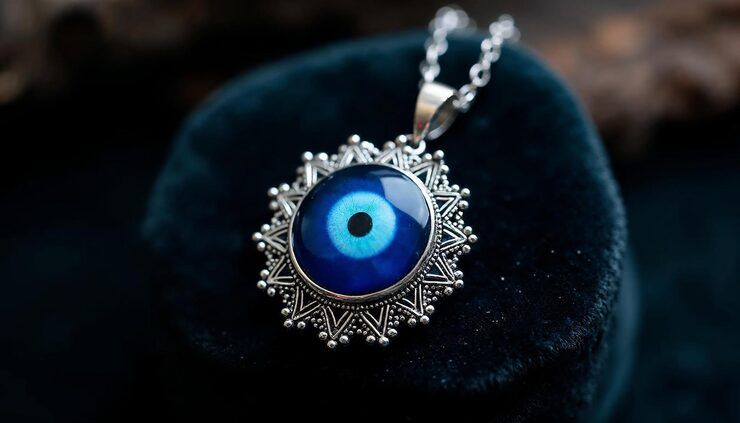
Turkish evil eye pendants are jewellery or decorative objects based on the traditional Nazar Boncuğu, a distinctive eye-shaped glass bead associated with Turkish culture. The familiar design generally features concentric blue, white, and dark-colored elements arranged to resemble an eye.
ent can vary in size, color arrangement, thickness, and shape.
Why Turkish Evil Eye Pendants Matter Today
Nazar Boncuğu represents more than a decorative pattern. It connects jewellery design with cultural history, traditional glassmaking, symbolism, and everyday decorative practices.
Its recognizable eye pattern has also made it adaptable to contemporary jewellery.
Cultural and Decorative Use
Historically, Nazar Boncuğu objects have been associated with important moments in life, including birth, marriage, and other milestones. UNESCO documentation notes that the objects have been used both as accessories and decorative objects.
Contemporary pendants may therefore be viewed from several perspectives:
Cultural heritage
Jewellery design
Traditional craftsmanship
Personal symbolism
Travel-related cultural objects
Decorative art
Contemporary fashion
The symbolic meaning can differ between individuals and communities. A person may wear a Nazar pendant because of cultural tradition, personal belief, aesthetic preference, or a combination of these reasons.
The Eye Motif
The most recognizable Nazar design normally contains multiple circular layers. Blue is especially strongly associated with the modern visual form, although traditional examples can include several colors.
| Element | Typical Role |
|---|---|
| Blue outer area | Dominant visual color |
| White ring | Creates contrast |
| Dark center | Forms the eye-like pupil |
| Glass | Traditional bead material |
| Metal setting | Supports the pendant |
| Chain or cord | Allows it to be worn |
The exact arrangement is not completely standardized. Handmade examples can vary significantly from one another.
Jewellery Applications
Nazar-inspired designs can be incorporated into:
Pendant necklaces
Charm bracelets
Earrings
Rings
Brooches
Layered necklaces
Minimalist pendants
Statement jewellery
This flexibility allows a traditional visual symbol to appear in both heritage-inspired and contemporary jewellery.
Recent Developments in Turkish Evil Eye Jewellery
The Nazar Boncuğu tradition itself is older than current fashion cycles, but its visual form continues to appear in contemporary jewellery and cultural-design contexts.
Continued Recognition of Traditional Craft
UNESCO's documentation identifies Nazar Boncuğu craftsmanship, practices, and beliefs as part of Türkiye's national intangible cultural heritage inventory. The documentation also records the role of traditional production knowledge and master-apprentice transmission.
The UNESCO nomination was ultimately withdrawn by Türkiye rather than becoming an inscription on the Representative List. UNESCO's current record explicitly identifies the nomination as withdrawn at the request of the submitting state.
This distinction is important: Nazar Boncuğu is documented as national intangible cultural heritage in Türkiye, but it should not be described as currently inscribed on UNESCO's Representative List.
Contemporary Jewellery Design
During 2025–2026, the broader jewellery environment continued to combine traditional motifs with minimalist and contemporary forms.
For Nazar pendants, this can be seen in design approaches such as:
Small eye-shaped pendants
Minimal blue-and-white charms
Gold-framed glass beads
Silver Nazar pendants
Layered necklaces
Geometric interpretations
Mixed-material designs
Contemporary versions can preserve the recognizable eye motif while changing the scale, metal setting, surface finish, or surrounding design.
Transparency in Jewellery Materials
Another important recent development concerns the distinction between natural and laboratory-produced precious stones in Türkiye.
On June 24, 2026, Türkiye's Ministry of Trade announced a regulatory change requiring products containing synthetic precious stones to clearly identify them as synthetic in relevant labels, certificates, invoices, and sales areas. The change was presented as a consumer-information and transparency measure.
This development is more relevant to Nazar pendants containing precious stones than to traditional glass beads, but it illustrates the increasing emphasis on clear material identification within the jewellery sector.
Laws, Regulations and Policies in Türkiye
Türkiye provides an especially relevant regulatory example because Nazar Boncuğu is closely associated with Turkish cultural heritage while modern jewellery is also subject to consumer-protection and product-safety rules.
Cultural Heritage Context
The Turkish Ministry of Culture and Tourism maintains the National Intangible Cultural Heritage Inventory. UNESCO's documentation states that Nazar Boncuğu was included in Türkiye's national inventory in 2008.
The cultural-heritage context does not mean that every modern pendant is handmade or historically produced. Contemporary manufacturers may use different materials and production methods.
Product Safety
Türkiye's Product Safety and Technical Regulations Law No. 7223 establishes a general framework covering product safety, technical regulations, conformity assessment, market surveillance, and responsibilities of economic operators.
The law entered into force in March 2021 and also covers products distributed through online channels.
Türkiye's Ministry of Trade states that products placed on the market must meet minimum safety requirements relating to human health, consumer protection, and other applicable considerations. Manufacturers, authorized representatives, and importers have responsibilities concerning product safety.
2025 Product-Safety Updates
The Ministry of Trade's product-safety legislation page was updated on January 31, 2025, and lists Law No. 7223 along with the relevant market-surveillance framework.
For jewellery and decorative pendants, the precise requirements depend on the product category, materials, intended users, and applicable technical rules.
The Ministry also maintains a Türkiye Product Rules Database containing current information on technical regulations and product requirements.
Material Safety
Material composition can matter when a pendant contains metal components that come into prolonged contact with skin.
For products entering Türkiye, applicable chemical and product-safety requirements should therefore be reviewed according to the exact materials and product category rather than assuming that all pendants follow identical requirements.
Tools and Resources for Turkish Evil Eye Pendants
Researching a Turkish evil eye pendant can involve cultural history, material identification, jewellery measurements, and product-safety information.
Useful Resources
UNESCO Intangible Cultural Heritage database: Useful for researching the documented history and cultural context of Nazar Boncuğu.
Türkiye Ministry of Culture and Tourism resources: Useful for information about Turkish cultural heritage.
Türkiye Product Rules Database: Provides information about current technical regulations and product requirements.
Ministry of Trade product-safety resources: Useful for current consumer-product regulations.
Digital calipers: Help measure pendant diameter and thickness.
Jewellery scales: Measure the weight of metal and glass components.
Material-identification references: Help distinguish glass, ceramic, enamel, and different metals.
Jewellery CAD software: Can be used to model modern Nazar-inspired pendant structures.
Color references: Help document the blue, white, black, and other colors used in different Nazar designs.
Photographic documentation: Useful for recording handmade variations in bead shape and color placement.
Factors Worth Comparing
When researching a Turkish evil eye pendant, useful characteristics include:
Bead material
Handmade or machine-produced construction
Pendant dimensions
Metal type
Metal purity, where applicable
Glass color arrangement
Surface finish
Chain or cord construction
Clasp type
Cultural provenance
Material documentation
A pendant's visual similarity to a traditional Nazar bead does not by itself establish that it was produced using traditional Turkish glassmaking methods.
Frequently Asked Questions
What is a Turkish evil eye pendant?
A Turkish evil eye pendant is a jewellery piece based on the Nazar Boncuğu, a traditional Turkish eye-shaped glass bead associated with the cultural concept of the evil eye. The design is used today in necklaces, charms, bracelets, earrings, and decorative objects.
What does the Nazar Boncuğu symbolize?
Nazar Boncuğu is traditionally associated with protection from nazar, or the evil eye. This is a cultural and traditional belief rather than a scientifically established protective effect. UNESCO documentation describes the bead's traditional association with this belief.
Is every Turkish evil eye pendant handmade?
No. Traditional Nazar Boncuğu glassmaking uses molten glass and hand-operated tools, but contemporary pendants can be produced through various manufacturing methods. The production method should be confirmed separately when it is relevant.
Is Nazar Boncuğu listed by UNESCO?
Nazar Boncuğu was submitted to UNESCO for possible inscription on the Representative List of the Intangible Cultural Heritage of Humanity, but the nomination was withdrawn by Türkiye. It was nevertheless included in Türkiye's National Intangible Cultural Heritage Inventory in 2008.
What materials are used in modern Nazar pendants?
Traditional beads are made from glass, while modern pendants can combine glass with gold, silver, plated metals, brass, stainless steel, enamel, ceramic, cord, or other materials. The exact material composition depends on the individual design.
Conclusion
Turkish evil eye pendants represent the intersection of jewellery, glassmaking, symbolism, and cultural heritage. Their central visual element, the Nazar Boncuğu, has a distinctive eye-like design that has been used in Türkiye as both an accessory and decorative object.
Traditional Nazar Boncuğu craftsmanship involves molten glass and specialized techniques transmitted through generations. At the same time, modern jewellery designers have adapted the familiar motif into gold, silver, minimalist, geometric, and mixed-material pendants.
Recent developments in Türkiye's jewellery regulatory environment also demonstrate the growing importance of transparent material identification. In June 2026, the Ministry of Trade announced new requirements concerning clear identification of synthetic precious stones in relevant jewellery documentation and presentation.
For anyone researching Turkish Nazar pendants, evil eye jewellery, or Nazar Boncuğu glass beads, it is useful to distinguish cultural symbolism from claims about physical effects and to distinguish traditional craftsmanship from contemporary manufacturing.
Türkiye's product-safety framework further emphasizes that products placed on the market should meet applicable safety requirements and that economic operators have defined responsibilities.
Ultimately, the enduring appeal of Turkish evil eye pendants comes from their recognizable visual language and the long cultural history surrounding the Nazar Boncuğu. Their modern forms demonstrate how a traditional symbol can continue to evolve while remaining connected to its historical Turkish context.