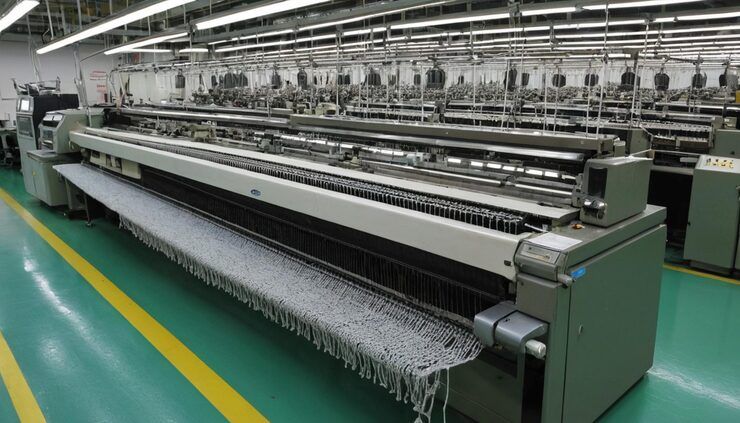
Water jet looms are high-speed weaving machines that use a narrow stream of water to carry the weft yarn across the warp shed. The technique is part of modern shuttleless weaving technology and is particularly associated with synthetic filament yarns and fabrics.
A conventional weaving process requires the weft yarn to travel from one side of the fabric to the other. In a water jet loom, a carefully controlled water stream transports the yarn through the shed at high speed.
The technology combines mechanical motion, electronic controls, water circulation, yarn management, and precision timing. Modern machines can incorporate sensors and programmable controls to regulate weaving parameters and monitor production.
How a Water Jet Loom Works
The basic weaving sequence involves several coordinated movements:
Warp yarns are separated to create a shed.
A measured length of weft yarn is prepared.
A water jet carries the weft through the shed.
The reed moves the inserted yarn into the fabric structure.
The fabric is advanced by the take-up mechanism.
Warp yarn is continuously supplied through the let-off system.
The timing of these operations must remain synchronized. Variations in water pressure, yarn tension, warp alignment, or machine timing can affect fabric formation.
Main Components
A modern water jet weaving machine generally contains:
Warp beam
Let-off mechanism
Shedding mechanism
Water pump
Water tank or circulation system
Main nozzle
Relay nozzles where applicable
Weft measuring and storage system
Reed and sley mechanism
Take-up mechanism
Fabric winding system
Electronic control system
Sensors and monitoring equipment
Different machine configurations are designed for different fabric widths, yarn types, production speeds, and weaving requirements.
Why Water Jet Looms Matter Today
Water jet looms are important because they can achieve high weaving speeds with suitable synthetic yarns while maintaining continuous weft insertion.
They are particularly relevant to manufacturers producing fabrics from polyester, nylon, and other water-compatible filament yarns.
Suitable Fabric Applications
Water jet weaving technology can be used for fabrics such as:
Polyester fabrics
Nylon fabrics
Synthetic filament fabrics
Lining materials
Apparel fabrics
Home-textile fabrics
Technical textile structures
Lightweight woven fabrics
The technology is less suitable for some absorbent natural fibers because the water-based insertion method can interact differently with moisture-sensitive or absorbent yarns.
Advantages of Water Jet Weaving
Important characteristics include:
High weaving speed
Efficient weft insertion
Suitable operation with many synthetic filament yarns
Continuous automated weaving
Consistent fabric formation when properly calibrated
Compatibility with electronic monitoring
Reduced mechanical contact during weft insertion
The technology is particularly relevant to industrial water jet looms, high-speed weaving machines, textile weaving machinery, and synthetic fabric manufacturing equipment.
Water Jet Versus Other Loom Technologies
| Loom Type | Weft Insertion Method | Common Applications |
|---|---|---|
| Water jet loom | Water stream | Synthetic filament fabrics |
| Air jet loom | Compressed air | Many lightweight and medium fabrics |
| Rapier loom | Rapier mechanism | Wide range of yarns and fabrics |
| Projectile loom | Projectile device | Heavy and specialized fabrics |
| Shuttle loom | Shuttle | Traditional and selected specialty fabrics |
The appropriate loom depends on yarn characteristics, fabric construction, width, production requirements, and environmental conditions.
Recent Water Jet Loom Developments
The textile machinery sector continued moving toward automation, digital monitoring, energy management, and improved production control during 2025 and 2026.
Greater Digital Control
Modern weaving machinery increasingly incorporates electronic controls and sensors that can monitor parameters such as yarn tension, machine speed, stoppages, and other operating conditions.
Digital monitoring can help operators identify interruptions and investigate recurring production problems.
For large weaving facilities, data from multiple machines can also support production planning and maintenance analysis.
Machine Safety Standardization in India
A significant development occurred in India during 2025. BIS published October 2025 guidelines specifically addressing all types of weaving machines and their technical-file requirements under the Machinery and Electrical Equipment Safety framework.
The BIS document explicitly includes water-jet weaving machines among the machine categories covered by its technical-file guidance. It requires manufacturers to identify applicable Indian Standards and essential safety requirements for each machine model.
This is particularly important for organizations researching water jet weaving machinery in India, because compliance is no longer simply a matter of machine performance; safety documentation and applicable standards also need to be considered.
Industry 4.0 Integration
Weaving facilities are increasingly connecting machine controls with factory-level monitoring systems. This can allow production data, machine alerts, downtime information, and quality measurements to be reviewed through centralized systems.
Potential technologies include:
IoT-enabled machine monitoring
Digital production dashboards
Automated fault detection
Predictive maintenance
Electronic quality monitoring
Production-data collection
Energy monitoring
These developments support the broader transition toward digitally managed textile manufacturing.
Water Management
Because water is directly involved in weft insertion, water management is a distinctive consideration for water jet looms.
Modern textile facilities can focus on water circulation, filtration, quality monitoring, and efficient reuse. Water quality can influence nozzle performance, deposits, fabric quality, and machine maintenance.
For this reason, water treatment and filtration can become important components of a modern water jet weaving installation.
Laws, Standards and Policies in India
India provides an important regulatory example because textile machinery is covered by machinery-safety standards and because textile manufacturing facilities can also face environmental requirements involving water, wastewater, energy, and workplace safety.
Machinery and Electrical Equipment Safety
The Machinery and Electrical Equipment Safety (Omnibus Technical Regulations) Order, 2024 establishes a framework under which specified machinery and electrical equipment must conform to applicable Indian Standards and essential safety requirements.
BIS's October 2025 weaving-machine guidance states that weaving-machine technical files must address applicable Type A, Type B, and Type C safety standards. It specifically identifies water-jet weaving machines as one of the machine categories requiring technical documentation.
The broader framework includes IS 16819:2018 / ISO 12100:2010, which covers general machinery safety principles, risk assessment, and risk reduction.
Textile Machinery Safety
The Gazette material associated with India's machinery-safety framework identifies IS 17361 (Part 6):2020 / ISO 11111 (Part 6):2005 as the textile-machinery safety standard for fabric-manufacturing machinery. It covers all types of weaving machines.
For a water jet loom, the exact compliance pathway can depend on the machine model, applicable standards, manufacturing location, and regulatory status.
Water and Environmental Requirements
Water jet weaving requires water for weft insertion and therefore differs from air jet weaving in its resource requirements.
A textile facility should evaluate applicable environmental permissions and wastewater requirements according to its location and complete production process. Requirements can involve water intake, wastewater discharge, treatment, and environmental monitoring.
The relevant requirements may also depend on dyeing, finishing, washing, or other processes carried out at the same facility.
BIS Standards Resources
BIS's Know Your Standard platform allows users to search Indian Standards by standard number or keyword. It provides access to standard documents, amendments, notifications, testing information, laboratories, and related information. The platform was updated on May 8, 2026.
Tools and Resources for Water Jet Looms
Operating a water jet loom efficiently requires technical resources covering yarn selection, machine settings, water quality, production monitoring, and fabric inspection.
Useful Tools
Loom production calculators: Estimate theoretical and practical fabric output.
Weft insertion calculators: Help analyze insertion requirements for different machine settings.
Warp and weft calculators: Determine yarn consumption based on fabric construction.
Fabric GSM calculators: Estimate fabric weight from yarn and construction parameters.
Yarn-count conversion tools: Convert between common yarn numbering systems.
Water-quality testing equipment: Checks parameters that can affect machine operation.
Flow meters: Monitor water circulation and consumption.
Digital tension meters: Help evaluate yarn tension.
Fabric inspection systems: Identify weaving defects.
Predictive-maintenance software: Tracks machine conditions and maintenance intervals.
BIS Know Your Standard: Helps identify relevant Indian Standards.
Important Machine Parameters
When researching industrial water jet looms, useful specifications include:
Maximum weaving width
Rated weaving speed
Suitable yarn range
Weft insertion system
Number of nozzles
Water pressure
Water circulation arrangement
Pump configuration
Warp beam capacity
Electronic control system
Fabric take-up system
Machine monitoring features
Energy consumption
Water consumption
Safety systems
Machine speed should not be considered independently. Actual fabric output depends on fabric construction, yarn characteristics, machine settings, stoppages, maintenance, and quality requirements.
Frequently Asked Questions
What is a water jet loom?
A water jet loom is a shuttleless weaving machine that uses a controlled stream of water to carry weft yarn through the warp shed. It is commonly associated with synthetic filament yarns.
What types of yarn are suitable for water jet looms?
Water jet looms are commonly used with hydrophobic synthetic filament yarns such as polyester and nylon. Yarn characteristics, fabric construction, and machine configuration determine suitability.
How is a water jet loom different from an air jet loom?
A water jet loom uses a water stream for weft insertion, while an air jet loom uses compressed air. Water jet systems are particularly associated with synthetic filament fabrics, whereas air jet technology can accommodate a broader range of textile applications.
Does a water jet loom require water treatment?
Water quality can affect nozzle performance, deposits, circulation equipment, and machine maintenance. The exact treatment requirements depend on the water source, machine configuration, and operating conditions.
Are water jet looms covered by Indian machinery-safety requirements?
Yes, water-jet weaving machines are explicitly identified in BIS's October 2025 technical-file guidance for weaving machines under India's Machinery and Electrical Equipment Safety framework. Applicable standards and requirements depend on the specific machine model and regulatory circumstances.
Conclusion
Water jet looms are specialized high-speed weaving machines that use controlled water streams to insert weft yarn through a warp shed. Their strongest applications are generally associated with synthetic filament yarns and fabrics where water-based weft insertion is technically appropriate.
The technology combines mechanical weaving movements with pumps, nozzles, water circulation, yarn control, electronic monitoring, and automated production systems. Proper synchronization of these components is important for stable fabric formation.
Recent developments are increasingly focused on digital monitoring, machine safety, water management, predictive maintenance, and Industry 4.0 integration. In India, the October 2025 BIS technical-file guidance specifically recognizes water-jet weaving machines within its weaving-machine framework.
For organizations researching water jet weaving machines, the most important considerations include fabric type, yarn characteristics, machine width, weaving speed, water quality, water circulation, energy consumption, production monitoring, maintenance, and applicable safety standards.
Water jet weaving remains an important textile-manufacturing technology because it provides a specialized method of high-speed weft insertion. Its future development is likely to focus on improved automation, resource management, digital monitoring, machine safety, and more efficient integration with modern textile-production systems.