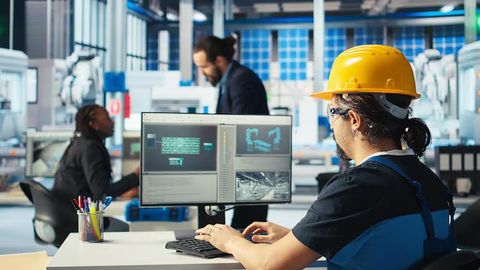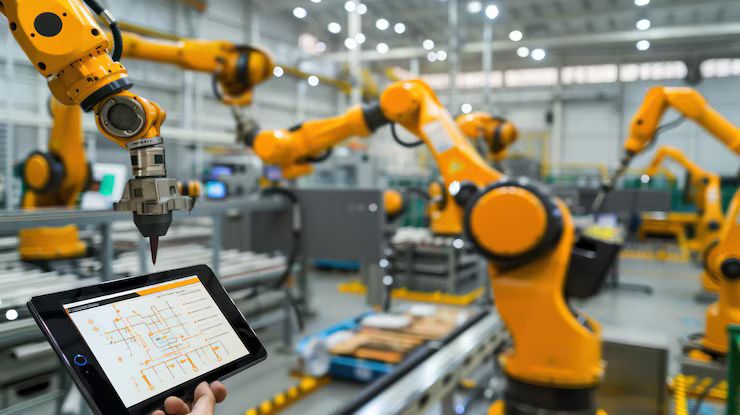
Factory automation uses industrial control systems, sensors, software, robotics, machines, and communication networks to monitor and control manufacturing activities. It can coordinate production equipment, material movement, inspection, data collection, and process monitoring across a factory.
Modern factory automation increasingly combines programmable logic controllers, industrial robots, machine vision, Industrial IoT, manufacturing execution systems, artificial intelligence, and real-time analytics. These technologies are used in automotive production, electronics, pharmaceuticals, food processing, packaging, chemicals, warehouses, and other manufacturing environments.
Context
What Is Factory Automation?
Factory automation is the use of automated technologies to perform or control manufacturing activities with reduced dependence on continuous manual intervention.
Automation can range from a single automated machine to an integrated factory-wide architecture. A small production cell might contain sensors, a PLC, a robot, and an HMI, while a large smart manufacturing facility can connect thousands of devices to supervisory and enterprise-level systems.
How Factory Automation Works
A typical automated manufacturing system follows a feedback cycle:
Sense → Communicate → Analyze → Control → Act
Sensors collect information from machines or production processes. Controllers process the information and send commands to actuators, motors, valves, robots, or other equipment.
Higher-level systems can collect this information for production monitoring, quality analysis, maintenance planning, and manufacturing management.
Main Factory Automation Technologies
| Technology | Primary Function | Typical Applications |
|---|---|---|
| PLC | Machine and process control | Production machinery |
| SCADA | Supervisory monitoring | Industrial plants |
| HMI | Operator interaction | Machine control |
| Industrial Robots | Automated movement | Assembly and handling |
| Machine Vision | Automated inspection | Quality control |
| Industrial Sensors | Process measurement | Monitoring and feedback |
| VFDs | Motor-speed control | Pumps and conveyors |
| MES | Production management | Manufacturing operations |
| IIoT Platforms | Connected data collection | Smart factories |
| Digital Twins | Process and equipment modeling | Simulation and optimization |
Programmable Logic Controllers
PLCs are central components in many factory automation systems. They receive signals from sensors, execute programmed logic, and control connected equipment.
PLC applications include machine sequencing, conveyor control, packaging operations, assembly systems, safety functions, and process regulation.
SCADA Systems
SCADA platforms provide supervisory monitoring and data acquisition. They can collect information from distributed machines and display equipment status, alarms, measurements, and historical trends.
SCADA is particularly useful where operators need visibility across multiple machines or production areas.
Human-Machine Interfaces
HMIs provide a graphical interface between operators and automated equipment. An HMI can display process values, machine status, alarms, production information, and selected control functions.
Modern interfaces can also provide historical trends and diagnostic information.
Importance
Why Factory Automation Matters
Manufacturing processes often involve repetitive movements, precise timing, continuous monitoring, and coordination between multiple machines. Automation systems can coordinate these activities through programmed control logic and real-time feedback.
Automation can also create electronic production records and provide greater visibility into equipment and process conditions.
Supporting Production Operations
Automated systems can coordinate machines across different stages of production. For example, sensors can detect the arrival of a component, a robot can position it, a machine can perform a processing step, and a vision system can inspect the result.
Communication between these systems allows production cells to operate as coordinated units.
Improving Process Consistency
Automated equipment can execute predefined sequences repeatedly. This can help maintain consistent machine movements, process timing, and operating parameters.
Actual process consistency depends on equipment design, calibration, maintenance, material variation, and control-system configuration.
Automated Quality Inspection
Machine vision, dimensional sensors, laser measurement systems, and other inspection technologies can evaluate products during manufacturing.
Automated inspection can identify selected defects or dimensional deviations and communicate results to production-control systems.
Production Data Collection
Connected automation systems can capture information such as machine operating time, production counts, alarms, cycle durations, process variables, and equipment status.
Manufacturers can analyze this information to understand production patterns and investigate process deviations.
Smart Manufacturing Systems
What Is Smart Manufacturing?
Smart manufacturing combines automation, connectivity, data analysis, software, and advanced control technologies to create more connected production environments.
Unlike isolated automation systems, smart manufacturing architectures can connect machines with production-management, quality, maintenance, and enterprise systems.
Industrial Internet of Things
Industrial IoT connects sensors, machines, controllers, and software platforms through industrial communication networks.
IIoT systems can collect data from production equipment and transmit it to edge devices, local servers, or cloud-based analytics platforms.
Manufacturing Execution Systems
Manufacturing Execution Systems, or MES, connect production activities with manufacturing management.
MES platforms can track production orders, materials, equipment status, quality information, work instructions, and electronic production records.
Digital Twins
Digital twins use digital representations of physical machines, processes, or production systems.
Real-world sensor information can be combined with models to evaluate equipment behavior, simulate process changes, and support engineering analysis.
Edge Computing
Edge computing processes industrial data close to the equipment generating it. This can reduce the need to transmit every data point to a remote platform and can support applications requiring rapid local analysis.
Automation Equipment
Industrial Robots
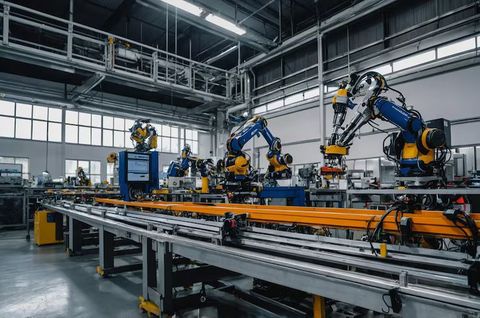
Industrial robots can perform assembly, welding, painting, material handling, palletizing, machine tending, and other repetitive operations.
Robotic systems typically combine mechanical arms with controllers, end-effectors, sensors, safety equipment, and application software.
Automated Guided Vehicles
Automated guided vehicles and autonomous mobile robots can transport materials through factories and warehouses.
Navigation can use markers, magnetic guidance, laser-based systems, cameras, sensors, maps, or other technologies depending on the platform.
Conveyors
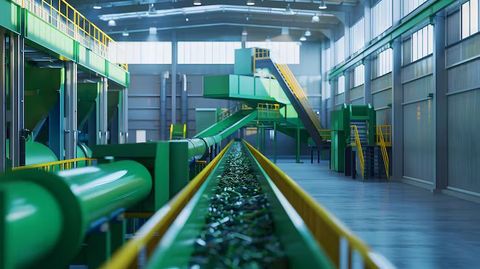
Automated conveyor systems move components, products, containers, and materials between production stations.
Sensors and controllers can coordinate conveyor speed, accumulation, routing, and transfer operations.
Variable-Frequency Drives
VFDs regulate AC motor speed and can be used in pumps, fans, conveyors, compressors, and other rotating machinery.
Motor control can be integrated into broader automation systems through industrial communication networks.
Machine Vision
Machine-vision systems use cameras, lighting, image-processing software, and computing hardware to inspect products and identify defined visual characteristics.
Applications include dimensional verification, component identification, orientation checking, label inspection, and defect detection.
Industrial Sensors
Sensors provide information about temperature, pressure, flow, level, position, proximity, vibration, force, and other process variables.
Sensor selection depends on the measurement, environment, accuracy requirements, response time, and communication architecture.
Industrial Applications
Automotive Manufacturing
Automotive factories use automation for welding, painting, assembly, inspection, material handling, and component testing.
Robots, conveyors, vision systems, PLCs, and manufacturing software can operate as integrated production cells.
Electronics Manufacturing
Electronics production requires precise handling and inspection. Automation technologies can include robotic assembly, pick-and-place systems, machine vision, automated testing, and material-handling equipment.
Pharmaceutical Manufacturing
Pharmaceutical facilities use automation for process control, filling, packaging, environmental monitoring, material handling, and electronic documentation.
Automation architectures must align with applicable manufacturing and data-integrity requirements.
Food and Beverage
Automated systems can control mixing, filling, labeling, packaging, temperature, flow, and material movement.
Sensors and controllers help coordinate equipment while monitoring selected process conditions.
Chemical Processing
Chemical plants use automation to regulate temperature, pressure, flow, level, dosing, mixing, and other process variables.
DCS, PLC, SCADA, sensors, analyzers, and safety systems can form interconnected control architectures.
Packaging
Packaging automation can coordinate conveyors, filling machines, labeling equipment, inspection systems, case packers, and palletizing robots.
Machine vision can verify packaging characteristics before products move to subsequent stages.
Warehousing and Logistics
Automated storage and retrieval systems, conveyors, mobile robots, barcode systems, RFID, and warehouse-management software can coordinate material movement.
Integration between manufacturing and logistics systems can provide additional visibility across internal material flows.
Manufacturers and Suppliers
The factory automation ecosystem includes manufacturers of PLCs, robots, sensors, drives, control systems, machine-vision equipment, industrial networks, MES platforms, and integrated production equipment.
Some companies focus on individual automation components, while system integrators combine multiple technologies into complete production architectures.
When evaluating manufacturers or suppliers, organizations can consider:
- Automation architecture
- Equipment compatibility
- Communication protocols
- Controller capabilities
- Safety functions
- Software integration
- Scalability
- Cybersecurity features
- Technical documentation
- Training requirements
- Maintenance support
Compatibility between components is particularly important when integrating equipment from multiple manufacturers.
Recent Updates
Artificial Intelligence in Manufacturing
AI is increasingly being applied to manufacturing data for anomaly detection, visual inspection, forecasting, process analysis, and production planning.
Machine-learning models can analyze large datasets that would be difficult to evaluate manually. Their performance depends on data quality, model design, validation, and operating conditions.
Collaborative Robots
Collaborative robots are designed for applications where robots and people may work in closer proximity under defined safety conditions.
Their suitability depends on the task, payload, speed, tooling, workspace, risk assessment, and applicable safety requirements.
Industrial Edge AI
Edge computing combined with AI can allow selected analytics to run near production equipment.
Potential applications include machine-vision inspection, equipment monitoring, anomaly detection, and process analysis.
Wireless Industrial Connectivity
Industrial wireless technologies can connect selected sensors and equipment without conventional cabling.
Wireless architectures require consideration of signal reliability, interference, cybersecurity, power management, and environmental conditions.
Predictive Maintenance
Sensors can continuously collect vibration, temperature, electrical, acoustic, and other equipment data.
Analytics systems can evaluate changes in these measurements and support maintenance investigations. Predictive methods complement established inspection and maintenance procedures rather than replacing engineering judgment.
Digital Production Management
Factories are increasingly connecting automation systems with MES, enterprise resource planning, quality systems, and maintenance platforms.
This creates a data flow from physical production equipment to operational and management systems.
Laws or Policies
Machinery Safety
Automated machinery should incorporate appropriate safeguarding, emergency stops, interlocks, guarding, access controls, and risk-reduction measures.
The specific requirements depend on machine type, operating environment, jurisdiction, and applicable standards.
Functional Safety
Safety-related automation systems may use dedicated safety PLCs, safety sensors, emergency circuits, light curtains, interlocks, and other protective technologies.
Safety functions should be designed and validated according to applicable engineering and safety requirements.
Industrial Cybersecurity
Connected factories create cybersecurity considerations across controllers, networks, HMIs, servers, and cloud systems.
Security measures can include network segmentation, authentication, access controls, secure configuration, monitoring, backup procedures, and controlled software updates.
Electrical and Environmental Requirements
Automation equipment may need to comply with applicable electrical, electromagnetic compatibility, hazardous-location, and environmental requirements.
The correct certification depends on the equipment and installation environment.
Worker Safety
Organizations should assess hazards associated with robots, moving machinery, electrical systems, automated vehicles, stored energy, and maintenance activities.
Lockout and isolation procedures may be required before personnel perform certain maintenance or intervention activities.
Tools and Resources
PLC Programming Platforms
PLC programming environments allow engineers to develop control logic, configure inputs and outputs, diagnose faults, and manage controller programs.
SCADA and HMI Platforms
SCADA and HMI systems provide visualization, alarm management, historical data, and supervisory control.
MES Platforms
MES systems connect production orders, materials, equipment, operators, quality information, and production records.
Industrial Communication Protocols
Factory automation systems can use communication technologies such as PROFINET, EtherNet/IP, Modbus, OPC UA, CAN-based networks, and other industrial protocols.
Protocol selection depends on equipment compatibility, network architecture, performance, cybersecurity, and application requirements.
Simulation and Digital Modeling
Simulation software can model production lines, robotic movements, material flows, and machine interactions before physical implementation.
Digital modeling can help engineers evaluate alternative layouts and control strategies.
FAQs
What is factory automation?
Factory automation is the use of machines, sensors, controllers, robots, software, and communication systems to monitor and control manufacturing activities with reduced continuous manual intervention.
What technologies are used in factory automation?
Common technologies include PLCs, SCADA, HMIs, industrial robots, machine vision, sensors, VFDs, MES, Industrial IoT platforms, automated material-handling systems, and digital twins.
What is smart manufacturing?
Smart manufacturing combines automation, connectivity, data analytics, software, and advanced control systems to create interconnected production environments.
How is AI used in factory automation?
AI can analyze manufacturing data for anomaly detection, visual inspection, process analysis, equipment monitoring, forecasting, and selected production-planning activities.
What should manufacturers consider when selecting automation equipment?
Important factors include process requirements, machine compatibility, controller architecture, communication protocols, safety functions, cybersecurity, scalability, environmental conditions, integration requirements, and technical documentation.
Conclusion
Factory automation combines industrial sensors, controllers, robots, machines, software, communication networks, and data systems to coordinate modern manufacturing operations. Technologies such as PLCs, SCADA, HMIs, machine vision, industrial robotics, MES, and Industrial IoT provide different layers of control and information.
Smart manufacturing is extending these capabilities through AI analytics, edge computing, digital twins, connected equipment, and integrated production-management systems. Successful factory automation requires careful system architecture, equipment compatibility, safety engineering, cybersecurity, workforce training, and alignment with applicable technical and regulatory requirements.