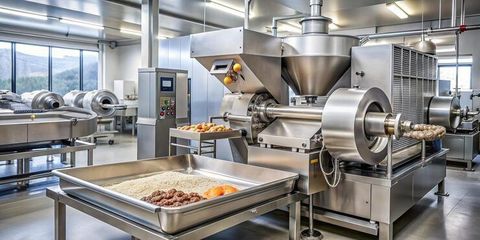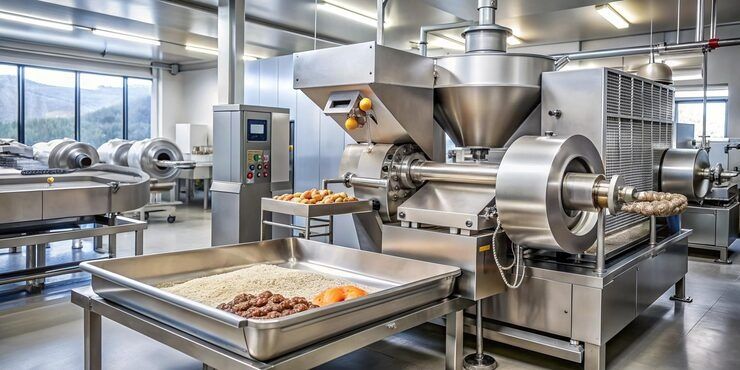
Food extruder machines are important processing systems used to shape, cook, mix, and modify a wide range of food materials. Food extruder machines insights help readers understand how extrusion technology works, what functions these machines perform, and how different operating conditions can affect food products.
Modern food extrusion combines mechanical energy, heat, pressure, and controlled material flow. The technology is used across several food categories, including snacks, breakfast cereals, pasta, pet food, textured vegetable protein, and other formulated products.
Context – What Are Food Extruder Machines?
A food extruder machine is a processing system that pushes prepared food material through a shaped opening called a die. Depending on the machine design and formulation, the material may be cooked, mixed, compressed, shaped, expanded, or partially dried during extrusion.
The basic process generally involves feeding ingredients into a barrel containing one or more rotating screws. The screws move the material forward while mechanical forces generate mixing and pressure. Heat may also be introduced through controlled barrel zones.
At the end of the barrel, the material passes through a die. The die determines the general cross-sectional shape of the extrudate. A cutting mechanism can then divide the material into pieces of a desired length.
| Extrusion element | General function |
|---|---|
| Feed system | Introduces prepared ingredients |
| Screw | Moves and mixes material |
| Barrel | Provides controlled processing conditions |
| Heating or cooling zones | Manage material temperature |
| Die | Shapes the processed material |
| Cutter | Divides extrudate into pieces |
| Control system | Monitors operating parameters |
Food extruders can use single-screw or twin-screw configurations. Twin-screw systems generally provide greater flexibility for mixing and processing formulations containing several ingredients.
Importance – Why Food Extrusion Matters
Food extrusion is significant because one continuous process can combine several operations. Depending on the formulation and equipment configuration, extrusion can provide cooking, mixing, shaping, texturization, and expansion.
The technology affects food manufacturers, ingredient processors, food scientists, quality-control teams, and consumers because processing conditions can influence texture, shape, moisture, density, and nutritional characteristics.
Common food applications include:
- Breakfast cereals and cereal pieces
- Expanded snack products
- Pasta and similar shaped foods
- Textured plant-protein products
- Modified starch products
- Some confectionery and specialty foods
- Pet-food formulations
Extrusion parameters need careful control. Screw speed, moisture, temperature, pressure, feed rate, and die geometry can all influence the final product.
For example, changing moisture content can affect material flow and expansion. Temperature changes can influence starch transformation and texture. Die design can affect the shape and dimensions of the finished product.
Recent Updates – Trends and Developments
Recent developments in food extrusion have focused on process control, energy management, ingredient flexibility, and improved understanding of food structure.
One important area is the use of automation and digital monitoring. Sensors can continuously measure variables such as temperature, pressure, torque, and feed conditions. These measurements can help operators identify changes during production and maintain more consistent processing conditions.
Another development involves plant-based ingredients. Extrusion is widely studied for producing fibrous textures from protein-rich ingredients. Soy, pea, wheat, and other plant materials can be processed under controlled conditions to create different textures.
Food researchers are also examining alternative raw materials and formulations. This includes combinations of cereals, pulses, proteins, fibers, and functional ingredients.
Key development areas include:
- Automated process monitoring
- Improved screw and die designs
- Digital data collection
- Plant-protein texturization
- Ingredient flexibility
- Energy-efficient processing approaches
- Better control of moisture and temperature
Advanced process monitoring can also help researchers connect extrusion conditions with measurable product characteristics such as density, expansion ratio, hardness, and moisture.
Laws or Policies – Relevant Food Processing Rules
Food extrusion equipment and the products made with it are subject to food-safety requirements established by the relevant authority in each country. Regulations can cover hygiene, food-contact materials, labeling, contaminants, additives, sanitation, and manufacturing practices.
In the United States, the U.S. Food and Drug Administration (FDA) regulates many aspects of food safety and food manufacturing. Food-contact materials and processing equipment may need to meet applicable requirements depending on their use.
In the European Union, food businesses must follow applicable food-safety and hygiene legislation, including requirements associated with food-contact materials and good hygiene practices.
In India, the Food Safety and Standards Authority of India (FSSAI) establishes food-safety requirements applicable to food businesses and food products.
Businesses using food extruders should therefore check the rules applicable to their specific ingredients, product category, facility, and market. Regulatory requirements can vary according to the intended food application and country.
Tools and Resources – Useful Information Sources
Several technical resources can help people understand food extrusion technology and related food-processing requirements.
Government food-safety websites are useful for checking current regulations and guidance. Academic publications can provide information about extrusion parameters, starch behavior, protein texturization, moisture control, and product characteristics.
Useful resource categories include:
- Food-safety authority websites
- University food-science departments
- Scientific journals
- Food-processing research databases
- Equipment technical manuals
- Food engineering references
- Ingredient technical documentation
Process calculations may also involve moisture content, feed rate, residence time, expansion ratio, specific mechanical energy, and mass balance. These calculations are commonly used in food-engineering research and process development.
When reviewing technical information, it is important to distinguish laboratory findings from commercial-scale processing results because equipment size, formulation, and operating conditions can produce different outcomes.
FAQs – Food Extruder Machines Insights
What are food extruder machines used for?
Food extruder machines are used to process and shape food materials. Depending on the system and formulation, they can perform mixing, cooking, texturization, compression, shaping, and expansion.
What foods can be produced with extrusion technology?
Extrusion technology is used for products such as breakfast cereals, snacks, pasta, textured plant proteins, modified starch products, and some pet-food formulations.
What factors affect food extrusion?
Important factors include ingredient composition, moisture level, feed rate, screw configuration, screw speed, barrel temperature, pressure, and die geometry. Changes in these parameters can affect texture, density, shape, and expansion.
What is the difference between single-screw and twin-screw extruders?
Single-screw extruders use one main screw to transport and process material. Twin-screw extruders use two screws and can provide additional flexibility for mixing and processing more complex formulations.
Why is temperature control important in extrusion?
Temperature influences material flow and food transformations during extrusion. Appropriate temperature control can affect starch gelatinization, protein behavior, moisture movement, texture, and product expansion.
Conclusion – Key Food Extrusion Insights
Food extruder machines combine controlled material movement, pressure, heat, mixing, and shaping in a versatile food-processing operation. Their applications range from cereal and snack products to pasta and textured plant proteins.
Understanding extrusion requires attention to both machine characteristics and ingredient behavior. Parameters such as moisture, temperature, screw speed, feed rate, and die design can significantly influence the resulting food product.
For students, researchers, food-processing professionals, and general readers, learning the basic functions of food extrusion provides useful knowledge about how many formulated foods are processed.
Regulatory requirements should always be checked against the specific product and country of operation. Technical manuals, scientific research, and government food-safety resources can provide additional information for understanding food extrusion technology.