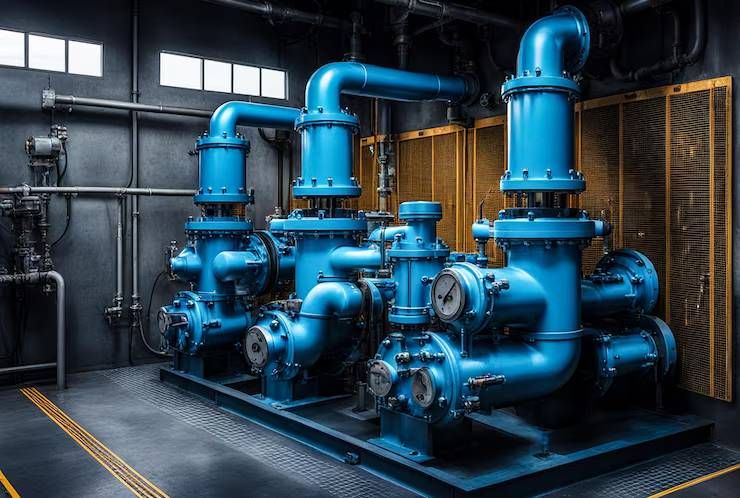
Industrial water pumps are mechanical systems used to move water through pipelines, processing systems, cooling networks, irrigation arrangements, and other industrial applications. Understanding pump performance, flow rate, pressure, efficiency, and operating conditions helps users select appropriate equipment and maintain reliable water movement.
An industrial water pump works by converting mechanical energy into hydraulic energy. Different pump designs are suited to different flow requirements, pressure levels, water conditions, temperatures, and operating schedules. Basic knowledge of these factors can help engineers, facility managers, and technical teams understand pump operation and system performance.
Context
An industrial water pump moves water from one location to another by creating a pressure difference. The pump receives mechanical energy from an electric motor or another power source and transfers energy to the water.
Centrifugal pumps are widely used in industrial water systems. They use a rotating impeller to increase the velocity of water before converting part of that velocity into pressure. Positive displacement pumps use a different operating principle and move defined volumes of fluid during each operating cycle.
Pump selection depends on several technical characteristics:
- Required flow rate
- Required pressure or head
- Water temperature
- Water quality
- Pipeline dimensions
- Operating hours
- Installation conditions
- Motor and electrical requirements
Flow describes how much water moves through the system during a specific period. It may be expressed in litres per minute, litres per second, cubic metres per hour, or gallons per minute.
Pressure describes the force exerted by water within the system. Pump specifications often use head, measured in metres or feet, to describe the energy added to the water. Pressure and head are related, but they are not identical measurements.
Importance
Pump performance directly affects the operation of many industrial water systems. A pump that does not provide sufficient flow may limit production or cooling capacity, while excessive flow can increase hydraulic losses and energy consumption.
Efficiency is also an important consideration. Pump efficiency represents how effectively the pump converts input energy into useful hydraulic output. Overall system efficiency can also be affected by the motor, pipes, valves, fittings, controls, and operating conditions.
The following table summarizes common pump factors:
| Factor | Meaning | Why It Matters |
|---|---|---|
| Flow rate | Volume of water moved over time | Determines system capacity |
| Head | Energy added to the water | Helps overcome elevation and resistance |
| Pressure | Force within the water system | Influences system operation |
| Efficiency | Useful hydraulic output compared with input energy | Relates to energy performance |
| NPSH | Pressure conditions related to pump suction | Helps reduce cavitation risk |
| Power | Energy required to operate the pump | Influences electrical demand |
Pump performance can change when actual operating conditions differ from the original design point. For example, changes in pipeline resistance, water temperature, valve positions, or system demand can move a pump away from its intended operating range.
Cavitation is another important consideration. It can occur when local pressure falls sufficiently for vapor bubbles to form and collapse inside the pump. Repeated cavitation can cause noise, vibration, reduced performance, and component damage.
Recent Updates
Modern industrial water pumping systems increasingly use variable-speed drives and electronic controls. These technologies can adjust motor speed according to changing water demand rather than operating continuously at one fixed speed.
Variable-speed operation can be particularly useful where flow requirements change during the day or across different production stages. Reducing pump speed can significantly change hydraulic output and may reduce energy consumption when the system does not require full capacity.
Digital monitoring is another developing area. Sensors can collect information about:
- Flow rate
- Pressure
- Motor current
- Temperature
- Vibration
- Operating hours
- Energy consumption
This information can support condition monitoring and maintenance planning. Some systems analyze changes in vibration, temperature, or electrical performance to identify unusual operating conditions.
Pump manufacturers and engineering organizations also increasingly provide digital performance curves, selection tools, and monitoring information. However, actual site measurements remain important because real systems can behave differently from theoretical calculations.
Laws or Policies
Industrial water pump requirements vary by country, industry, water source, and installation type. There is no single global regulation covering every industrial pumping application.
Energy-efficiency requirements may apply to pumps, electric motors, variable-speed drives, or complete pumping systems. In some jurisdictions, equipment efficiency is regulated through national or regional energy programs.
Environmental regulations may also apply when pumps are connected to wastewater, groundwater, cooling water, industrial discharge, or other regulated water systems. Water abstraction can require authorization in certain regions, while wastewater discharge may be subject to limits for pollutants, temperature, or flow.
Electrical installations are commonly subject to national electrical codes and workplace safety requirements. Industrial facilities may also have rules covering pressure systems, machinery safety, noise, guarding, and maintenance procedures.
Because requirements differ by location and application, technical teams should consult the applicable national, regional, and local authorities before designing or modifying a regulated pumping system.
Tools and Resources
Several technical resources can help users understand industrial water pump performance.
Pump performance curves are among the most important resources. A typical curve shows the relationship between flow and head at a particular pump speed or impeller configuration.
Hydraulic calculators can help estimate pressure losses through pipes, valves, elbows, filters, and other components. Basic calculations often require pipe diameter, length, water properties, elevation changes, and flow rate.
Useful resources include:
- Pump performance curves and technical manuals
- Hydraulic head-loss calculators
- Motor efficiency information
- Energy-monitoring instruments
- Flow and pressure measurement equipment
- National electrical and machinery regulations
- Engineering standards and technical references
A basic pump system assessment can compare the required duty point with the pump's documented performance curve. The duty point represents the combination of flow and head that the system requires.
FAQs
What is industrial water pump efficiency?
Pump efficiency describes how effectively the pump converts input mechanical energy into useful hydraulic energy. Actual efficiency changes with flow, head, speed, and operating conditions.
How are flow and pressure related?
Flow and pressure are connected through the characteristics of the pump and the hydraulic system. Increasing resistance in a pipeline can change the relationship between flow and pressure.
What is pump head?
Pump head represents the amount of hydraulic energy added to the water and is commonly expressed in metres or feet. It accounts for factors such as elevation and system resistance.
What causes pump cavitation?
Cavitation can occur when pressure at the pump suction becomes too low. Conditions such as insufficient suction pressure, excessive flow, high water temperature, or restricted inlet flow can contribute to the problem.
Why are variable-speed drives used with water pumps?
Variable-speed drives allow pump speed to change according to system demand. This can help regulate flow and pressure while potentially reducing energy use during periods of lower demand.
Conclusion
Industrial water pump performance depends on the relationship between flow, pressure, head, efficiency, system resistance, and operating conditions. Understanding these fundamentals provides a useful foundation for evaluating pump operation and identifying factors that can affect reliability.
Pump systems should be assessed as complete hydraulic systems rather than as isolated machines. Pipe dimensions, valves, water properties, motor characteristics, controls, and operating schedules can all influence actual performance.
Regular measurement of flow, pressure, temperature, vibration, and energy consumption can provide useful information about changing operating conditions. Technical documentation and applicable regulations should also be reviewed whenever a pumping system is designed, modified, or evaluated.