Furniture drilling machines are important tools in modern woodworking and furniture manufacturing. They create accurate holes in materials such as solid wood, plywood, medium-density fiberboard (MDF), particleboard, and laminated panels. These holes support the installation of hinges, screws, dowels, shelf pins, connectors, and other furniture components.
As furniture designs become more detailed and manufacturing processes increasingly rely on automation, drilling technology plays an important role in maintaining consistent dimensions and reliable assembly. From small woodworking workshops to large industrial production facilities, different drilling systems help manufacturers prepare components for efficient assembly.
Understanding furniture drilling machines involves examining their types, operating principles, applications, technological developments, and workplace safety requirements. Knowledge of drilling accuracy, CNC machinery, production efficiency, and industrial equipment standards can also help businesses evaluate manufacturing processes.
Understanding Furniture Drilling Machines
What Is a Furniture Drilling Machine?
A furniture drilling machine is a mechanical device designed to create holes in wood-based materials and furniture components. It uses a rotating drill bit or specialized boring tool to remove material and produce a hole with a defined diameter and depth.
Unlike general-purpose drilling equipment, furniture drilling machines are often designed around specific production requirements. These include drilling several holes simultaneously, maintaining consistent spacing, and positioning holes accurately along the edges or surfaces of panels.
Typical applications include:
Creating holes for cabinet hinges and drawer runners.
Preparing panels for dowel-based furniture assembly.
Drilling shelf-pin holes in wardrobes and bookcases.
Producing connector holes for modular furniture.
Preparing components for screws and fastening systems.
Main Types of Furniture Drilling Equipment
Different machine designs address different production volumes, material characteristics, and accuracy requirements.
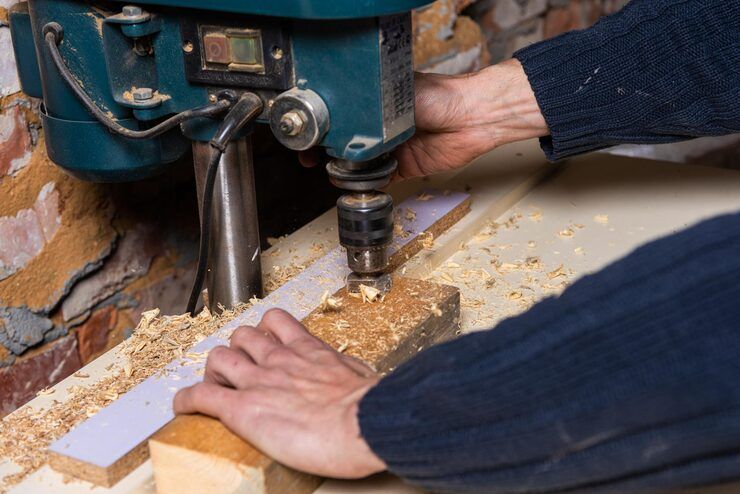
Bench drilling machines: These compact systems are commonly used in small workshops. The operator positions the material beneath a drill head and controls the drilling operation.
Multi-spindle drilling machines: These machines contain several drilling heads that operate together. They can create multiple holes in one operation, making them useful for repetitive cabinet and panel production.
Line boring machines: Line boring equipment creates rows of accurately spaced holes. It is frequently used for adjustable shelving, cabinet construction, and modular furniture components.
CNC furniture drilling machines: Computer numerical control (CNC) systems use programmed instructions to position drilling heads and control machining operations. Depending on the configuration, they can process multiple hole patterns with limited manual repositioning.
Automatic panel drilling systems: These systems integrate material handling, positioning, drilling, and sometimes labeling or other machining tasks. They are commonly found in larger furniture production facilities.
Why Furniture Drilling Technology Matters
Accuracy and Consistency in Manufacturing
Furniture components often require holes in specific positions. Small dimensional errors can make hinges difficult to align, prevent connectors from fitting correctly, or create visible gaps during assembly.
Precision drilling helps manufacturers maintain consistent hole diameters, depths, and spacing across repeated components. CNC drilling and automated positioning can reduce variations associated with manual measurement and repositioning.
The required accuracy depends on the furniture design, material, hardware specifications, and assembly method.
Production Efficiency and Material Utilization
Drilling operations can influence the overall speed of furniture manufacturing. When several holes are produced simultaneously, or when programmed drilling patterns are used, repetitive work can become more predictable.
Well-planned drilling operations can also reduce unnecessary handling and help limit material damage caused by incorrectly positioned holes.
Important performance indicators include:
Cycle time: The time required to complete a drilling operation.
Throughput: The number of components processed during a defined period.
First-pass yield: The percentage of components meeting requirements without rework.
Machine utilization: The proportion of available operating time during which equipment performs productive work.
Tool life: The amount of useful operation obtained from a drill bit before replacement or reconditioning.
Who Uses Furniture Drilling Machines?
These machines serve a wide range of manufacturing environments, including:
Kitchen cabinet and wardrobe manufacturers.
Office furniture production facilities.
Custom furniture workshops.
Modular furniture manufacturers.
Woodworking and panel-processing plants.
Educational institutions teaching industrial woodworking.
Small workshops may prioritize flexibility and ease of operation, while larger facilities may focus on automation, throughput, software integration, and consistent output.
Recent Trends in Furniture Drilling Technology
CNC Automation and Digital Manufacturing
During 2025 and 2026, digital manufacturing continued to be an important area of development across industrial machinery. CNC-controlled woodworking equipment supports repeatable drilling patterns and integration with computer-aided design and manufacturing workflows.
In furniture production, digital instructions can translate component designs into machining operations. This reduces repeated manual measurements and helps maintain consistency when furniture designs contain numerous holes or different panel configurations.
However, automation does not eliminate the need for skilled setup, correct tooling, maintenance, and quality inspection.
Integrated Drilling and Nesting Workflows
Furniture manufacturers increasingly use connected panel-processing workflows that combine cutting, drilling, routing, and material identification. Depending on the machine configuration, several operations may be completed within one production setup.
Nesting-based manufacturing arranges multiple component shapes on a sheet of material to improve layout efficiency. When drilling is integrated into this workflow, manufacturers can coordinate hole positions with the dimensions and orientation of each component.
Software Integration and Production Monitoring
Manufacturing software can connect furniture designs with machine instructions, production schedules, and quality records. Some advanced systems also support machine monitoring, maintenance alerts, and production data analysis.
These capabilities can help identify recurring drilling errors, unexpected downtime, and tool wear. The actual benefits depend on the equipment, software compatibility, operator training, and quality of the production data.
Dust Control and Energy Awareness
Woodworking machinery produces dust and fine particles that require appropriate extraction and housekeeping. Manufacturers continue to emphasize effective dust collection, workplace cleanliness, and equipment maintenance.
Energy efficiency is also relevant when evaluating industrial machinery. Motor performance, idle-time management, extraction systems, and operating schedules can influence the energy used per finished component.
Specific improvements vary by machine model and factory conditions; there is no single performance figure applicable to all furniture drilling systems.
Laws, Regulations, and Workplace Policies
Machinery Safety Requirements
Furniture drilling equipment must be operated within the applicable machinery safety and workplace health regulations of its country of use. Requirements may cover moving parts, electrical systems, emergency stopping, machine guarding, operator training, and maintenance procedures.
Manufacturers and operators should identify the applicable national standards and any relevant machinery-specific requirements before installing or operating equipment.
In the European Union, machinery legislation includes Regulation (EU) 2023/1230, which establishes requirements for machinery safety and is generally applicable from 20 January 2027. During the transition period, the applicable framework must be assessed according to the relevant date and circumstances.
Occupational Safety and Dust Exposure
Wood dust can irritate the respiratory system, and exposure to certain types of wood dust presents additional health risks. Appropriate extraction and exposure-control measures are therefore important.
Relevant workplace measures may include:
Local exhaust ventilation near drilling points.
Suitable guards around rotating tools and moving mechanisms.
Eye and hearing protection where required by risk assessment.
Safe procedures for changing drill bits and clearing blockages.
Training on emergency stops and isolation of electrical power.
Regular inspection of extraction ducts, filters, and machine components.
In the United States, the Occupational Safety and Health Administration (OSHA) establishes workplace requirements relevant to woodworking machinery, machine guarding, and occupational exposure to wood dust.
Environmental and Electrical Requirements
Applicable environmental rules may govern industrial dust emissions, waste handling, and workplace ventilation. Electrical safety requirements can also apply to machine installation, grounding, wiring, and maintenance.
In India, factories and woodworking facilities must consider applicable occupational safety and environmental requirements, including relevant provisions of the Factories Act, 1948, where applicable, and state-level rules. The implementation and applicability of newer labour and safety frameworks should be checked against current official notifications.
Compliance depends on the location, type of facility, machinery configuration, and applicable legal framework. Businesses should consult qualified safety professionals and relevant regulatory authorities rather than assuming one standard applies everywhere.
Tools and Resources for Better Drilling Operations
Design and Manufacturing Software
Computer-aided design (CAD) tools help engineers define furniture dimensions, connector locations, and drilling patterns. Computer-aided manufacturing (CAM) software can convert suitable designs into machine instructions.
Before production, teams should verify hole coordinates, panel orientation, drill diameters, and machining clearances.
Measurement and Quality-Control Equipment
Accurate measurement supports reliable drilling and assembly. Useful equipment includes:
Digital calipers for checking hole diameter and component dimensions.
Depth gauges for measuring drilling depth.
Precision rulers and measuring squares for layout checks.
Test panels for verifying tool settings before production.
Inspection templates for checking repeated hole patterns.
Maintenance and Production Records
A structured maintenance log can record drill-bit changes, machine inspections, alignment checks, downtime, and recurring quality issues. Production records can help identify whether defects are associated with tooling, material variation, setup errors, or machine performance.
The following table illustrates example metrics for evaluating a drilling process. The values are hypothetical and are not industry benchmarks.
Performance metric | Example measurement | Purpose |
|---|---|---|
Drilling cycle time | 12 seconds per component | Track operating speed |
First-pass yield | 96% | Assess quality consistency |
Unplanned downtime | 4 hours per month | Monitor reliability |
Tool inspection interval | Every operating shift | Support preventive maintenance |
Hole-position tolerance | Defined by the design | Verify dimensional accuracy |
Actual targets should be established using product specifications, production requirements, and measured machine performance.
Training and Technical Documentation
Machine manuals, tooling charts, safety procedures, and manufacturer training materials are useful resources for operators and maintenance personnel. Documentation should specify suitable drill bits, operating limits, maintenance intervals, and procedures for changing tools.
Training should also cover material differences. MDF, plywood, particleboard, and solid wood can respond differently to drilling because of their density, grain structure, adhesives, and surface finishes.
Frequently Asked Questions
What Is a Furniture Drilling Machine Used For?
It creates holes in furniture components for hinges, screws, dowels, shelf supports, connectors, and other fittings. The machine type determines the range of materials, hole patterns, and production tasks it can handle.
What Is the Difference Between CNC and Manual Drilling?
Manual drilling generally requires the operator to position and control the material and drilling operation. CNC drilling follows programmed instructions to control movements and hole locations. CNC equipment can improve repeatability, particularly for complex or repetitive designs, but it requires appropriate programming and setup.
Which Machine Is Suitable for Cabinet Manufacturing?
The appropriate machine depends on production volume, cabinet design, hole patterns, available floor space, and required accuracy. Bench machines may suit occasional work, while multi-spindle, line boring, or CNC systems may better support repetitive cabinet production.
How Can Drilling Accuracy Be Improved?
Accuracy can be improved by maintaining correct machine alignment, selecting suitable drill bits, securing panels firmly, checking drilling depth, and verifying hole positions. Operators should also inspect tooling regularly and test machine settings before processing a production batch.
What Safety Precautions Are Important?
Operators should use appropriate machine guards, dust extraction, personal protective equipment, and approved operating procedures. Loose clothing and unsecured hair should be kept away from rotating machinery. Drill-bit changes and maintenance should follow the required power-isolation procedure.
Conclusion
Furniture drilling machines are essential components of modern woodworking and furniture manufacturing. They support accurate hole placement, consistent assembly, and repeatable production across applications ranging from custom furniture to industrial cabinet manufacturing.
Manual, multi-spindle, line boring, and CNC drilling systems each address different production needs. Choosing suitable equipment requires consideration of material type, hole geometry, manufacturing volume, tooling, maintenance, and operator skills.
Developments in automation, digital design integration, dust extraction, and production monitoring continue to influence woodworking operations. At the same time, machinery safety, environmental controls, and quality assurance remain fundamental requirements.
A well-managed drilling process combines appropriate equipment with careful planning, regular inspection, trained operators, and clear production specifications. These practices help furniture manufacturers maintain dependable quality while adapting to changing designs and manufacturing demands.