Ice cream making machines are specialized food-processing systems designed to mix, freeze, aerate, and prepare ice cream for consumption or further packaging. They are used in restaurants, cafés, dessert shops, small food businesses, and large-scale manufacturing facilities.
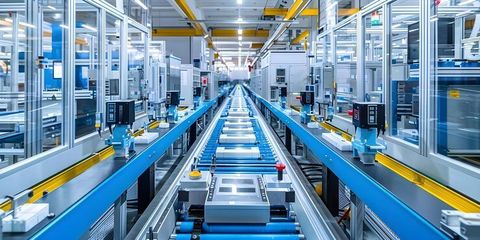
The equipment varies according to production requirements. Small countertop machines can prepare limited quantities, while industrial systems process large volumes through automated mixing, pasteurization, freezing, hardening, and packaging stages.
Ice cream production requires more than freezing a liquid mixture. Ingredients must be blended consistently, the mixture must be handled under appropriate food-safety conditions, and freezing must produce the desired texture. Machine design therefore influences production efficiency, product consistency, hygiene, and energy consumption.
Understanding Ice Cream Making Machines
Ice cream machines generally work by freezing a prepared mixture while incorporating air and continuously moving the mixture to control ice crystal formation.
The main components may include a refrigeration system, mixing chamber, dasher or agitator, temperature controls, and a mechanism for dispensing or transferring the finished product.
Different machine designs support different production methods.
Batch freezers: Process a defined quantity of ice cream during each cycle.
Continuous freezers: Produce ice cream continuously for large manufacturing operations.
Soft-serve machines: Freeze and dispense a softer product directly for immediate consumption.
Hard ice cream production systems: Prepare mixtures that undergo additional hardening after freezing.
Gelato machines: Support the preparation of gelato, which generally has different formulation and serving characteristics from conventional ice cream.
Laboratory and pilot-scale machines: Help food technologists test formulations and production parameters.
Some facilities use integrated production lines, while others combine separate machines according to their requirements.
How Ice Cream Production Works
Commercial ice cream manufacturing typically involves several stages.
Ingredient preparation: Milk, cream, sugar, stabilizers, flavorings, and other ingredients are measured according to a defined formulation.
Mixing: Ingredients are blended to create a uniform mixture. Industrial systems may use specialized tanks and mixing equipment to prevent lumps and improve consistency.
Pasteurization: The mixture undergoes a validated heat-treatment process to reduce harmful microorganisms. The specific time and temperature depend on the formulation, equipment, and applicable regulations.
Homogenization: Where used, homogenization reduces fat globule size and helps create a more uniform mixture.
Cooling and aging: The mixture is cooled and held under controlled conditions to allow the fat and stabilizing components to develop suitable properties.
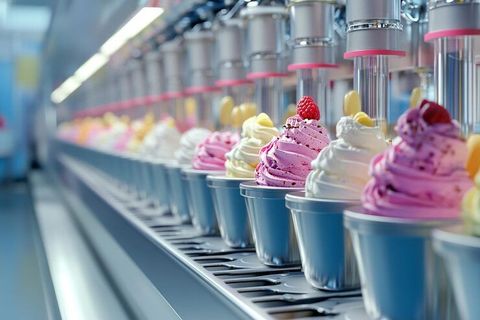
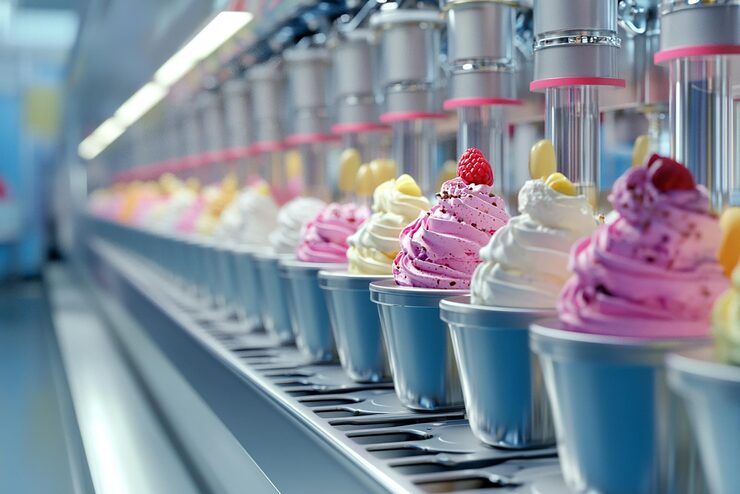
Freezing and aeration: A freezer lowers the mixture's temperature while incorporating a controlled amount of air.
Hardening and storage: Packaged or portioned ice cream is further frozen to help maintain its structure during storage and distribution.
Not every small-scale machine performs all these stages. Some processes require separate equipment and dedicated temperature-controlled facilities.
Importance of Ice Cream Making Machines
Ice cream manufacturing equipment supports food consistency, production planning, hygiene, and efficient use of ingredients.
Product Quality and Consistency
Temperature control, mixing speed, and freezing conditions affect ice crystal size, air incorporation, and texture. Reliable control of these variables helps manufacturers maintain consistent characteristics between batches.
Poorly controlled freezing can produce coarse ice crystals or an undesirable texture. Inadequate formulation control can also affect flavor, firmness, and melting behavior.
Production Efficiency
Automated equipment can reduce repetitive manual operations and improve control over processing time. Larger facilities can coordinate mixing, freezing, hardening, and packaging to maintain a steady production flow.
However, actual output depends on the formulation, machine capacity, operating conditions, cleaning requirements, and downtime.
Food Safety and Hygiene
Dairy-based mixtures can support microbial growth if they are handled incorrectly. Suitable pasteurization, cleaning, temperature monitoring, and hygienic equipment design are therefore essential.
Food-processing equipment should have appropriate food-contact surfaces and allow effective cleaning and sanitation. Operators must also follow established procedures for ingredient handling and cold storage.
Energy and Resource Management
Refrigeration can represent a significant part of the energy demand in ice cream production. Equipment efficiency, insulation, maintenance, production scheduling, and heat recovery can influence overall resource consumption.
Water use is another consideration because equipment and production areas require regular cleaning.
Recent Developments in Ice Cream Manufacturing Technology
Developments during 2025 and 2026 have continued to emphasize automation, energy efficiency, alternative formulations, and improved control of frozen dessert production.
Automation and Digital Monitoring
Modern food-processing systems increasingly use digital temperature sensors, programmable controls, and automated production records.
These systems help operators monitor freezing conditions, identify process deviations, and maintain more consistent production parameters. Connected equipment can also support preventive maintenance by identifying unusual operating patterns.
The practical benefits depend on equipment design, sensor accuracy, data management, and the manufacturer's ability to respond to alerts.
Alternative Ingredients and Frozen Desserts
Plant-based frozen desserts made with ingredients such as oat, soy, coconut, or almond have encouraged manufacturers to adapt formulations and processing conditions.
These mixtures can differ from dairy-based ice cream in fat composition, protein content, viscosity, and freezing behavior. As a result, manufacturers may need to adjust mixing, homogenization, stabilizer selection, and freezing parameters.
Product labeling must also accurately describe the food's ingredients and characteristics under applicable rules.
Energy-Efficient Refrigeration
Refrigeration technology remains an important area of development. Manufacturers are examining compressor efficiency, insulation, heat exchange, and refrigerant selection to improve equipment performance.
The environmental implications of refrigeration depend partly on the refrigerant used, its leakage characteristics, electricity consumption, and the source of that electricity.
Hygiene and Traceability
Food manufacturers increasingly use digital batch records, automated temperature monitoring, and documented sanitation procedures.
These approaches can help trace production batches and identify potential problems. They do not replace validated food-safety systems, equipment maintenance, or appropriate staff training.
Laws, Regulations, and Food Safety Policies
Ice cream production is regulated by food-safety, hygiene, labeling, and equipment requirements that vary by country.
Food Safety Regulations in the United States
The US Food and Drug Administration's food regulations include requirements relevant to dairy processing, sanitation, preventive controls, and food labeling.
The federal Current Good Manufacturing Practice, Hazard Analysis, and Risk-Based Preventive Controls framework under 21 CFR Part 117 applies to many food facilities, subject to relevant exemptions and specific provisions.
Manufacturers must determine which requirements apply to their operations and maintain appropriate controls for hazards such as microbial contamination, allergens, and temperature abuse.
Food Safety Requirements in India
In India, ice cream manufacturers fall under the regulatory framework administered by the Food Safety and Standards Authority of India (FSSAI).
The Food Safety and Standards Act, 2006, and associated regulations establish requirements relating to food safety, licensing or registration, hygiene, product standards, and labeling.
Manufacturers should consult current FSSAI requirements and the relevant state food-safety authority before establishing or modifying a production facility.
Equipment Hygiene and Workplace Safety
Ice cream machines should be installed, operated, cleaned, and maintained according to applicable food-contact, electrical, refrigeration, and workplace-safety requirements.
Important considerations include:
Hygienic food-contact surfaces
Effective cleaning and sanitation
Appropriate refrigeration controls
Electrical protection
Moving-part guards
Safe handling of cleaning chemicals
Allergen management
Temperature records and traceability
Requirements vary by jurisdiction and the scale of the facility.
Tools and Resources for Ice Cream Production
Several tools can help manufacturers evaluate equipment and improve process control.
Production Planning Tools
Spreadsheets can be used to calculate ingredient quantities, batch sizes, expected output, and production schedules. For example, a formulation designed for 10 kilograms can be scaled proportionally for a larger batch, provided the equipment and process remain suitable.
Temperature Monitoring
Calibrated thermometers, digital temperature probes, and automated monitoring systems help record temperatures during pasteurization, cooling, freezing, and storage.
Temperature records should be evaluated against the validated process requirements rather than generic settings.
Equipment Evaluation Checklist
| Factor | What to Assess |
|---|---|
| Production capacity | Required output per batch or hour |
| Product type | Hard ice cream, soft serve, gelato, or plant-based dessert |
| Temperature control | Freezing accuracy and monitoring |
| Food-contact materials | Suitability for food processing |
| Cleaning | Access for sanitation and inspection |
| Energy use | Electricity requirements and refrigeration efficiency |
| Installation | Space, ventilation, utilities, and drainage |
| Compliance | Applicable food-safety and equipment requirements |
Official Technical Resources
Useful references include the FDA for United States food regulations, FSSAI for Indian food-safety requirements, and the Codex Alimentarius Commission for international food standards and food-hygiene guidance.
Equipment manuals and technical specifications are also important for determining operating limits, cleaning procedures, and maintenance intervals.
Frequently Asked Questions
What types of ice cream making machines are available?
Common types include batch freezers, continuous freezers, soft-serve machines, gelato machines, and integrated industrial production systems. The suitable type depends on production volume and the desired product.
How does an ice cream machine create a smooth texture?
The machine freezes the mixture while agitating it. This process helps control ice crystal formation and incorporates air. Formulation, freezing speed, and subsequent hardening also affect the final texture.
What is the difference between batch and continuous ice cream freezers?
A batch freezer processes a defined quantity during each cycle. A continuous freezer processes a steady flow of mixture and is generally suited to larger-scale production.
Why is pasteurization important in ice cream production?
Pasteurization reduces harmful microorganisms in the prepared mixture when performed under validated conditions. It is an important food-safety step, although hygienic handling, proper cooling, and temperature-controlled storage are also necessary.
How can manufacturers improve ice cream production efficiency?
Efficiency can be improved through suitable machine selection, preventive maintenance, accurate ingredient measurement, automated temperature monitoring, optimized production scheduling, and effective cleaning procedures.
Conclusion
Ice cream making machines combine refrigeration, mixing, aeration, and temperature control to produce frozen desserts with consistent characteristics. Equipment ranges from small batch machines to automated industrial production lines that coordinate multiple processing stages.
Recent manufacturing trends emphasize digital monitoring, improved refrigeration efficiency, alternative formulations, and stronger production traceability. These developments can support consistency and resource management when implemented with appropriate technical controls.
Selecting suitable equipment requires consideration of production capacity, product formulation, hygiene, energy consumption, maintenance, and applicable regulations. When equipment is integrated with validated food-safety procedures and reliable process monitoring, manufacturers can manage production more effectively while maintaining product quality.